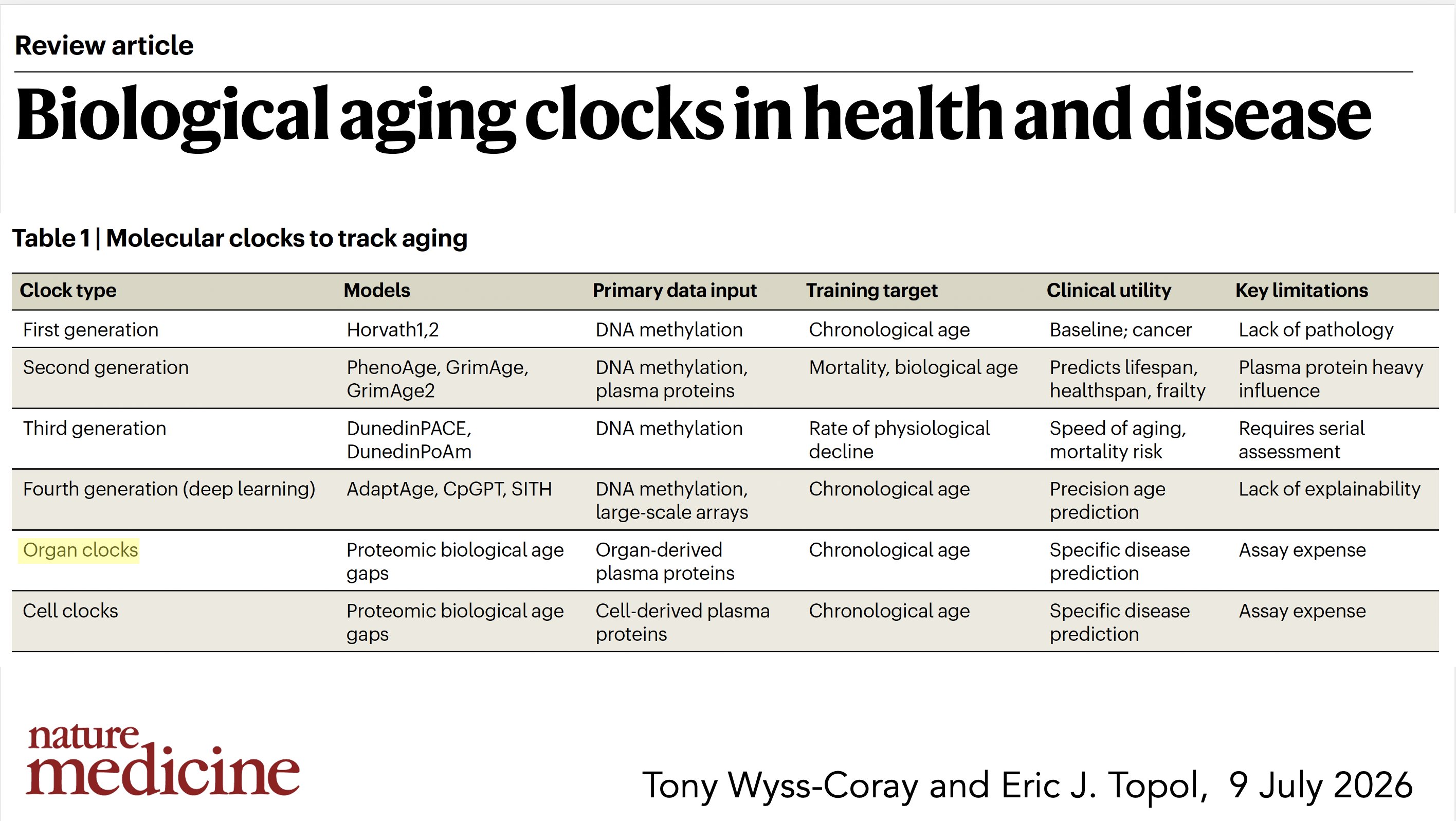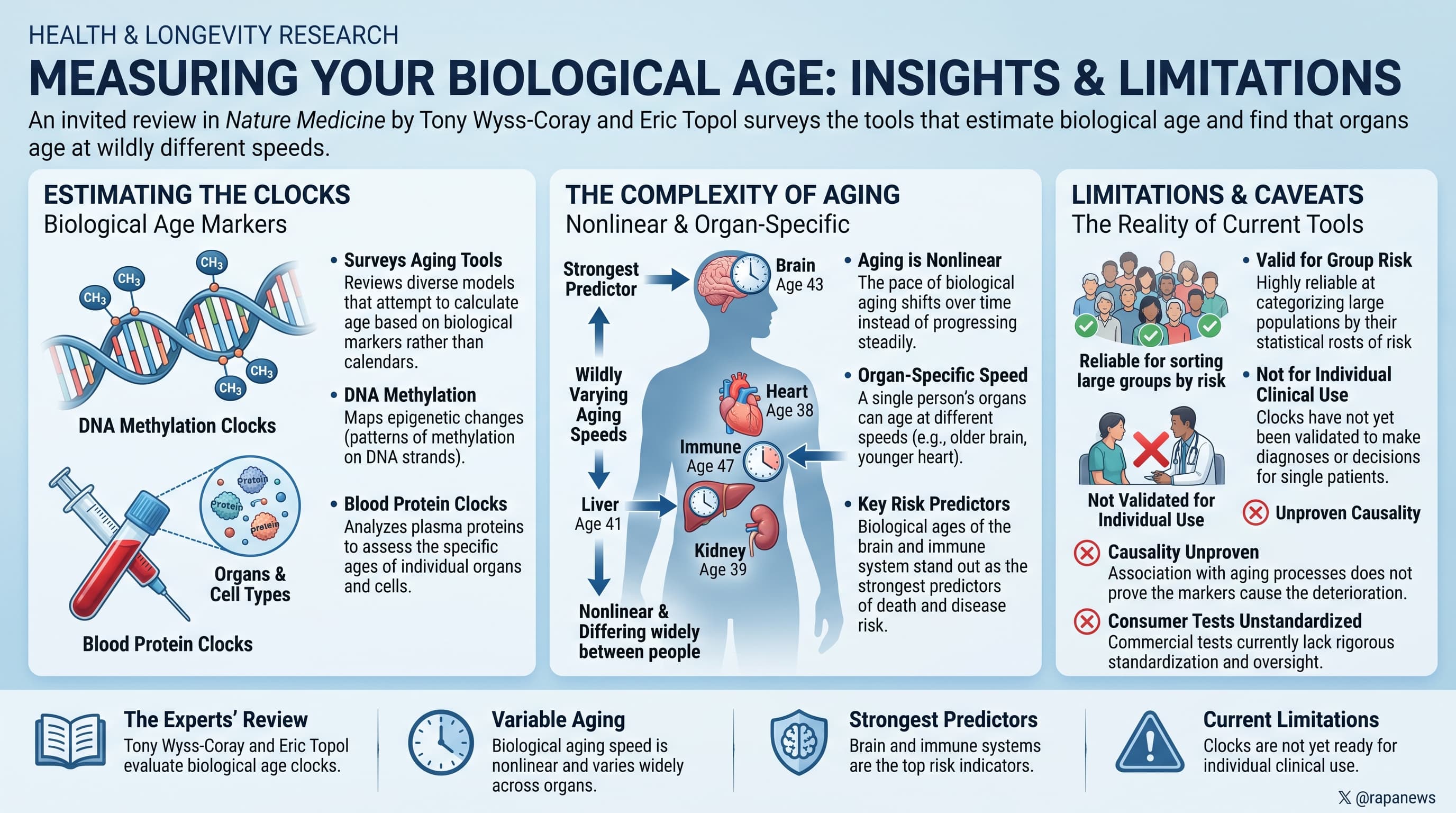
This invited review by Tony Wyss-Coray and Eric Topol surveys the tools that estimate biological age, from DNA methylation clocks to newer blood protein clocks that assign separate ages to individual organs and cell types. Its main argument is that aging is nonlinear, differs widely between people, and runs at different speeds in different organs of the same person. Clocks reliably sort large groups by risk of death and disease, with brain and immune system age standing out as the strongest predictors. The authors state plainly that the clocks are not validated for individual clinical use, that causality is unproven, and that consumer tests are unstandardized.
Your birth certificate is a poor guide to how old your body is. That is the central message of a new review in Nature Medicine by Stanford neuroscientist Tony Wyss-Coray and Scripps cardiologist Eric Topol. They conclude that biological aging clocks are scientifically impressive but not yet fit for the clinic.
Aging clocks are statistical models that estimate biological age from molecular data. The first, built in 2013, read chemical tags on DNA. Later versions were trained to predict death and disease instead of birthdays, and a third type estimates the speed of aging. The newest generation reads thousands of proteins in a small blood sample. It assigns a separate age to the brain, heart, liver, kidneys, arteries and immune system, and more recently to about 40 individual cell types.
Two ideas run through the review. The first is that aging is not a steady slope. Pooling seven studies, the authors describe waves of molecular change clustering around ages 33, 60, 69 and 78. The second is that organs within one person age at different speeds. In a British cohort of about 1,800 people born in 1946, organ ages measured at 63 spanned roughly a decade. People whose organs ranked in the oldest tenth died at about 1.5 to 3 times the rate of everyone else, and those with three or more such organs fared worst.
The brain and immune system stand out. In UK Biobank data, people with youthful brain or immune profiles survived longest. An old-looking brain was linked to a threefold higher rate of Alzheimer’s disease, regardless of APOE genotype. At the cell level, people whose astrocytes looked oldest developed Alzheimer’s about five times as often as average.
The authors are frank about what is missing. Almost all of the evidence comes from single blood draws in large population studies, many drawing on the UK Biobank, which lacks diversity. That shows clocks can sort groups by risk. It does not show that a reading tells one person anything reliable, or that pushing a clock number down prevents disease. Exercise shifts epigenetic clocks favorably. Omega-3, vitamin D, a daily multivitamin and the shingles vaccine produce smaller shifts, with unknown consequences for lifespan.
The review is blunt about consumer tests. Products costing 300 to 500 US dollars are sold without regulatory approval or standardization, and one person can get markedly different results from different tests.
The practical test of the idea is now underway. A randomized trial (NCT07646054) will assign people at high risk of Alzheimer’s to intensive lifestyle coaching or educational materials. It will track a blood marker, p-tau217, and the proteomic brain clock. The authors concede that both are stand-ins that still need validation against actual disease.
The big idea is that clocks could move medicine from treating disease to preventing it, by showing who is at risk and roughly when. For now that remains a research agenda.
Actionable Insights
- Do not buy a consumer aging test to guide decisions. The review says individual-level usefulness is unproven and repeat tests can disagree.
- The clocks point back to familiar habits. In the 1946 British cohort, sustained physical activity was linked to younger organs; smoking and adolescent overweight were linked to older ones. These are associations, not proof of cause.
- Exercise has the most consistent clock evidence, with larger shifts at higher activity levels. The review gives no numbers.
- Keep the risk numbers in proportion. Over 15 years, about 6.5 of every 100 people with the oldest-looking astrocytes developed Alzheimer’s, against 1.5 of every 100 average people. That is about four times the risk, but 93 of 100 in the worst group stayed free of the disease.
- For multi-organ aging, about 66 percent of people with 20 or more extremely aged cell types died within 15 years, against about 10 percent of normal agers. That group was under 1 percent of the population.
Context and Source
- Paywalled Paper: Biological aging clocks in health and disease
- Authors: Tony Wyss-Coray and Eric J. Topol
- Journal: Nature Medicine, published online 9 July 2026
- Institutions: Stanford University School of Medicine (Department of Neurology, Knight Initiative for Brain Resilience, Wu Tsai Neurosciences Institute) and Scripps Research Translational Institute
- Country: USA
- Impact evaluation: The impact score of this journal is 52.5, evaluated against a typical high-end range of 0 to 60+ for top general science, therefore this is an Elite impact journal.