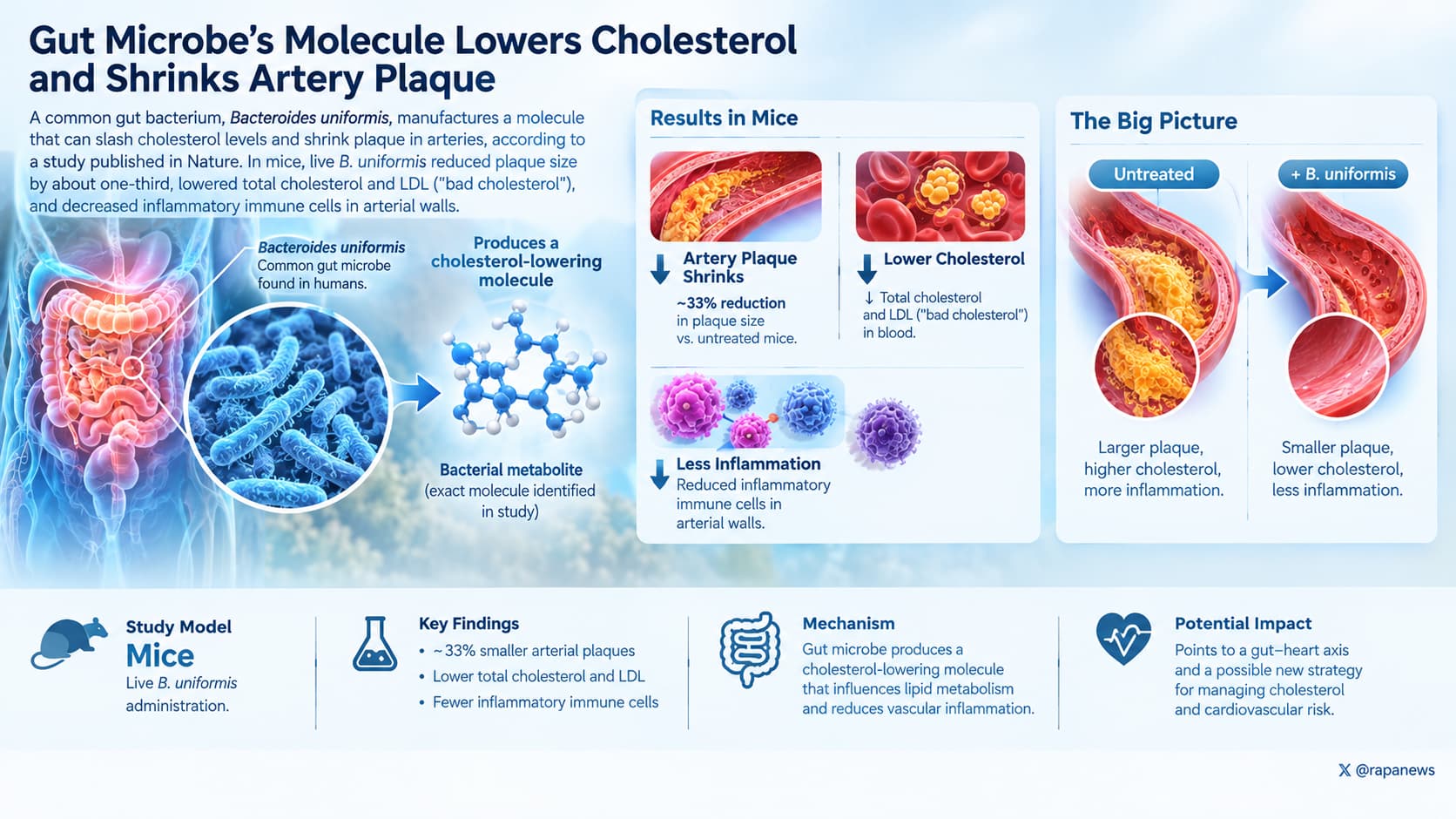
Researchers at Sun Yat-sen University report that Bacteroides uniformis, a common gut bacterium depleted in people with cardiovascular disease, protects mice against atherosclerosis by secreting pentadecanoic acid (PA, or C15:0), a 15-carbon saturated fatty acid. PA directly inhibits HMG-CoA reductase, the same enzyme targeted by statins, though roughly 300 times more weakly. Blocking the enzyme lowers cholesterol inside liver cells, which triggers the SREBP2 feedback circuit, raises LDL receptor levels, and clears LDL cholesterol from blood. Plaque burden in treated mice fell by roughly a third to a half. The protection disappeared entirely in mice lacking the liver LDL receptor. In 209 human stool and 211 serum samples, PA was significantly lower in people with dyslipidemia.
For a decade, pentadecanoic acid has had one job in nutrition science: it was the molecule you measured in someone’s blood to estimate how much dairy fat they ate. Because cows and other ruminants make it and humans were assumed not to, C15:0 in serum was treated as a reasonably objective dietary biomarker, more trustworthy than a food questionnaire. Epidemiologists used it to show, repeatedly and somewhat awkwardly for dietary guidelines, that people with more dairy fat in their blood had less cardiovascular disease.
The big idea in this paper is that the biomarker was never purely dietary. Gut bacteria make it too, in quantities large enough to matter, and the molecule itself appears to do the work.
The team started from human metagenomes, comparing 223 patients with atherosclerotic cardiovascular disease against 189 healthy controls, and found Bacteroides species depleted in the patients. Feeding live B. uniformis to atherosclerosis-prone mice cut plaque and dropped LDL cholesterol. Heat-killed bacteria did nothing, which pointed to a secreted molecule rather than a structural component of the cell. So they grew 27 liters of the bacterium, split the broth across solvents, and tracked LDL uptake in liver cells through round after round of fractionation until 51.6 milligrams of a single pure compound remained. Mass spectrometry and NMR identified it as PA.
Then comes the part that makes the story mechanistic rather than correlative. Purified human HMG-CoA reductase, the rate-limiting enzyme of cholesterol synthesis, binds PA directly. Three independent methods agree on the affinity, landing between 6 and 7 micromolar. Enzyme kinetics show the fatty acid competes with the natural substrate for the same site. Giving PA alone to mice reproduced most of the bacterium’s benefit. Deleting either of two bacterial genes needed to make PA stripped most of the protection away. And knocking out the LDL receptor in mouse liver abolished it completely, which ties the whole chain together: bacterium makes fatty acid, fatty acid blocks the enzyme, liver senses the cholesterol shortfall, liver puts out more LDL receptors, LDL leaves the blood.
Screening 100 gut strains showed PA production is largely confined to the Bacteroidota phylum, and the biosynthetic genes turn up across more than 4,700 reference genomes. In the authors’ own clinical samples, people with dyslipidemia had less PA in both stool and serum.
The honest reading is that this reframes an epidemiological puzzle rather than solving a clinical problem. If much of the C15:0 in blood is microbial rather than dietary, then twenty years of dairy-fat biomarker studies have been partly measuring the microbiome. That is a real contribution. Whether swallowing C15:0 does anything useful in a human artery is a separate question this paper does not answer.
Actionable Insights
The effect sizes here are large but they are mouse effect sizes, and the human data are observational.
In mice given PA alone, aortic plaque fell 57 percent by one measure and 32 percent by another in the same animals. Cohen’s d was 1.87 and 1.36. A d of 1.0 means the average treated animal does better than about 84 percent of controls, so these are strong effects, but the groups still overlap visibly.
The human numbers are far more modest. Across quartiles of serum C15:0 in a 4,150-person Swedish cohort, moving from the bottom quarter to the top quarter tracks with LDL cholesterol lower by 0.3 mmol/L (about 12 mg/dL, a 7.5 percent relative difference) and cardiovascular disease prevalence lower by 2 percentage points, from 10 percent to 8 percent. That is an absolute risk difference implying roughly 50 people would need the higher level for one fewer case, if the association were causal, which is not established. The pooled hazard ratio across 18 studies was 0.75 (95 percent CI 0.61 to 0.93).
Practically: the amount of C15:0 separating the top and bottom quartiles of the population is about 0.09 percent of total fatty acids, a difference achievable through ordinary full-fat dairy intake. Nothing here demonstrates that supplementing beyond that does more, but is something people can try, and then track their results to see if it does help them lower cholesterol (they did not test effects on LP(a)).
Context and Source
- Paywalled Paper: A gut microbial odd-chain fatty acid alleviates atherosclerosis in mice.
- Institution: Shenzhen Key Laboratory for Systems Medicine in Inflammatory Diseases, Zhongshan School of Medicine, Sun Yat-sen University (Shenzhen Campus), with the Shenzhen Institute of Advanced Technology (Chinese Academy of Sciences), Shenzhen Bay Laboratory, and the Seventh Affiliated Hospital of Sun Yat-sen University.
- Country: China.
- Journal: Nature. Published online 07 October 2026.
- Impact evaluation: The impact score of this journal is 56.1, evaluated against a typical high-end range of 0 to 60+ for top general science, therefore this is an Elite impact journal.