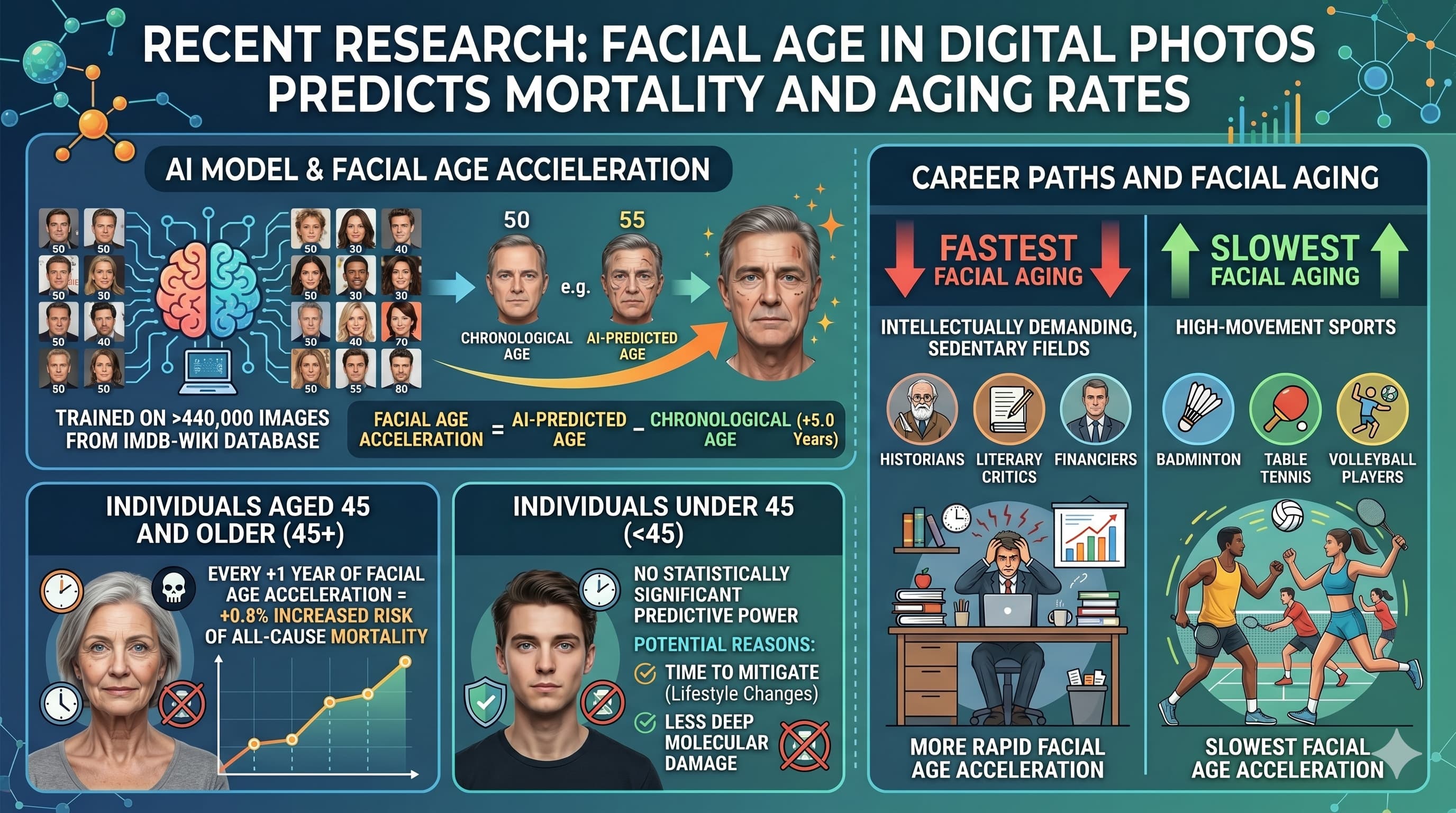
Recent research suggests that how “old” you look in a digital photograph is more than just a matter of aesthetics; it is a statistically significant predictor of when you might die. Researchers trained an artificial intelligence model using a massive dataset of over 440,000 images of celebrities from the IMDB-WIKI database to determine “face photo-based age acceleration”—the discrepancy between a person’s chronological age and their AI-predicted age.
The study found that for individuals aged 45 and older, every one-year increase in facial age acceleration is associated with a 0.8% increase in the risk of all-cause mortality. Interestingly, this predictive power did not extend to younger populations under 45, potentially because younger individuals have more time to mitigate aging through lifestyle modifications or because facial changes in youth do not yet reflect deep molecular damage.
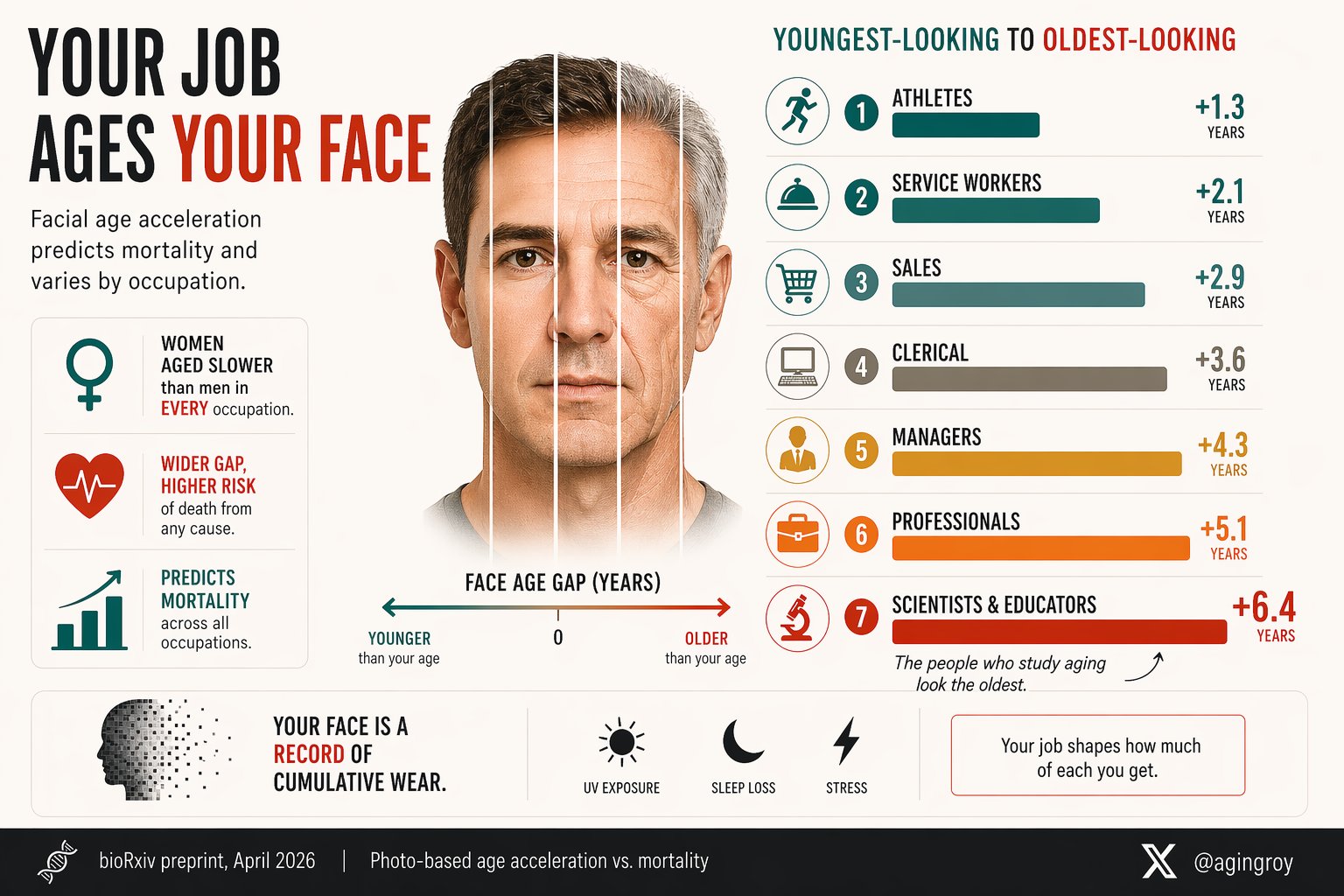
Beyond mortality, the study investigated how different career paths impact the rate at which we age. Athletes—specifically those in high-movement sports like badminton, table tennis, and volleyball—demonstrated the slowest facial aging. Conversely, those in intellectually demanding but sedentary fields, such as historians, literary critics, and financiers, showed the most rapid facial age acceleration.
This research highlights that while we debate the exact drivers of aging, the human face serves as a low-cost, non-invasive biomarker for biological age that correlates with internal molecular health. By utilizing transfer learning on deep neural networks (specifically the VGG-16 architecture), the researchers have provided a tool that could eventually complement expensive epigenetic clocks in personalized medicine and longevity research.
Actionable Insights
Prioritize Physical Activity: The study confirms that professional athletes age the slowest, likely due to the systemic benefits of high-volume exercise which have been previously linked to slowed epigenetic aging.
Targeted Skin Care and Health Monitoring: AI models identify the nose-mouth region as the most significant area for determining biological age. Changes in this area, including the nasolabial folds, may be the most reliable external indicators of internal aging.
Monitor Post-45 Vitality: Since facial aging becomes a significant mortality predictor after age 45, this represents a critical window for aggressive longevity interventions.
Career-Specific Health Adjustments: Those in sedentary, high-stress “knowledge” sectors (science, education, finance) should be aware of their higher risk for accelerated aging and may need more frequent health screenings compared to those in physically active roles.
The study utilizes AI to bypass the need for specific molecular pathways, yet the findings align with established longevity hallmarks:
Facial Region Importance: Grad-CAM analysis revealed that the nose-mouth area is more informative for age prediction than the eyes or the entire face. This suggests that age-related changes in skin elasticity and subcutaneous fat in the mid-lower face are primary indicators of biological age.
Physical Activity Pathway: The findings regarding athletes suggest that the pathways activated by exercise (likely AMPK activation and SIRT1 upregulation) manifest externally as younger facial features. [Confidence: Medium]
Sex Differences: Females generally exhibited lower mean age acceleration than males across all occupation categories. [Confidence: Medium]
Novelty
This is the first study to explicitly demonstrate that AI-predicted facial age acceleration is a robust predictor of all-cause mortality, bridging the gap between computer vision and clinical longevity metrics. It identifies an “inflection point” at age 45 where the face becomes a reliable proxy for death risk.
Critical Limitations
Sample Bias: The cohort consists exclusively of famous individuals, meaning low-income and low-education groups—who typically age faster due to socioeconomic stressors—are underrepresented.
Image Noise: “In-the-wild” photos include variables like lighting, plastic surgery, makeup, and hair dye, which can confound AI predictions.
Lack of Direct Molecular Correlation: While the authors claim the model approaches biological age, the study lacks simultaneous blood-based or epigenetic data to confirm the exact molecular correlates of facial aging.
Knowledge Gap: It remains unknown why facial age acceleration fails to predict mortality in individuals under 45. Additional longitudinal data following young individuals into middle age is required for a full answer.
The following verification assesses specific biological and medical claims from the research paper “Face photo-based age acceleration predicts all-cause mortality and differs among occupations (2025)” against external clinical and observational literature.
1. Primary Longevity Claims
Claim: AI-predicted facial age acceleration is a robust predictor of all-cause mortality.
Evidence Level:Level C (Human Observational/Cohort Studies).
Claim: Every one-year increase in facial age acceleration is associated with a ~0.8–1.0% increase in mortality risk.
Evidence Level:Level C (Human Observational/Cohort Study).
Verification: The Kerepesi et al. study reported a Hazard Ratio (HR) of 1.008. This is slightly more conservative than older human-rated studies, such as the LSADT study, which reported a 3% increase in mortality risk per year of rated age Predicting mortality from human faces (2012).
Claim: Facial aging is not predictive of mortality for individuals under 45 years of age.
Evidence Level:Level C (Human Observational/Cohort Study).
Verification: No external meta-analysis or large RCT currently exists to confirm this specific “inflection point” across general populations. Most facial age studies focus on 70+ cohorts. This claim relies heavily on the IMDB-WIKI dataset analysis in the subject paper.
2. Lifestyle & Occupational Claims
Claim: Professional athletes and physical sports participants age the slowest.
Evidence Level:Level C (Human Observational/Cohort Study).
Verification: While specific “career-ranking” studies are rare, high-volume physical activity is consistently linked to slowed biological aging. A systematic review noted that while older clocks (Horvath) show inconsistent results, newer clocks (GrimAge/PhenoAge) show a strong negative correlation between exercise and age acceleration Leisure-Time and Occupational Physical Activity Associates Differently with Epigenetic Aging (2021).
Claim: Occupations in Science, Education, and Finance are associated with accelerated facial aging.
Evidence Level:Level C (Human Observational/Cohort Study).
Verification: This finding is specific to the Kerepesi et al. cohort of “notable people”. External verification of these specific categories in the general population is missing, though high stress and sedentary behavior are known drivers of aging.
Claim: Females age slower than males across nearly every occupation category.
Evidence Level:Level C (Human Observational/Cohort Study).
Verification: General longevity data consistently supports a “female survival advantage,” and the paper notes lower mean age acceleration in females for every examined category.
3. Biological & Technical Claims
Claim: The nose-mouth region (including nasolabial folds) is the most predictive facial area for biological age.
Evidence Level:Level C (Technical Observational Study).
Verification: The use of Grad-CAM algorithms identified this region as having “remarkably higher mean importance” than eyes or the whole face. This is consistent with dermatological observations that lower-face sagging and fold deepening are primary markers of mid-to-late life skin aging.
Claim: Regular exercise is associated with slowed epigenetic aging.
Evidence Level:Level A (Systematic Reviews/Meta-analyses).
Translational Gap: The paper applies findings from a celebrity-only dataset (IMDB-WIKI) to general biological aging. Because this cohort has disproportionately high access to healthcare and potential aesthetic interventions (plastic surgery, high-quality nutrition), the absolute effect size of occupational aging may be skewed compared to the general public. [Confidence: Medium]
Missing Data: There is a lack of direct correlation between the AI facial clock and standard blood-based biomarkers (CRP, HbA1c) or epigenetic clocks (GrimAge) in the same subjects. Until “face age” is validated against “blood age” in a single RCT, it remains a proximal biomarker. [Confidence: High]