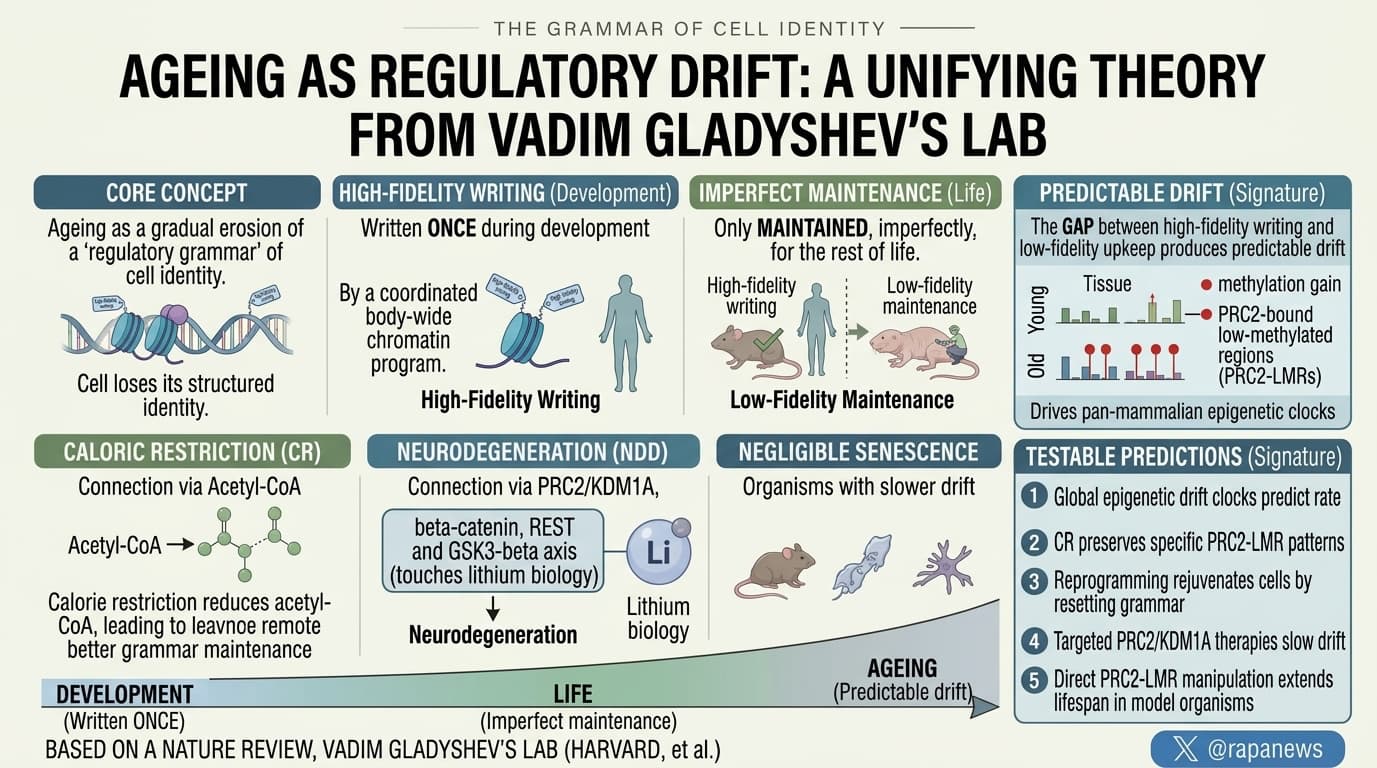
A theory-driven Nature review from Vadim Gladyshev’s lab at Harvard proposes that aging is the gradual erosion of a “regulatory grammar” of cell identity. That grammar is written once, during development, by a coordinated body-wide chromatin program, and is only maintained, imperfectly, for the rest of life. The gap between high-fidelity writing and low-fidelity upkeep produces predictable drift. The clearest sign of this drift is methylation gain at PRC2-bound low-methylated regions (PRC2-LMRs), which account for most age-related methylation gain in dividing tissues and drive pan-mammalian epigenetic clocks. The paper connects the idea to caloric restriction (via acetyl-CoA), to neurodegeneration (via a PRC2/KDM1A, beta-catenin, REST and GSK3-beta axis that touches lithium biology) and to negligible senescence.
Every cell in your body carries the same genome, yet a liver cell stays a liver cell for decades. A new review in Nature from Vadim Gladyshev’s group at Harvard Medical School argues that the slow failure of this identity-keeping explains why ageing looks so similar across tissues and species, more than any single kind of molecular damage does.
The authors describe cell identity as a system with three layers. The fast layer is the minute-to-minute traffic of transcription factors responding to stress, food and inflammation. The intermediate layer covers shifts that take days or weeks, such as a stem cell waking from rest. The slow layer is chromatin architecture: the chemical tags and folding patterns that decide which genes a cell can ever switch on.
The core claim is an asymmetry. During development, the slow layer is written by a coordinated, body-wide program that uses a lot of energy. Once maturity arrives, that program shuts down. From then on, cells can only maintain what was written, locally and imperfectly. Each burst of stress signalling, each DNA break and each inflammatory episode nudges the chromatin slightly off its original setting, and repair never fully restores it. The errors add up. The authors call the result epigenetic decanalization. The image is a ball rolling in a valley that grows shallower with age, so ordinary noise can push cells into confused, mixed-identity states.
The best-supported evidence is a pattern in DNA methylation. Stretches of the genome that are normally kept unmethylated and are bound by a silencing complex called PRC2 steadily gain methylation with age. A 2024 analysis, co-authored by Gladyshev, estimated that these regions account for about 90% of age-related methylation gain in dividing tissues. The same regions anchor the epigenetic clocks that now estimate age across 185 mammal species. The review argues that those clocks work so well because they track this predictable drift.
The framework also tries to explain why species that develop slowly tend to live longer: more time spent writing may lay down deeper, more durable constraints. It recasts caloric restriction as partly an epigenetic effect. The proposal is that lower levels of acetyl-CoA, a fuel molecule used to tag histones, take pressure off PRC2’s silencing marks. It also links a chain of chromatin proteins in neurons to lithium, which was recently tied to protection against Alzheimer’s-type pathology in mice.
This is a theory paper with no new experiments. Several of its load-bearing claims rest on small datasets from the senior author’s own collaborations. One of them, that PRC2 binding declines with age, sits awkwardly beside data from the 2024 study showing unchanged PRC2 binding at these regions in old skin cells.
Still, the idea has practical consequences. If ageing is maintenance failure, then drugs or habits that improve maintenance should slow drift without reversing it. Only something that restarts the developmental writing program, such as cellular reprogramming, could truly roll it back. The authors list five predictions to test this, including whether human cells grafted into mice keep a human ageing pace.
For now the review offers a useful map of where the ageing epigenome breaks. It does not show that repairing those spots would help anyone live longer.
Actionable Insights
This review tests no intervention, so the numbers below come from the studies it relies on, mostly in mice.
- Eating less still has the strongest evidence. In about 940 genetically diverse female mice, a 40% calorie cut raised median lifespan by roughly 9 months, from about 25 to 34 months (a 36% gain). Milder restriction and fasting gave smaller gains, in proportion to the size of the cut. The costs were lost lean mass and immune changes, and effects on human lifespan are unproven.
- The chromatin marker at the center of this theory barely moved with restriction. Old calorie-restricted mice had only slightly lower methylation at these regions, in groups of four. That result is statistically compatible with no effect. Rapamycin showed no detectable change.
- Let stress end. Biological age rose in patients having emergency hip fracture surgery and returned to baseline 4 to 7 days afterwards. The theory predicts that harm comes from repeated hits without recovery, which has not been tested in people.
- Use sun protection. Sun-exposed skin from older donors carried more of this age-linked methylation than covered skin from the same people.
- Be suspicious of a sudden “younger” epigenetic clock result. It may reflect recovery from stress rather than repaired chromatin.
Context and Source
- Paywalled Paper: Written in development and lost in ageing: the grammar of cellular identity, 30 September 2026.
- Authors: A. Doğa Yücel, Adrian Molière, Vadim N. Gladyshev
- Institutions: Brigham and Women’s Hospital, Harvard Medical School, Boston, MA; Department of Health Sciences and Technology, ETH Zurich
- Countries: USA and Switzerland
- Journal: Nature.
- Impact Evaluation: The impact score of this journal is 56.1, evaluated against a typical high-end range of 0 to 60+ for top general science, therefore this is an Elite impact journal.