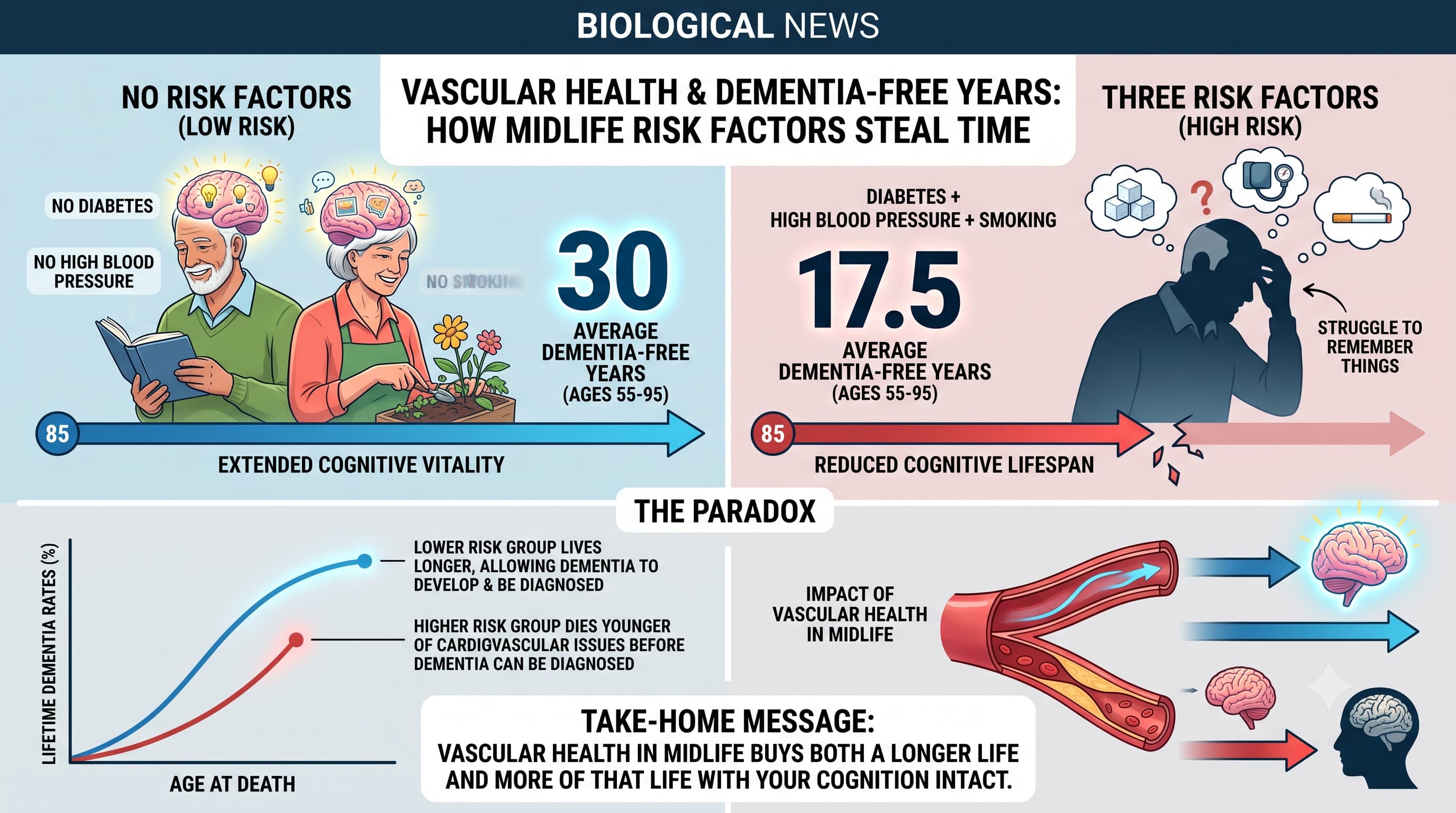
Tracking more than 12,000 American adults for over two decades, researchers translated familiar midlife risk factors, diabetes, high blood pressure, and smoking, into a single number people can actually feel: years of life spent alive and free of dementia. Adults who entered their mid-fifties with none of the three risk factors averaged about 30 dementia-free years between ages 55 and 95, while those carrying all three averaged only about 17.5, a gap of roughly 12 to 13 years. A paradox sits inside the finding. The high-risk group showed lower lifetime dementia rates, not because their brains were protected, but because they died earlier of cardiovascular and other causes before dementia could be diagnosed. The take-home is that vascular health in midlife buys both a longer life and more of that life with your cognition intact.
For decades, prevention messaging has asked people to lower abstract probabilities. Cut your risk of dementia by some percentage. Reduce your relative hazard. These numbers are hard to feel and easy to ignore. A new analysis from the long-running Atherosclerosis Risk in Communities study reframes the same biology in a currency anyone understands: time. Specifically, the number of years a person can expect to live between ages 55 and 95 while remaining free of dementia.
The research team followed 12,409 adults who were alive and dementia-free at age 55, measuring three modifiable risk factors in midlife: diabetes, hypertension, and current smoking. Over a median follow-up of 26 years, 3,008 people developed dementia and 5,238 died without ever developing it. When the team counted up dementia-free years, the gradient was steep and orderly. Zero risk factors bought about 30.1 dementia-free years. One risk factor, 26.3 years. Two, 21.0 years. All three, just 17.5 years. Optimal midlife vascular health was associated with up to 12.6 additional years of cognitively intact life.
The study’s most counterintuitive result is a lesson in why single statistics mislead. People with three risk factors actually had a lower lifetime chance of being diagnosed with dementia by age 95, roughly 23 percent, versus 42 percent for the healthiest group. This is not protection. It is competing mortality. The high-risk group was dying of heart attacks, strokes, and other vascular causes at more than four times the rate before dementia had a chance to develop and be diagnosed. Dementia is, in part, a disease of survivors. Keep people alive and their brains become the organ that eventually fails.
The gradient held across sex, race, and genetic risk, though the absolute numbers differed. Women averaged more dementia-free years than men. Black participants averaged fewer dementia-free years than White participants, a disparity that widened at the highest risk levels and tracks with a heavier vascular burden in that group. Carriers of the APOE-e4 gene, the strongest common genetic risk factor for Alzheimer disease, lost dementia-free years relative to non-carriers, but vascular burden still mattered on top of genetics.
The big idea is a communication tool as much as a scientific one. Telling a 55-year-old that quitting smoking and controlling blood pressure could return years of clear-headed life is more motivating than quoting a hazard ratio. The authors are careful. This is association, not proof of causation, and it rests on a single snapshot of midlife risk. But the direction, the dose-response, and the decades of follow-up all point the same way.
Actionable Insights
The practical message is simple: the vascular risk factors your doctor already nags you about, high blood pressure, diabetes, and smoking, are also brain-longevity levers, and the payoff is measured in years of clear thinking, not just abstract risk reduction.
Here is the magnitude in plain terms. Going from all three risk factors to none was associated with about 12.6 more dementia-free years across the 55-to-95 window. That is a 72 percent increase in dementia-free time relative to the high-risk group, or put the other way, carrying all three risk factors was linked to losing about 42 percent of the dementia-free years the healthiest people enjoyed. Even removing risk factors one at a time mattered on a sliding scale. Zero to one cost about 3.8 years, one to two about 5.3 years, two to three about 3.5 years.
An important caveat on how to read this. Because the study measured risk factors only once in midlife and cannot prove cause, these are best understood as the size of the association, not a guaranteed personal return on quitting smoking tomorrow. The true benefit of actively fixing a risk factor could be smaller. Still, the consistency across every subgroup and the clean dose-response make the direction believable. If you want one number to carry away: optimal midlife vascular health tracked with roughly a decade or more of extra life lived with your mind intact.
Context and Source
- Open Access Paper: Midlife Vascular Risk Burden and Dementia-Free Survival Years: The Atherosclerosis Risk in Communities Neurocognitive Study.
- Authors: Jiaqi Hu and colleagues, with Michael Fang and Jordan Weiss as co-senior authors.
- Lead institutions: Tsinghua University (Beijing, China); NYU Grossman School of Medicine (New York); Johns Hopkins Bloomberg School of Public Health (Baltimore); with collaborators at University of North Carolina, University of Minnesota, University of Mississippi, and the NIH/NINDS. Country: primarily United States (data), with international co-authorship (China and USA).
- Journal: Neurology: Open Access (published by Wolters Kluwer on behalf of the American Academy of Neurology).
- Impact evaluation: Neurology: NA. Journal launched in March 2025, so as of this analysis it has no established Journal Impact Factor or CiteScore.