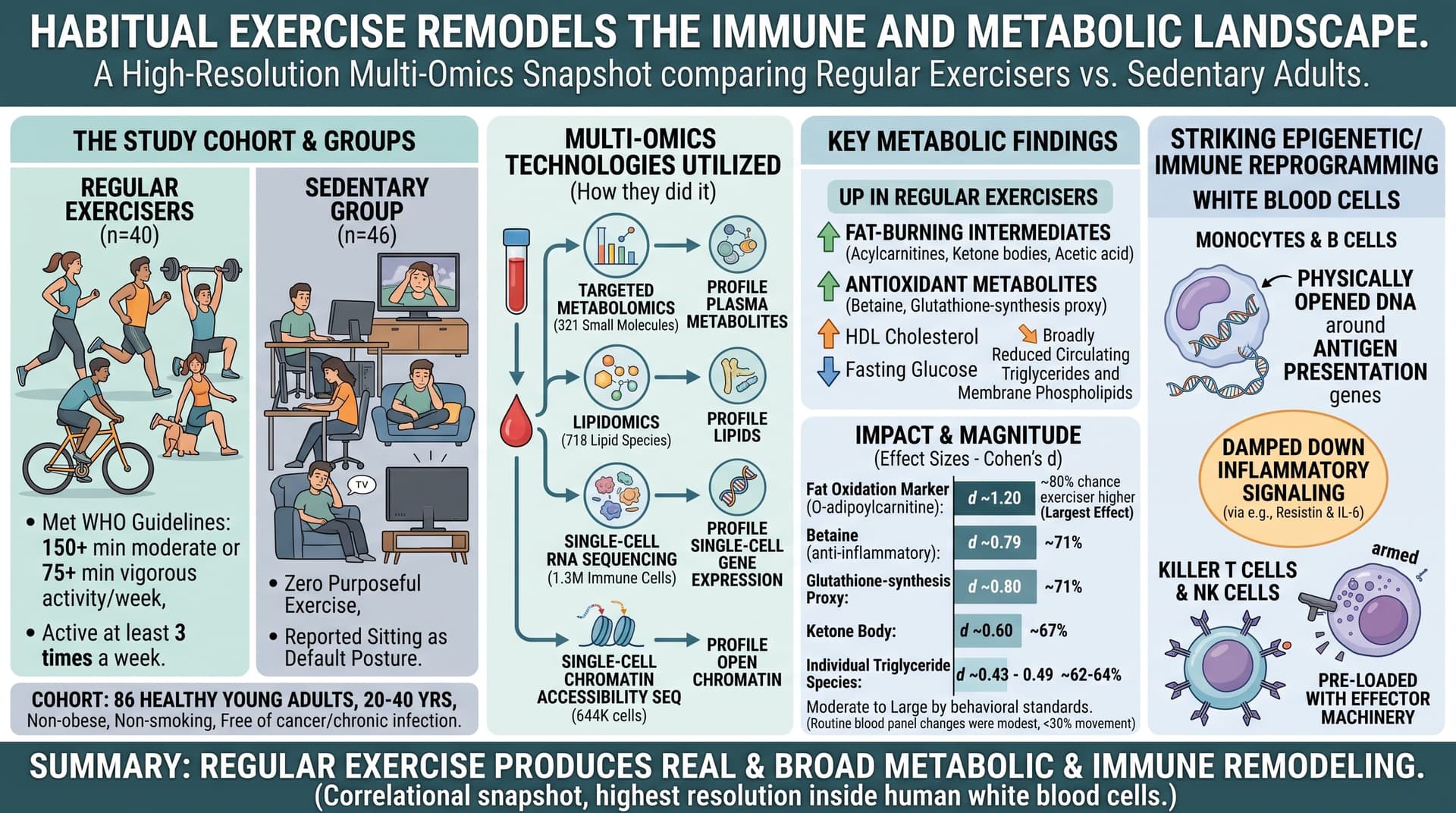
Chinese researchers profiled the plasma metabolites, lipids, single-cell gene expression, and open chromatin of 86 healthy young adults, 40 who met WHO physical activity guidelines and 46 who reported literally zero purposeful exercise. Regular exercisers showed elevated fat-burning intermediates and antioxidant metabolites, broadly reduced circulating triglycerides and membrane phospholipids, and a striking epigenetic reprogramming of their immune cells. Monocytes and B cells had physically opened the DNA around their antigen presentation genes, while killer T cells and NK cells sat pre-loaded with effector machinery. Inflammatory signaling through resistin and IL-6 was damped down.
The health benefits of exercise are one of the least controversial findings in medicine. What has remained frustratingly vague is the molecular accounting. Most of what we know comes from short, tightly controlled training studies, often in athletes or patients, that measure a handful of markers before and after a treadmill session. That tells you about acute stress responses. It tells you much less about what a body looks like after years of simply being an active person.
A team drawing on the Chinese Immune Multi-omics Atlas went after the second question. From a cohort of 428 adults they selected the two extremes: 40 people who exercised at least three times a week and hit the WHO threshold of 150 minutes of moderate or 75 minutes of vigorous activity, and 46 people who reported zero minutes of deliberate exercise and named sitting as their default posture. Everyone was between 20 and 40, non-obese, non-smoking, and free of cancer or chronic infection. Then the researchers ran four separate technologies on their blood: targeted metabolomics on 321 small molecules, lipidomics on 718 lipid species, single-cell RNA sequencing on 1.3 million immune cells, and single-cell chromatin accessibility sequencing on another 644,000.
The metabolic picture was what an exercise physiologist would predict. Acylcarnitines, ketone bodies, and acetic acid were all higher in the active group, the signature of a body routinely pulling fat into mitochondria and burning it. Triglycerides fell across essentially every species measured. Antioxidant-associated molecules including betaine rose. Fasting glucose was lower, HDL cholesterol higher.
The immune findings are the genuinely new part. In the exercisers, monocytes and dendritic cells had not merely turned up expression of their antigen presentation genes. The chromatin around those genes, the physical packaging of the DNA, had been pried open. At the HLA-DQB1 promoter the accessibility difference carried a false discovery rate of roughly ten to the minus fifty-two. Transcription factors that drive antigen presentation, including SPI1, IRF1, and STAT1, showed elevated activity, while the AP-1 stress and inflammation family was suppressed. Killer CD8 T cells and mature NK cells showed the same pattern at their own effector genes, with the master regulators TBX21 and EOMES more accessible and granzymes and perforin more highly expressed. B cells joined in. When the team mapped cell-to-cell signaling, the active group showed amplified MHC class I and class II conversation between antigen-presenting cells and T cells, stronger interferon gamma flow, and weakened signaling through resistin and IL-6.
The proposed interpretation is that habitual exercise leaves the immune system in a state of primed alertness rather than chronic irritation, and that the priming is written epigenetically rather than just transcriptionally. That would explain why active people get fewer infections and respond better to vaccines. It would also, if it holds up, hand the field a set of chromatin-level biomarkers for what exercise adaptation actually is.
Actionable Insights
Nothing here changes the prescription. It changes what you should expect the prescription to do.
Meeting the standard WHO minimum, three sessions a week totaling 150 minutes of moderate work, was enough to produce the entire signature. No one in this study was an elite athlete. The comparison was simply people who train versus people who do nothing.
On magnitude, the paper reports only p-values, so effect sizes below are derived from those p-values and the group sizes. Translated into plain terms, a Cohen’s d of 0.5 means that if you picked one exerciser and one sedentary person at random, the exerciser would show the higher value about 64 percent of the time. Pure chance would be 50 percent.
- Fat oxidation marker (O-adipoylcarnitine): d approximately 1.20, exerciser higher about 80 percent of the time. The single largest effect in the paper.
- Betaine, an anti-inflammatory exercise mimetic: d approximately 0.79, about 71 percent.
- Glutathione-synthesis proxy (2-hydroxybutyrate): d approximately 0.80, about 71 percent.
- Ketone body (3-hydroxybutyrate): d approximately 0.60, about 67 percent.
- Individual triglyceride species: d approximately 0.43 to 0.49, about 62 to 64 percent.
These are moderate to large by behavioral-intervention standards. But routine blood panel changes were modest: no biochemical index moved more than roughly 30 percent, read from the published figure. The metabolic and immune remodeling is real and broad.
Context and Source
- Open Access Paper: Multiomics profiling identifies molecular and cellular signatures of regular exercise in human peripheral blood
- Lead institutions: BGI Research, Shenzhen; State Key Laboratory of Genome and Multi-omics Technologies. Collaborating sites include Huazhong Agricultural University, Peking University Cancer Hospital, Chinese PLA General Hospital, Henan Provincial People’s Hospital, and Shanxi Medical University.
- Country: China
- Journal: Science Advances, volume 12, article eaeh0260, published 18 September 2026
- Impact: The impact score of this journal is 13.9, evaluated against a typical high-end range of 0 to 60+ for top general science, therefore this is a High impact journal.