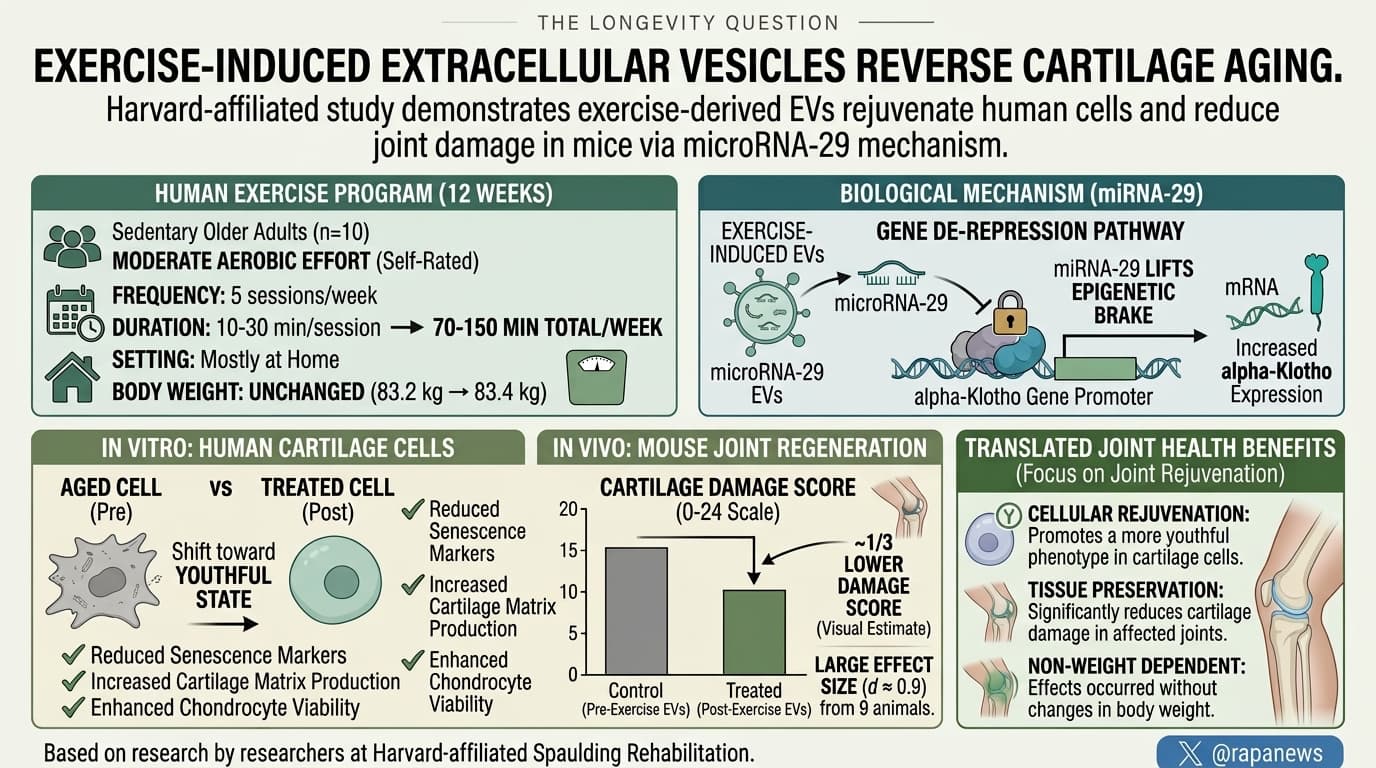
Researchers at Harvard-affiliated Spaulding Rehabilitation report that tiny blood-borne particles called extracellular vesicles (EVs), collected from ten sedentary older adults after 12 weeks of moderate aerobic exercise, pushed aged human cartilage cells toward a more youthful state in the dish. The same vesicles reduced cartilage damage scores when injected into the knees of old mice. The team traces the effect to microRNA-29, which appears to lift an epigenetic brake on the gene for alpha-Klotho.
Exercise is the first-line treatment for knee osteoarthritis, yet nobody has explained how a brisk walk reaches cartilage, a tissue with no blood supply. A paper in Nature Aging proposes an answer: the message travels in extracellular vesicles, nanoscale membrane bubbles that cells release into the bloodstream carrying short regulatory RNAs.
The team started at the computer. They reanalyzed a public dataset of ten older men sampled before and after a single cycling session and flagged 16 vesicle microRNAs that changed. Mapping the targets of those microRNAs onto a cartilage-specific gene network pointed to cell-matrix adhesion, the machinery by which cartilage cells sense the stiffness of their surroundings. One family, microRNA-29, accounted for most of the predicted effect.
Then they tested it. Ten sedentary adults averaging 69 years, eight of them women, completed a 12-week program that built from 70 to 150 minutes of moderate aerobic activity per week. Blood was drawn before and after. Vesicles from each draw were applied to cartilage cells from a 65-year-old donor grown on a gel as stiff as aged cartilage, a condition that normally drives the cells into an aged, flattened, matrix-degrading state.
Vesicles collected after training reversed much of that. The cells rounded up, made more type II collagen and aggrecan, and produced less of the enzymes MMP13 and ADAMTS4 that chew through cartilage. Levels of DNMT1, an enzyme that silences genes by methylating DNA, fell. Methylation of the Klotho promoter dropped and alpha-Klotho protein rose. Vesicles collected before training did little.
In old mice, each animal received pre-training vesicles in the left knee and post-training vesicles in the right, twice weekly for four weeks. Knees given post-training vesicles showed lower cartilage damage scores, more collagen and less degradative enzyme.
Finally, the researchers loaded vesicles with synthetic microRNA-29. These reproduced the anabolic shift in cells, and silencing Klotho partly blocked it. The authors conclude that a microRNA-29 to Klotho axis carries part of the benefit of exercise to the joint.
The idea is attractive, and the paper is open about some gaps. It never shows that circulating vesicles penetrate human cartilage in meaningful numbers. The trial that supplied the blood was terminated when funding ended, so no pain, function or imaging data exist for these participants. There was no non-exercising comparison group, so seasonal or other time-related changes in blood cannot be excluded.
Other gaps go unremarked. Of the two microRNA-29 members measured in the participants, only one reached conventional statistical significance, and the rise was concentrated in a few individuals. The mouse experiment had no saline-injected knee, so it shows a difference between two vesicle preparations but not a benefit over doing nothing. And microRNA-29 is not a simple youth signal: other work links elevated microRNA-29 to aging phenotypes in mice.
The result is a well-built hypothesis with early supporting data. It does not justify exosome injections or microRNA therapies for arthritic knees.
Actionable Insights
The paper is a reason to keep doing aerobic exercise.
- The program used was modest: five sessions a week of self-rated moderate effort, building from 10 to 30 minutes each, mostly at home, for 12 weeks. Total weekly time was 70 to 150 minutes.
- Body weight did not change (83.2 kg before, 83.4 kg after), so whatever shifted in the blood was not a weight-loss effect.
- No joint outcome was measured in people. The only tissue-level result is in mice, where knees given post-exercise vesicles scored roughly one-third lower on a 0 to 24 cartilage damage scale than the opposite knee given pre-exercise vesicles. That is a visual estimate from the published plot. The standardized effect is about 0.9, conventionally “large”, but it comes from nine animals and is likely inflated.
- Response varied. The microRNA-29 increase was driven by a few of the ten participants. Not everyone may get this particular signal from this dose of exercise.
- Nothing here supports commercial exosome products, Klotho boosters or microRNA supplements. The engineered vesicles were tested only on cells in a dish.
- Resistance training was not studied. Its absence here says nothing about its value.
Context and Source
- Paywalled Paper: Exercise enhances aged chondrocyte health through microRNA-29-enriched extracellular vesicles
- Access: Paywalled. The article is published under exclusive licence to Springer Nature with no open access statement.
- Institutions: Schoen Adams Research Institute at Spaulding, Harvard Medical School and Spaulding Rehabilitation Hospital (lead), with Columbia University Irving Medical Center, University of Pittsburgh and University of Kansas Medical Center
- Country: USA
- Journal: Nature Aging, published online 29 September 2026
- Impact evaluation: The impact score of this journal is 25.0 (2025 Journal Impact Factor), evaluated against a typical high-end range of 0 to 60+ for top general science, therefore this is a High impact journal.