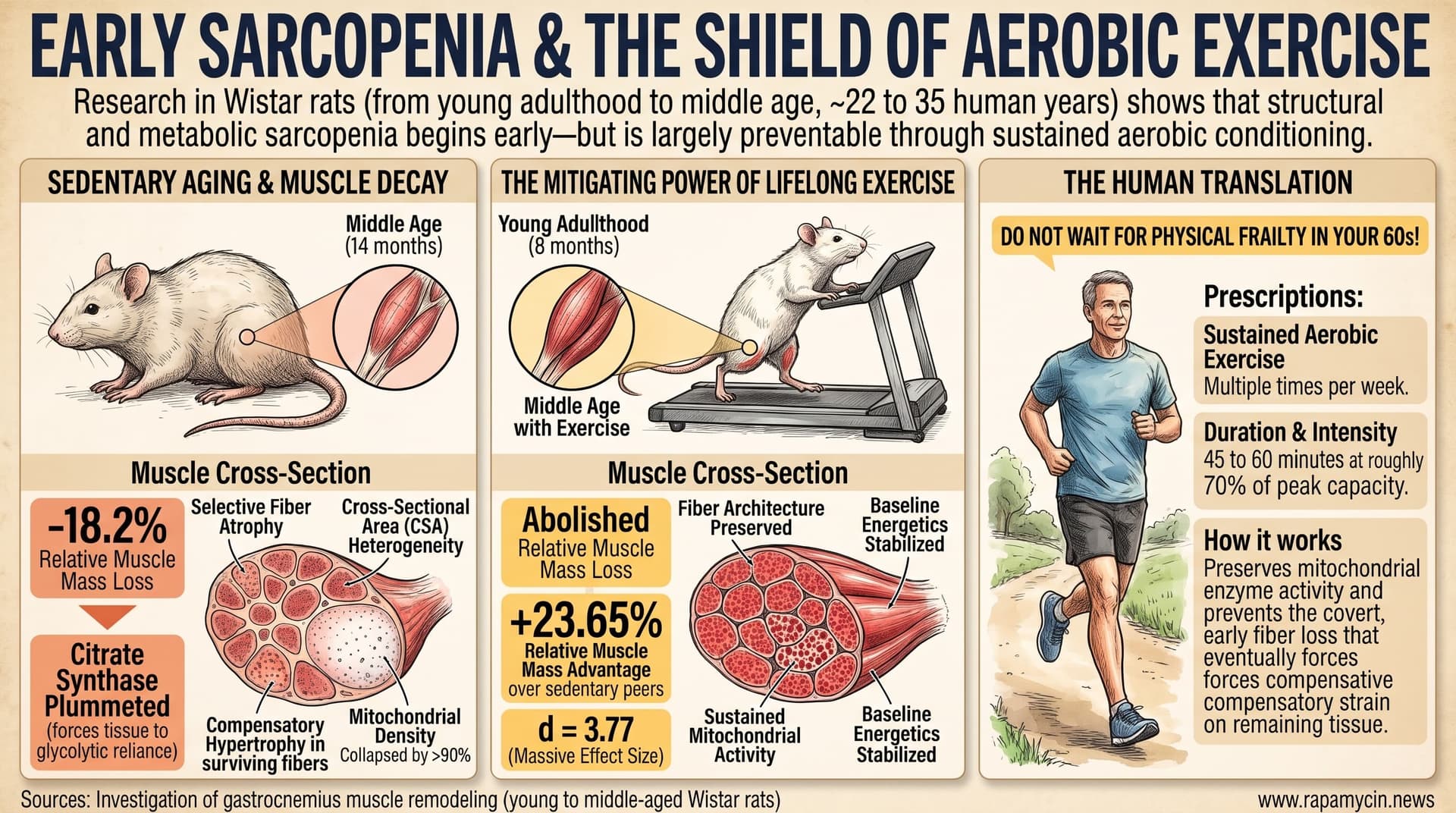
Sarcopenia is typically diagnosed late in life, yet its cellular foundations develop decades before clinical symptoms emerge. This investigation examined gastrocnemius muscle remodeling in male Wistar rats between young adulthood (8 months) and middle age (14 months), corresponding roughly to 22 and 35 human years. The authors evaluated whether lifelong moderate aerobic treadmill running mitigates early muscle deterioration. Sedentary aging caused an 18.2 percent decline in relative gastrocnemius muscle mass, accompanied by fiber cross-sectional area heterogeneity, selective fiber atrophy, and compensatory hypertrophy in surviving fibers. Concurrently, citrate synthase activity plummeted, forcing tissue toward glycolytic reliance, basal AMP-activated protein kinase activation, and anti-apoptotic signaling. Lifelong aerobic exercise completely prevented the loss of relative muscle mass, sustained mitochondrial enzyme activity, and stabilized baseline cellular energetics. These data establish that structural and metabolic sarcopenic decline begins in early adulthood and can be largely mitigated through sustained aerobic conditioning.
The standard clinical approach to muscle loss operates under a significant blind spot. Diagnostic criteria for sarcopenia generally trigger only when elderly patients present with overt frailty, reduced walking speed, or visible wasting. By that point, the biological machinery required for functional recovery has been deteriorating for decades. A study conducted in Portugal challenges this late-stage model, demonstrating that skeletal muscle enters a state of structural and metabolic crisis by early middle age, long before gross physical wasting becomes obvious.
Tracking male Wistar rats from young adulthood (8 months of age) to middle age (14 months of age), corresponding to human ages 22 and 35, the researchers assessed the gastrocnemius, a fast-twitch, mixed-fiber lower limb muscle vulnerable to age-related atrophy. In sedentary animals, absolute muscle mass remained superficially steady. However,when normalized against total body weight to derive the sarcopenia index, middle-aged sedentary animals experienced a sharp loss in relative muscle mass.
Histological inspection revealed that this decline was not uniform across all tissue. Instead, middle-aged muscles exhibited profound structural heterogeneity. Individual muscle fibers showed atrophic shrinking, while neighboring fibers enlarged drastically. This pattern represents compensatory hypertrophy: surviving fibers expand their cross-sectional area to shoulder the mechanical load left by dying or denervated neighbors.
Underneath this structural remodeling lies an energetic deficit. Sedentary middle-aged muscles suffered an acute collapse in citrate synthase activity, an enzymatic marker of mitochondrial density. Deprived of normal oxidative capacity, the muscle tissue was forced into an inefficient metabolic shift, leaning heavily on anaerobic glycolysis for basic ATP maintenance. This energy crisis was reflected in the elevated activation of the cellular fuel sensor, AMP-activated protein kinase, alongside an upregulation of the anti-apoptotic protein BCL2A1. The tissue effectively entered a compensatory survival state, suppressing cell death programs to preserve whatever functional fibers remained.
The positive outcome of the investigation centers on lifelong physical conditioning. Animals subjected to regular,moderate treadmill running over their lifespan completely bypassed this cascade. Exercised middle-aged rats maintained their youthful relative muscle mass, sustained citrate synthase activity, avoided the compensatory glycolytic shift, and showed normalized baseline cellular energy sensing. Notably, this protection occurred without changes in common catabolic markers such as atrogin-1 or classic oxidative protein damage markers, which remained unchanged across all cohorts. The primary takeaway is clear: the metabolic decay of sarcopenia is an early middle-age phenomenon, and consistent aerobic conditioning provides an effective, highly accessible defense.
Actionable Insights
Sarcopenia does not start in retirement; functional muscle loss begins in early adulthood. In this rodent model, the relative muscle-to-body-weight ratio declined by 18.15 percent between young adulthood and middle age. Concurrently,mitochondrial density collapsed by over 90 percent in sedentary subjects.
Lifelong aerobic exercise completely abolished this loss, yielding a 23.65 percent advantage in relative muscle mass over sedentary peers. Translated to standardized statistics, the intervention produced a massive effect size (Cohen’s d = 3.77),indicating that regular endurance running effectively shielded muscle architecture from middle-aged degradation.
For human health, the takeaway is straightforward: do not wait for strength declines or physical frailty in your 60s to prioritize physical conditioning. Sustained aerobic exercise, conducted at roughly 70 percent of peak capacity for 45 to 60 minutes multiple times per week, preserves mitochondrial enzyme activity and prevents the covert muscle fiber loss that forces remaining tissue into overstretched, compensatory hypertrophy. Aerobic exercise should be maintained consistently throughout young adulthood and middle age to protect metabolic flexibility, prevent excessive fat accumulation relative to lean mass, and preserve muscle quality before irreversible loss occurs.
Context/Source
- Open Access Paper: Exploring the effects of lifelong aerobic exercise on early skeletal muscle remodeling between 8 and 14 months in the rat
- Institutions: Research Center in Physical Activity, Health and Leisure (CIAFEL), Faculty of Sport, University of Porto; LAQV-REQUIMTE, Department of Chemistry, University of Aveiro; Centre for Research and Technology of Agro-Environmental and Biological Sciences (CITAB), University of Trás-os-Montes and Alto Douro; UCIBIO, University Institute of Health Sciences (IUCS-CESPU); Institute of Biomedicine (iBiMED), University of Aveiro Country: Portugal
- Journal Name: Journal of Physiology and Biochemistry
- Impact: The impact score of this journal is 3.4, evaluated against a typical high-end range of 0 to 60+ for top general science,therefore this is a Medium impact journal.