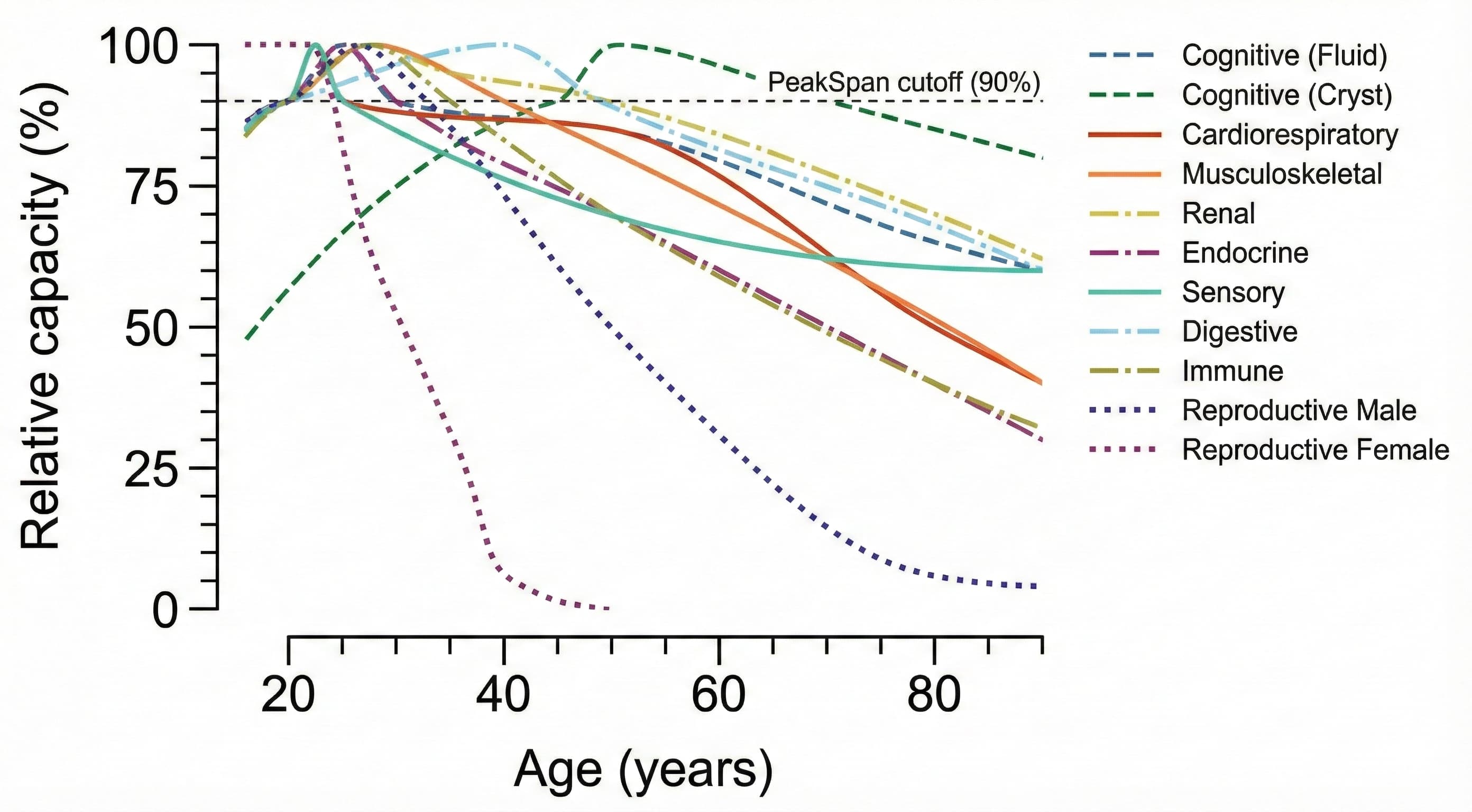
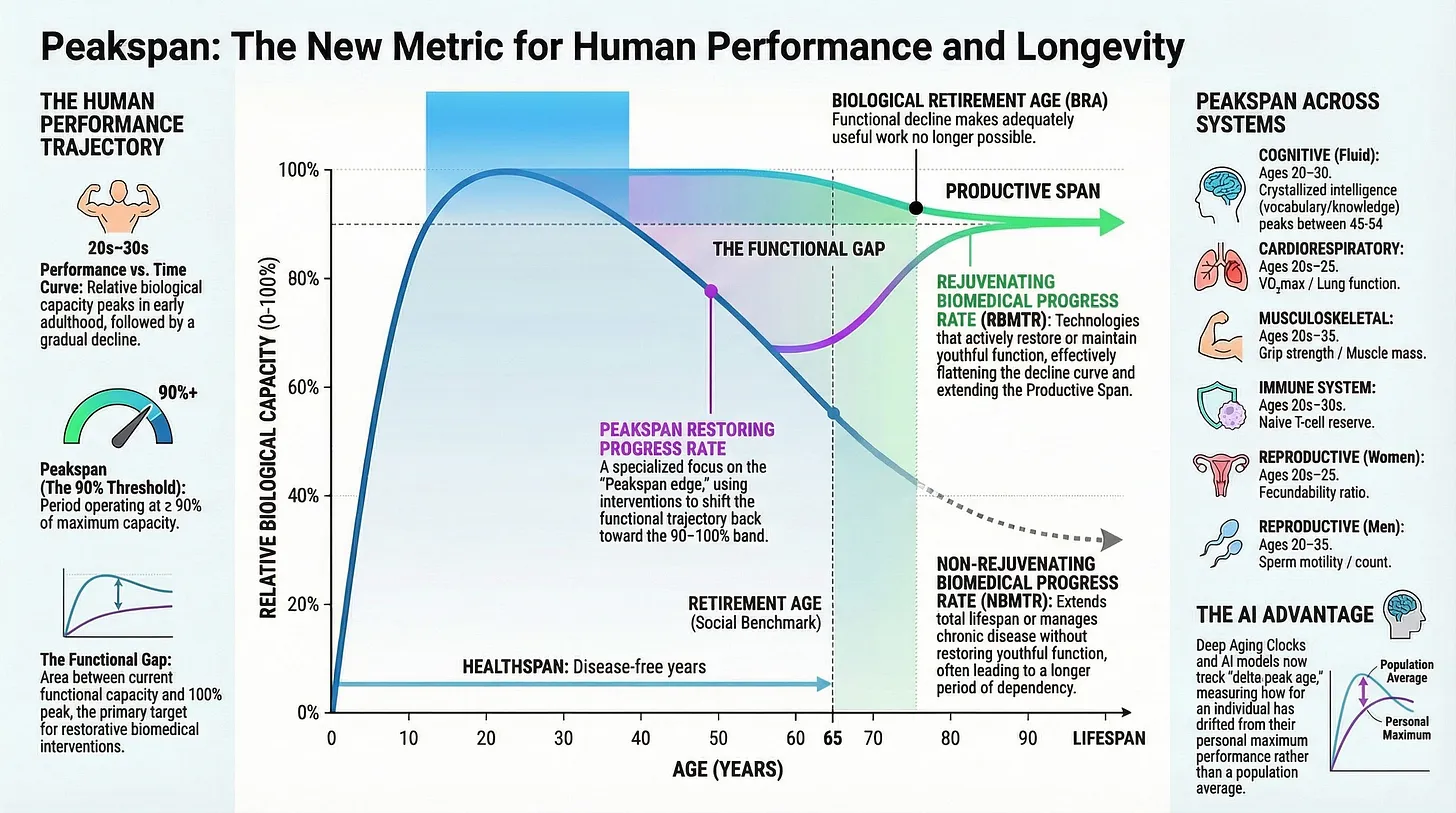
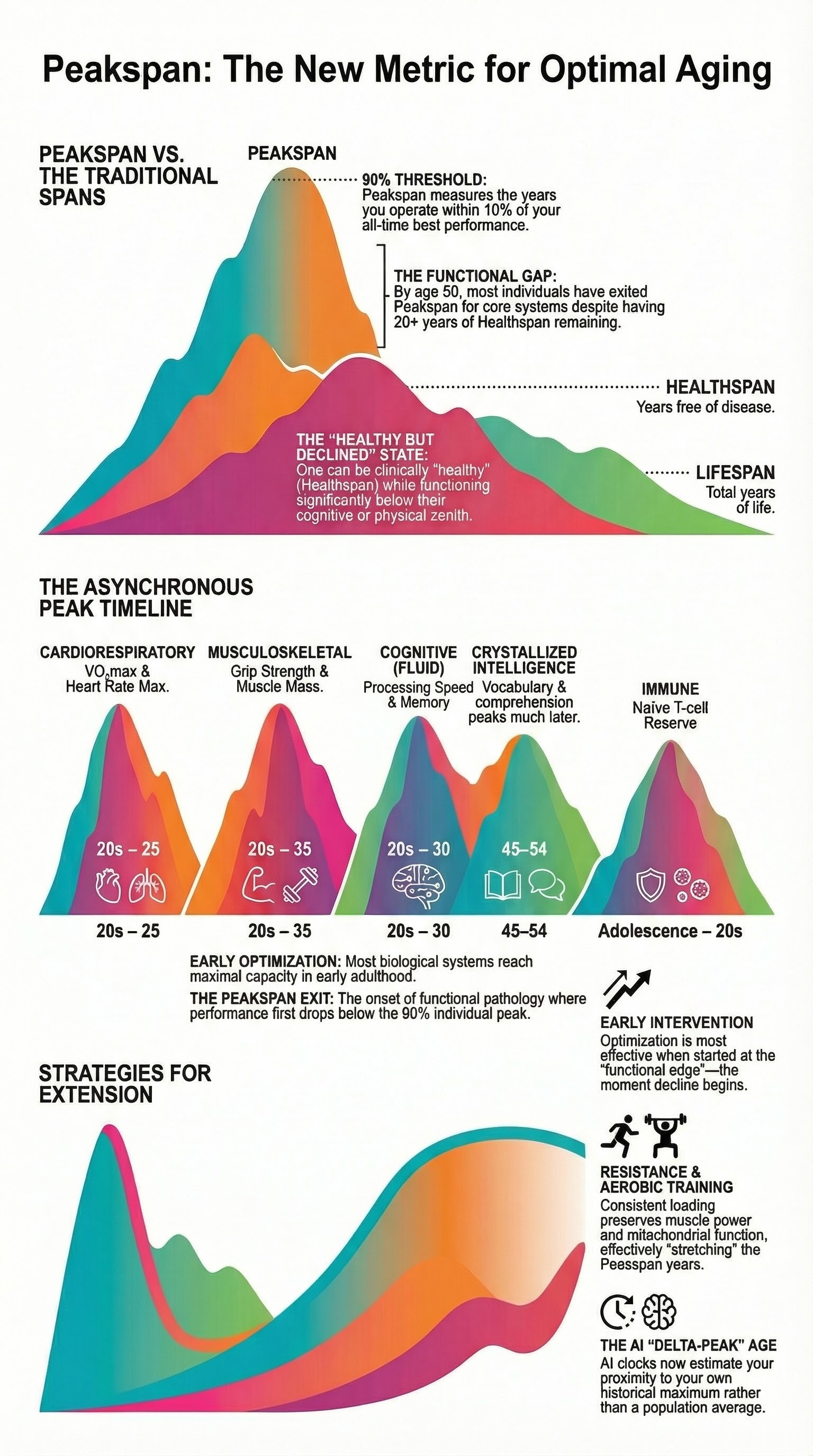
Geroscience has historically focused on extending lifespan and “healthspan”—the years free from debilitating chronic disease. However, a new perspective paper argues this framework is deeply flawed because it overlooks the gradual erosion of capacity that occurs even in ostensibly healthy individuals. The researchers introduce “Peakspan”: the period during which an individual maintains at least 90% of their peak functional performance in a specific physiological or cognitive domain. According to their multi-system analysis, most human biological systems reach maximal capacity in early adulthood, between the 20s and 30s.
Consequently, humans now spend the vast majority of their adult lives in a “healthy but declined” state, carrying a massive functional gap well before clinical disease is diagnosed.
The authors argue that extending Peakspan, rather than just healthspan, is the true functional manifestation of rejuvenative biomedical progress and is strictly necessary for sustained economic growth in aging societies. They advocate for a massive shift in how we measure and intervene in aging, leveraging artificial intelligence (AI) and “Deep Aging Clocks”. Instead of measuring chronological age deviation, these AI models would calculate a “delta-peak age,” estimating an individual’s proximity to their own historical maximum performance rather than a population average. By aggressively targeting the specific moment when function drops below 90% (the “Peakspan exit”), we can theoretically intervene before system-wide decline cascades into overt pathology. The paper essentially demands we stop accepting gradual functional deterioration as “normal” and start utilizing AI to optimize for maximal capacity throughout the life course.
Impact Evaluation: The impact score of this journal is 7.0, evaluated against a typical high-end range of 0–60+ for top general science, therefore this is a Medium impact journal.
While the paper avoids cellular pathway analysis (e.g., mTOR, AMPK), it forcefully reorients aging priorities toward organ-specific functional trajectories:
Cognitive: Fluid intelligence, including processing speed and working memory, peaks between ages 20 and 30. Conversely, crystallized intelligence peaks much later, between ages 45 and 54.
Cardiorespiratory: VO2max and maximum cardiac output peak in the early to mid-20s. Furthermore, gas-exchange efficiency (DLCO) decline accelerates after age 40. [Confidence: High]
Immune: Naïve T-cell export collapses rapidly after puberty, falling to 20% of pre-puberty levels by age 25. This effectively destroys the immune system’s Peakspan exceptionally early. [Confidence: High]
Endocrine: The paper highlights the decline of IGF-1, with serum levels in the late 70s dropping to 30-35% of young adult values.
Novelty
The framework shifts the therapeutic goalpost from “disease-free survival” to “preservation of ≥90% of absolute maximum personal capacity”.
It introduces the conceptual requirement for “delta-peak age” in AI clocks. This anchors biological age to an individual’s historical zenith rather than a generalized population mean. [Confidence: High]
Critical Limitations
Zero Actionable Interventions: As a theoretical framework, this paper completely lacks actionable insights regarding specific compounds, dosages, or lifestyle interventions required to actually extend Peakspan. It tells us what to measure, but not how to physically fix it. [Confidence: High]
The Baseline Data Problem: The entire concept relies on knowing an individual’s specific “peak”. Realistically, almost no one has comprehensive multi-omic, structural, and physiological baselines established during their 20s. Relying on retrospective inference of individual maxima introduces massive measurement error. [Confidence: Medium]
Unproven Reversibility: The paper heavily relies on the premise that identifying the “Peakspan exit” will allow for restorative interventions. However, it provides no empirical data demonstrating that a human who has dropped to 85% of their fluid cognitive peak can be therapeutically restored to ≥90%. [Confidence: High]
Development with Age: Unlike fluid intelligence (fast, novel problem-solving), crystallized intelligence strengthens as people get older, often peaking in middle age and holding steady into the 70s or 80s
“working memory, peaks between ages 20 and 30”
That really sucks folks. Explains why it’s easier for me to remember what happened 50 years ago than what happened 5 minutes ago.
Its an interesting point. If we go with the hypothesis that aging and development are the same process and then there is potentially a point on that process that you could aim for what normal chronological age would that be. Possibly around 30.
I would think crystallised intelligence is an issue of experience rather than development.
Well, some contexts are really very clear and there is no compensation. For example, performance in chess. It’s a younger man’s game. It becomes harder and harder to perform at peak level. By the 30’s there’s already a decline, 40’s almost universal and 50’s you simply will not win a world championship. In mathematics your most brilliant work will happen in your 20’s , even early 20’s. You can still do great work in more advanced age, but sheer spectacular brilliance is like a sprint - a young person’s sport.
I wonder how much of the decline in working memory is absolutely foundational vs situational. I legit thought I was going demented-lite the past few years. Turns out I was hypoesterogenic from nursing 5 kids nearly 2 years each (lactation suppresses estrogen). In roughly a month on HRT I have a noticeable decrease in items dropping from recall list, forgetting what I needed to do for the day, items to shop for, etc. and I have just started nudging hormones in the right direction, not fully normalized yet by any means. Turns out for women, the hippocampus shrinks with estrogen withdrawal and swells up with its restoration (this happens at a low amplitude during a menstrual cycle too). So for women at least what we might have assumed was broken could have merely been lying dormant. Of course beyond a certain point of severe estrogen withdrawal the wheels start to come off and restoration doesn’t fix things anymore, but if you normalize hormones early you might steer clear of the point of no return.
I’m less familiar with how it works for men, and what effect estrogen might have on their brain and whether some of their T converting to E helps in that regard. Not my wheelhouse. But wouldn’t surprise me if hormones were involved in their working memory regulation too.
By that logic, we should try to keep telomere length the same, and circulating NAD levels too. Yet, there’s not much human data that supports increasing these levels does much.
This is a great framework for thinking about the future, yours, mine, everyone’s. We decline into that place we don’t want to go. If we are successful and lucky, we decline slowly enough not to notice how from one day to the next we are not what we were. But we know it is happening over time, and our lives shrink to fit our reduced capacity.
My thoughts go to how to dramatically slow the declines. How to stay above that threshold (for as long as possible) below which I am no longer the me that I like.
I think there are three categories of action for each area of capacity (strength, cardio respiratory, flexibility, coordination, working memory, attention span, immune health, etc):
(1) get as high a peak as possible (train hard)
(2) have the peak be as late in life as possible (consistency over heroics; don’t get hurt / side-tracked)
(3) slow the decline in capacity post peak (use it or lose it)
I have not found any “silver bullets” besides avoiding stupid mistakes (injury, toxins, pathogen exposure, ego failures). Once the obvious errors are corrected, I try to have a broad capacity building / maintenance program applied consistently forever.
I have for each of the last two years improved on the previous year when testing for cardiorespiratory fitness (VO2 max) and musco-skeletal fitness (various strength and balance tests). At a senior age, I may currently be functionally growing younger in those two domains. I haven’t tested for fluid intelligence, but my brain wave patterns have normalized after neurofeedback training, possibly indicating a younger state.
I wonder if systematic interventions could set back the clock for some or even most of the remaining core functional domains, at least for some time.
It would be valuable to list the most promising interventions for each domain. And systematically try beating the clock for each one.
Granted, interventions would also need to be systemic, such as targeting mitochondria and stem cell exhaustion.
Maybe rapamycin is not a silver bullet, but so far it has dramatically slowed my aging process. I cannot prove it’s the rapamycin because I practice polypharmacy. While many things in my “stack” may improve healthspan, I believe rapamycin alone has any significant effect on lifespan by slowing the aging process.
I have been taking nearly the highest dose I can tolerate, which is 8 mg weekly with GFJ and enteric-coated capsules along with either EVOO or coconut oil.
Maybe at this point, I am the only forum member practicing this protocol. I have followed Dr. Blagosklonny’s theory that more is better up until you experience negative side effects. He was not talking about slight increases in glucose or lipid levels. I have been doing this for ~5 years.
While I might not look 15 years younger, I actually feel younger than ~85. I am doing things I couldn’t have done five years ago. I have much more endurance than I did in my late 70’s.