What kind of results are you getting from Akkermansia and for how long?

I’ve seen nothing showing that one can supplement directly with Akkermansia. Rather one has to supply the gut with the right nutrition/environment to promote the growth and sustainability of Akkermansia.

See discussions at: Immunity Code by Joel Greene and Akkermansia muciniphila, can strip the sugar coating from IgA antibodies, potentially leading to immune friendly fire.

Can you post “Pendulum’s research”?

Having a way to directly “supplement” with Akkermansia could prove very interesting.

Also, what do you mean by “BG”?


I just found Pendulum’s webpage on Pendulum Akkermansia.

Interesting, but it leaves me with questions:

  • Does their product have an enteric coating so that the “live Akkermansia” doesn’t get destroyed by stomach acid?

  • Does the product have some other means of delivering the Akkermansia to the gut?

  • How do they determine dosage?


OK, just saw that the webpage claims the product uses some kind of enteric capsule:

Akkermansia is encased in a plant-based, acid-resistant, delayed release capsule so that the strain gets through the stomach acid and to the gut microbiome where it can do its job.

Three months to really work seems like a lot.

Joel Greene’s microbiome protocols appear to resent a microbiome in weeks rather than months.

I remain interested but skeptical.

Has anyone used this stuff or any of their other products?

1 Like

You might both find this thread helpful

Would love to hear your thoughts once you have read it:

3 Likes

And you might both also like to read this

2 Likes

I’ve been using the Pendulum Glucose Control product for two months. I’m not using it for glucose control as I’m fine with my A1c/fasting blood glucose level. I’m trying it so see if I can get any benefits from its potential to strengthen gut lining/reduce gut permeability and increase butyrate production. Glucose Control contains multiple strains of bacteria, not just Akkermansia, so any perceived benefits I get may not be from that strain specifically.

Since I’ve started it I’ve experienced increased gut motility and a scaly, raised pink patch of skin on my forehead has faded significantly. These are associations, I’m not sure if there is any causation involved.

4 Likes

I used the Pendulum Akkermansia product for one month and noticed no improvements in anything.

3 Likes

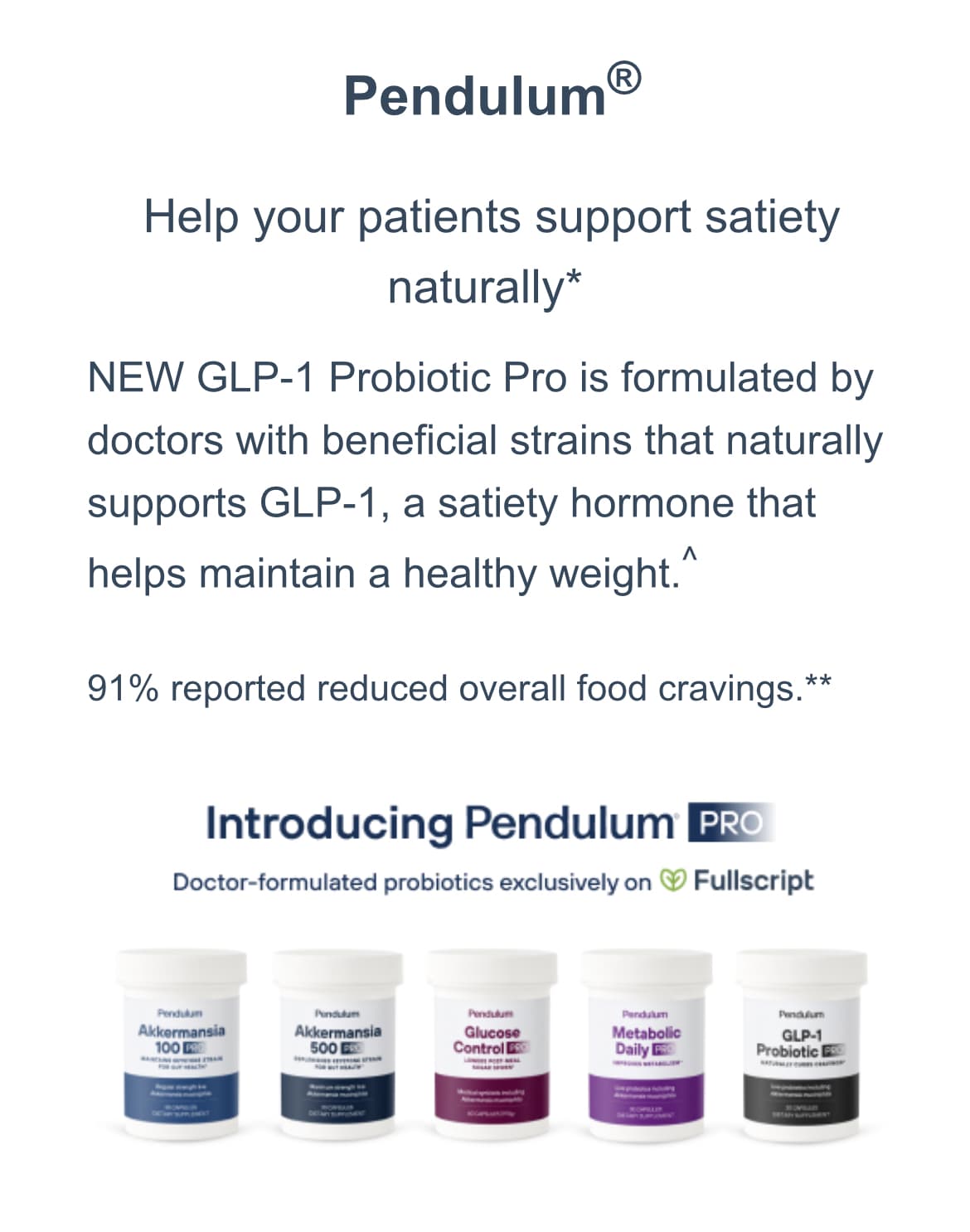
FYI. I’ve switched to the PRO products since they are on Fullscript. Fullscript is going to run a big sale (pendulum and more brands) in mid May. Message me if you want access. Anyone who has already set up an account will get notice of the sale.

8 Likes

My HBA1C went from 5.7 to 5.4 after using Pendulum Akkermansia and Polyphenols for a month as well as taking 500 mg Metformin daily. The benefits probably come from both actions, but it seems much larger than I would have gotten from Metformin alone. When I was prediabetic, I only took 1 g of Metformin weekly.

3 Likes

Have you switched to that product that contains 500 million AKK per capsule? Why not switch to GLP-1

1 Like

I did switch to the GLP-1 product. My gut motility improved after about 2 weeks (back to how it felt with the Akkermansia only product before I stopped using the supplement due to cost). I haven’t checked HbA1c yet to see if I’m getting the same benefit as on just Akkermansia but I feel good.

2 Likes

Glad to see you mention their polyphenols. I’m taking their glucose control and taking one pill a day (just to keep costs reasonable). I chose that product after hearing Attia say good things about the company.

According to ZOE, I have a horrible gut, so this is my main interest for pro/pre-biotics

They just gifted me a bottle of their polyphenols and I had wondered if it’s worth purchasing in the future. Do you see value in that particular product and plan to continue?

3 Likes

I only took the product for a month. I also added 500 mg of Metformin daily.

Due to a miscalculation when I used a glucose calculator instead of a fasting glucose one (which provide very different numbers), my HBA1C was not 4.9 as I thought. It’s actually 5.4. So I went from 5.7 to 5.4.

Unfortunately, now I think the reduction was mostly the Metformin. However, I did buy another month’s supply of Akkermansia, so we’ll see what happens at the next blood draw in August.

1 Like

Does anyone know where to get this delivered to Europe?

I ordered 2 bottles once from supplements megastore and my order never arrived , nor did I get reimbursed, despite my claim. I am thinking of trying the akkermansia pasteurised ones since at least I can order from EU firms … iherb would send it to Eu too but every time I checked it was not in stock so I gave up.

1 Like

I am trying akkermansia from codeage right now in hopes of increasing glp-1 but we’ll have to see. Nothing notable to report so far.

Could anyone report on results from longer-term supplementation with Akkermansia?

BG - blood glucose, aka BS (blood sugar).

I took Supersmart (60 caps), later CodeAge (90 caps).

Nada, Niente, Nic.

5 Likes

Joseph Lavelle had positive results. Brought down his BG. But he used Pendulum.

DeStrider tried Pendulum too.

2 Likes

Pendulum Akkermansia has 100 million CFU per capsule (around $1.42 per day on Amazon)

Just saw the Keptrohy brand on Amazon that lists 300 billion AFU (per 2 capsules) for $0.97 per day on Amazon Keptrohy Akkermansia. That sounds too good to be true : 3000 times the dosage of Akkermansia for a lower price than Pendulum ?

Keptrohy seems to be a company from China.

Current Trademark Owners

Party Name

SHANNON DENISE MARTIN

Party Type

10 - Original Applicant

Legal Entity Type

01 - Individual

Address

Please log in with your Justia account to see this address.

Correspondences

Name

GU, WEI

I do not know if the linkedin member is the same person.

https://www.linkedin.com/in/shannon-denise-martin-173667283

Google translate says the Chinese characters on linkedin are Meirong yuan, or beauty salon.

2 Likes

How to boost a person’s Akkermansia muciniphila levels:

The mechanism that explains most of the findings

A. muciniphila is a mucin specialist that lives in the colonic mucus layer and can feed on host-secreted mucin glycans when dietary substrate is scarce. It can thrive on mucins as an energy source and increases in relative abundance during hibernation, after very-low-calorie diets, and during long-term fasting. That single trait explains two things: why caloric restriction raises it (competitive release — everything else starves, it doesn’t), and why many polyphenols work indirectly by boosting goblet-cell mucin output or reshaping the gut redox environment rather than feeding it directly. Cell Press

Tier 1 — Human interventional support (moderate confidence)

Caloric restriction / intermittent fasting. The most reproducible non-drug lever in humans. A one-week fasting program raised F. prausnitzii and A. muciniphila, and calorie restriction in obese patients increased A. muciniphila alongside better metabolic outcomes. Ramadan time-restricted feeding produced a significant rise in gut A. muciniphila. Honest caveat: bariatric surgery, despite comparable dietary change, did not reproduce the increase — so it’s not weight loss per se, it’s the substrate-competition dynamic. Given your existing metabolic protocol, this is the lever with the most direct human read-through. PubMed Central + 2

Pomegranate / ellagitannins — but only if you’re a urolithin-A producer. This is the sharpest example of the responder/non-responder problem, and it’s a two-way relationship you’ll recognize. Four weeks of pomegranate supplementation raised fecal A. muciniphila 33–47× in urolithin-A producers versus non-producers. One trial (n=18) saw significant increases only in the 13 producers; a larger one (n=49, González-Sarrías 2017) found no overall change in Akkermansia. Critically, ellagic acid and urolithin A do not directly promote A. muciniphila growth in vitro — the causality runs at least partly the other way (Akkermansia helps make urolithin A). Practically: pomegranate, walnuts, and berries (raspberry, blackberry, strawberry) are worth it, but the effect size is producer-status-dependent. ScienceDirect + 2

Omega-3 PUFAs (EPA/DHA). One week of EPA/DHA-enriched fish oil in a mucosal gut-simulator model increased A. muciniphila and other mucolytic species. Human in vivo data is still limited, but mechanistically coherent (PUFAs as a mucus-niche substrate). Fatty fish is the clean whole-food version. nih

Inulin + butyrate. A human RCT in overweight/diabetic patients showed inulin and butyrate administration exerted bifidogenic effects and increased A. muciniphila abundance while lowering diastolic BP and TNF-α. Note inulin/FOS results across studies are somewhat mixed, so I’d call this suggestive rather than robust. Frontiers

Cranberry polyphenols. Dramatic in mice, modest in humans. In a clinical study, subjects eating dried cranberries daily for two weeks showed a trend toward increased fecal Akkermansia, and a separate human trial found cranberry (poly)phenols shifted the microbiota with a bifidogenic effect. Real but small. PubMed CentralNature

Tier 2 — Strong preclinical, thin human data (low-moderate confidence)

Treat these as plausible but unproven in people:

  • Concord grape proanthocyanidins: in mice, 1% grape polyphenol supplementation raised A. muciniphila from 7.5% to 54.8% of the community — the single strongest biomarker of the intervention. Human effect sizes are nowhere near this. ScienceDirect
  • Green tea EGCG: mouse data showing EGCG increased A. muciniphila ~500% even while cutting total bacteria by ~90% — a reminder that “relative abundance” can be misleading; total absolute counts matter. ScienceDirect
  • Capsaicin, fucoidan, chia seed all have positive animal signals; I wouldn’t build a protocol on them yet.

The two caveats that should govern any protocol

  1. Baseline-dependency is the dominant modifier. This appears everywhere: higher baseline A. muciniphila predicted better glucose, lipid, and body-composition outcomes after calorie restriction, and in the supplementation RCTs, benefits concentrated in low-baseline individuals while high-baseline participants saw little response. If you already sit in a healthy range, marginal gains from any of these will be small. This is a strong argument for measuring (16S/qPCR stool test) before optimizing. American Physiological SocietyScienceDirect
  2. Relative vs. absolute abundance. Several of the flashiest numbers (EGCG, fasting) partly reflect competitors dying rather than Akkermansia proliferating. That’s still a real ecological shift, but it’s a different thing from growing the population.

Metformin

Metformin is one of the most reliable Akkermansia-raising interventions on record — mice on metformin increased both A. muciniphila and mucin-producing goblet cells, and its therapeutic effect in T2D is attributed partly to raising intestinal A. muciniphila. American Physiological SocietyScienceDirect

Practical translation

Highest-yield, best-human-evidence combination: a fasting/TRE cadence you already run + oily fish for EPA/DHA + ellagitannin sources (pomegranate, walnuts, berries) if you’ve confirmed producer status + a fiber base including inulin-rich foods (chicory, onion, garlic, leek, Jerusalem artichoke). Cranberry and Concord grape are reasonable low-cost additions with honest, modest expectations.

On fermented foods (your kefir): I’d flag that direct fermented-food → Akkermansia evidence is weak. The Stanford fermented-foods work showed increased overall diversity and lower inflammation, not a specific Akkermansia bloom — so I wouldn’t claim kefir as an Akkermansia lever, though it’s defensible on broader grounds.
2 Likes