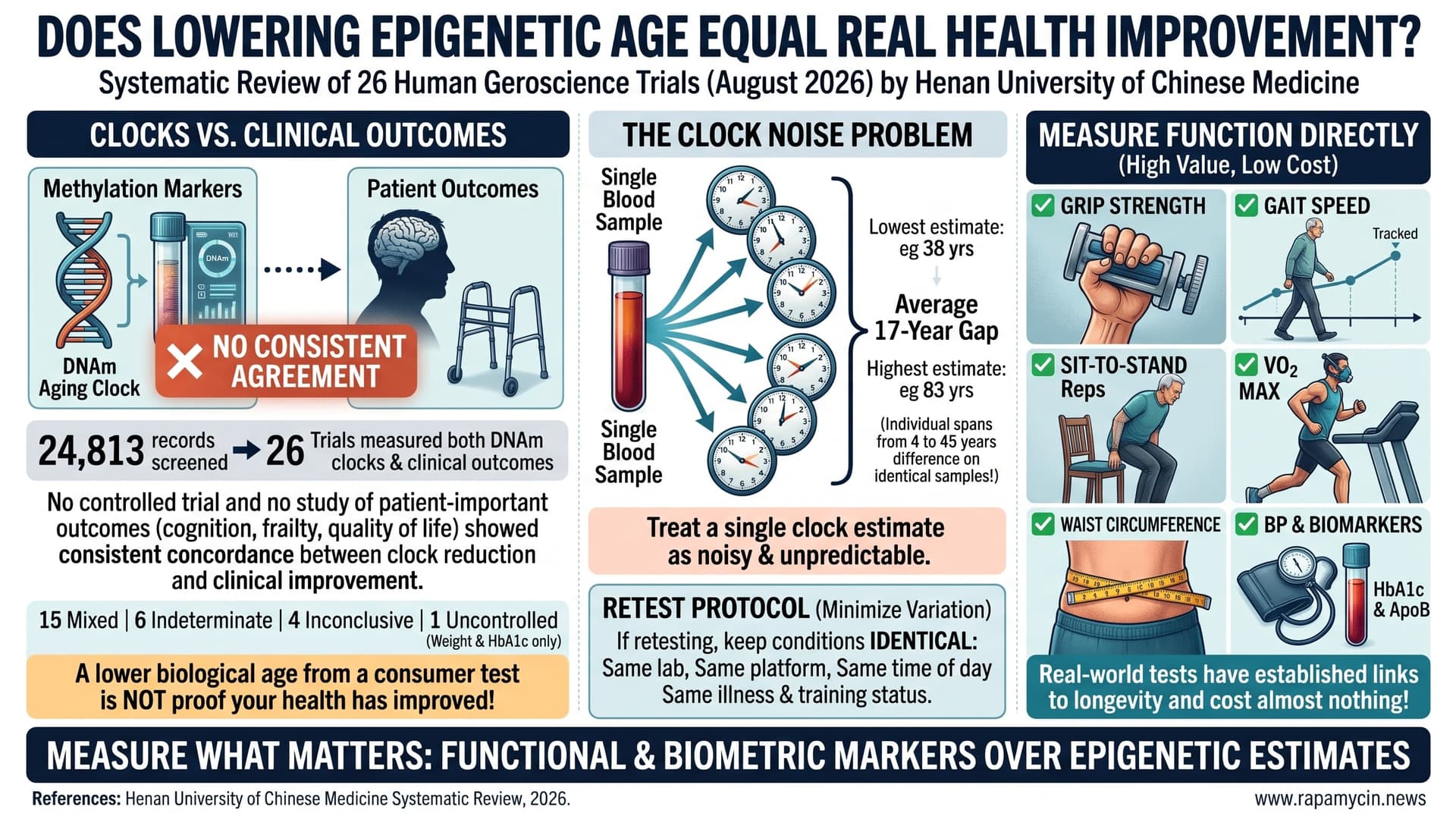
This systematic review from Henan University of Chinese Medicine asked a question the field has mostly skipped: when an intervention lowers someone’s epigenetic age, do their clinical outcomes improve in parallel? The authors searched five databases through August 2026, screened 24,813 records, and included 26 human geroscience trials that measured both a DNA-methylation clock and a clinical outcome before and after treatment. Results were sobering. Fifteen studies showed mixed patterns, six were indeterminate, four were inconclusive, and exactly one, an uncontrolled bariatric surgery study, showed uniform agreement, and only for intermediate measures like weight and HbA1c. No controlled trial and no study of patient-important outcomes such as cognition, frailty or quality of life showed consistent concordance.
Direct-to-consumer biological age tests have become a fixture of the longevity market. Send saliva or blood, receive a number, and often a claim that an intervention has made you biologically younger. The number comes from an epigenetic clock, an algorithm reading chemical tags on DNA at selected sites.
These clocks earned their reputation honestly. Observational studies consistently link accelerated epigenetic age to earlier death, cardiovascular disease and cognitive decline. But a team led by Zhiwan Wang in Zhengzhou noticed that this evidence answers a different question than the one buyers and trialists care about. Predicting who will get sick is not the same as proving that lowering the number makes anyone healthier.
The authors separated four properties that are routinely conflated. Predictive validity asks whether a baseline value forecasts future outcomes. Responsiveness asks whether the clock moves after treatment. Clinical concordance asks whether the clock and the patient’s health move together. Surrogate validity, the highest bar, asks whether the clock change reliably captures the treatment’s effect on health.
They then searched for trials that measured both a clock and a real clinical outcome in the same people. Twenty-six qualified, covering caloric restriction, exercise, metformin, rapamycin, nicotinamide riboside, multivitamins, bariatric surgery, kidney transplantation, plasmapheresis and more.
The pattern was messy. Fifteen trials showed mixed results, meaning some clock-outcome pairs agreed and others contradicted each other within the same study. Six could not be classified because of incomplete reporting. Four showed no clear change in either. One study, bariatric surgery without a control group, showed consistent agreement, and only for weight, waist measurement, insulin resistance and HbA1c.
No controlled trial achieved uniform concordance. No study of cognition, frailty, physical function or quality of life achieved it either.
Individual clocks performed no better. The Horvath clock improved in some weight-loss and exercise studies and worsened in a crossover trial. DunedinPACE slowed with two years of caloric restriction but ran faster after plasmapheresis. GrimAge and PhenoAge varied by study and by outcome.
The explanations are plausible and several are mundane. Blood methylation partly reflects which immune cells are in the sample, and only six of 26 studies clearly adjusted for that. Twenty-two measured the clock within twelve months, which may be too soon for cognition or frailty to change and perhaps too late or too early for methylation. Sixteen studies applied no correction for testing multiple clocks against multiple outcomes. Eight of twelve randomized trials were at high risk of bias, and half the studies had no control group at all.
The authors are careful not to overreach in either direction. They do not claim clocks are useless, and they point out that next-generation clocks remain more predictive and more responsive than older ones. They argue instead that a clock validated in a weight-loss trial tells you nothing about whether it will track cognitive benefit, and that the field should validate one clock, in one context, against one prespecified outcome, rather than measuring as many clocks as possible and reporting whichever moved.
Their bottom line is unusually clean: a reduction in epigenetic age (as measured by today’s biological clocks) should not be described as reversal of aging or clinical rejuvenation.
Actionable Insights
- A lower epigenetic age from a consumer test is not evidence that your health improved. Across 26 trials, no controlled study showed consistent agreement between clock improvement and clinical improvement.
- Two clocks on the same blood sample can disagree substantially. Applying eight blood-trained clocks to identical samples produced a mean span of 17 years between lowest and highest estimates, with individual spans from 4 to 45 years. Treat a single number as noisy.
- Measure function directly instead. Grip strength, gait speed, sit-to-stand repetitions, VO2 max, waist circumference, HbA1c, ApoB and blood pressure all have established links to outcomes and cost almost nothing.
- If you retest a clock, keep conditions identical: same lab, same platform, same time of day, same illness and training status. Technical variation alone can shift conventional clock estimates by several years.
- The one consistent signal was for intermediate metabolic measures after weight loss. If your goal is metabolic health, measure metabolic health.
Context and Source
- Open access paper: Concordance between changes in epigenetic clocks and changes in clinical outcomes in geroscience intervention trials: A systematic review
- Institutions: Henan Province Hospital of Traditional Chinese Medicine (Second Affiliated Hospital of Henan University of Chinese Medicine); Lung Disease Diagnosis and Treatment Center, First Affiliated Hospital of Henan University of Chinese Medicine; Collaborative Innovation Center for Chinese Medicine Prevention and Treatment of Respiratory Diseases
- Country: China
- Journal: Experimental Gerontology, volume 226 (2026), article 113367
- Impact evaluation: The impact score of this journal is 4.3, evaluated against a typical high-end range of 0 to 60+ for top general science, therefore this is a Low impact journal.