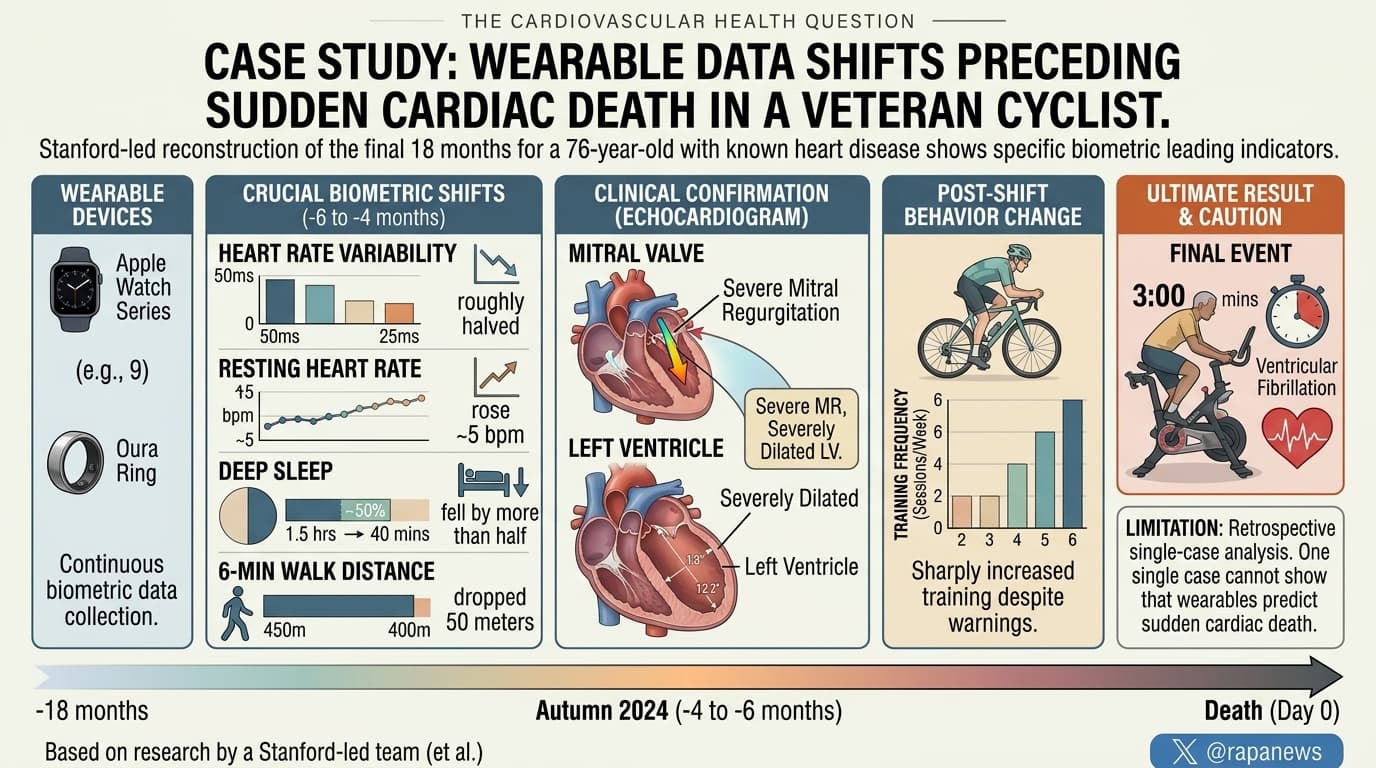
A Stanford-led team reconstructed the final 18 months of a 76-year-old cyclist with known structural heart disease who died of ventricular fibrillation three minutes after a hard Peloton session. His Apple Watch and Oura Ring recorded a coordinated shift in autumn 2024, four to six months before death: heart rate variability roughly halved, resting heart rate rose about 5 beats per minute, deep sleep fell by more than half, and estimated 6-minute walk distance dropped 50 meters. An echocardiogram in the same window showed severe mitral regurgitation and a severely dilated left ventricle. He then sharply increased his training frequency. The authors state plainly that one retrospective case cannot show that wearables predict sudden cardiac death.
On the evening of March 21, 2025, a 76-year-old man finished his 530th recorded Peloton workout. Three minutes later his Apple Watch registered a fall. His wife, a physician, started CPR and used the watch to call for help. Paramedics found ventricular fibrillation, and 39 minutes of resuscitation failed.
What makes the case unusual is the record he left behind. He had worn an Apple Watch for about five years and an Oura Ring for two, and had seven years of cycling logs and cardiac records. Researchers at Stanford, with colleagues in Bergen and Irvine, went back through all of it.
His heart was known to be damaged. In 2018, scans showed a scar from an old heart attack, a coronary calcium score of 1,350 and leaking mitral and aortic valves. By 2022 the mitral leak had worsened.
The wearable data show two clusters of change. The first, in spring 2024, followed hernia surgery and six weeks of enforced rest, and mostly involved walking and activity measures. The second, between late September and early December 2024, involved several body systems at once. His resting heart rate rose from 44 to 49 beats per minute. Two different devices recorded his heart rate variability falling by half or more. Deep sleep dropped from 39 to 18 minutes a night. His estimated walking capacity fell by about a tenth. None of these returned to their earlier levels.
During the same weeks he saw his primary care doctor for fatigue. A new murmur led to an echocardiogram on November 6, which showed a severely enlarged left ventricle and a severely leaking mitral valve. A cardiology appointment was eventually booked for a date that turned out to be 11 days after he died.
In the meantime he trained more, not less. In the first 79 days of 2025 he completed 69 indoor rides, more than in all of 2024, including a 24-day streak. His heart rate in the final session approached 150 beats per minute, above the simple age-based estimate of his maximum.
The authors argue that the signal worth watching is a sustained, multi-metric departure from a person’s own baseline, not any single abnormal reading. That is a reasonable hypothesis. It is not yet a tested one. The analysis was done after the outcome was known, there is no comparison with people whose wearables showed similar shifts and who did not die, and the autumn timing overlaps with seasonal change and a medication change.
There is also a less comfortable reading. The standard tools did work. A symptom, a stethoscope and an ultrasound identified severe valve disease four and a half months before death. What failed was the follow-through: the referral was slow and nobody told him to ease off. The wearable trace is a striking illustration, but the delay between the echocardiogram and the cardiology visit is the more direct lesson.
Actionable Insights
This paper tests no treatment, so there is no benefit to quantify. What it offers is a pattern to watch for, with the following magnitudes in one man.
Changes after the autumn 2024 shift, comparing 30 days before and after:
- Heart rate variability: down 49 percent (Apple Watch) and 65 percent (Oura)
- Resting heart rate: up 4.6 beats per minute, about 10 percent
- Deep sleep: down 21 minutes a night, about 54 percent
- Estimated 6-minute walk distance: down 50 meters, about 11 percent
Practical points:
- Track your own baseline. A sustained shift across several metrics lasting weeks matters more than a bad night. [Confidence: Low to Medium, based on one case]
- If you have known heart disease, unexplained fatigue plus this kind of shift is a reason to ask for re-evaluation, not a reason to train through it. [Confidence: Medium]
- If imaging shows severe valve disease or a dilated ventricle, get specific exercise limits from a cardiologist before the next hard session. Do not wait months for the appointment. [Confidence: High, consistent with standard practice]
- Wearables cannot rule out danger. Normal numbers do not mean a safe heart. [Confidence: High]
Context and Source
- Open Access Paper: Longitudinal Changes in Wearable-Captured Physiology Before Sudden Cardiac Death
- Institutions: Stanford University (lead and corresponding), University of Bergen, University of California Irvine
- Country: USA, with Norway
- Journal: JACC: Case Reports (Elsevier, for the American College of Cardiology Foundation)
- Impact evaluation: The journal’s 2025 two-year impact factor is listed as 0.68. The impact score of this journal is 0.68, evaluated against a typical high-end range of 0 to 60+ for top general medical and science journals, therefore this is a Low impact journal.