Verteporfin for Scar-less Skin Repair, and Hair Transplant Growth

Just aggregating a number of different posts from around the site around a common theme:

Researchers have identified the mechanism of scar formation in skin and demonstrated in mice a way to make wounds heal with normal skin instead of scar tissue.

Preventing Engrailed-1 activation in fibroblasts yields wound regeneration without scarring

https://www.science.org/doi/10.1126/science.aba2374

https://www.nytimes.com/2021/04/22/health/surgery-scar.html

Verteporfin sourced from India, (About 80 rupees to the US$, so divide these prices below by 80, so $13 to $30 per 15 mg vial or so for India-brand verteporfin)

https://www.rapamycin.news/t/how-to-reverse-skin-aging/3941/976?u=rapadmin

Use of Verteporfin to Regrow Hair and Reduce Fibrosis after Transplantation

journal-of-dermatology-research-and-therapy-ijdrt-11-131.pdf (433.7 KB)

8 Likes

Doesn’t seem to offer much help for established scars.

1 Like

Maybe I missed it. How is it administered for scars? Normally that medication is given IV.

I believe its injected into the wounds.

2 Likes

I’d be interested to see this used on the face in a sort of mesotherapy, lots of small subQ injections all over the face.

1 Like

After 4 months of trying different creams, including corticosteroids, I just ordered a rapamycin cream (0.2% concentration). Fingers crossed that the dear :blush: rapamycin can help to heal some scars.

(Haha, I just earned “first emoji!”. Thank you :blush:)

1 Like

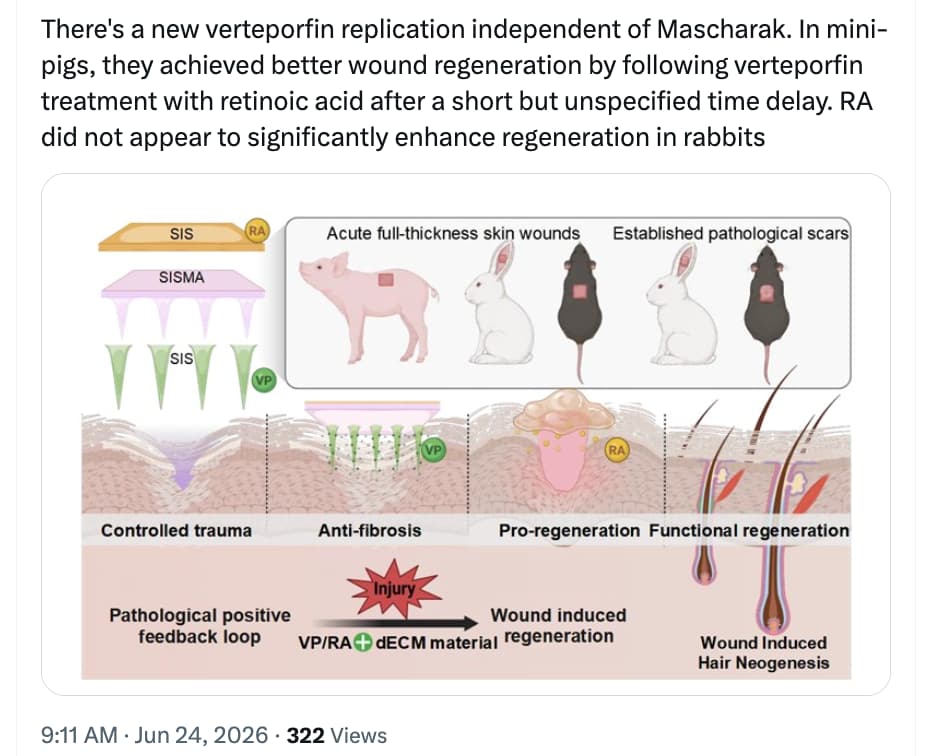
Controlled microtrauma opens a regenerative window for appendage-bearing skin repair

https://www.biorxiv.org/content/10.64898/2026.06.18.732512v1.full.pdf

Wound It to Heal It: A Patch That Weaponizes Injury to Regrow Hairy Skin Instead of Scars

Researchers built a dissolving microneedle patch that turns the tiny wounds it creates into a regenerative trigger, delivering an anti-scarring drug first and a hair-follicle-promoting signal second. In scar-prone rabbit ears and human-like pig skin, the staged combination closed wounds faster, suppressed scar tissue, and produced new hair follicles.

For all of modern medicine’s sophistication, adult human skin still heals the way it did for our ancestors fleeing predators: fast and ugly. The body slams a wound shut with stiff, disorganized collagen, prioritizing infection control over fidelity. The price is a scar, permanently stripped of hair follicles, sweat glands, and the other “appendages” that make skin functional rather than merely intact.

A team from Sichuan University and Shanghai Jiao Tong University has now tested a counterintuitive idea: what if the injury itself, delivered precisely, could be turned into a regenerative opportunity rather than a problem to be patched over?

Their device is a hierarchical microneedle patch made from pig-derived extracellular matrix. The needles do two jobs. First, they puncture the skin in a controlled, patterned grid, creating an array of micro-injuries. Decades of work has shown that wounding can, under the right conditions, reawaken the skin’s latent ability to grow new hair follicles. Second, the patch acts as a timed drug dispenser. The needle tips dissolve quickly, releasing verteporfin, a drug that blocks the mechanical-stress signaling (via the protein YAP) that drives fibroblasts to lay down scar. The patch’s backing layer then slowly releases retinoic acid, a vitamin A derivative that nudges skin toward growing follicles.

The logic is sequential: first remove the scarring brake, then press the regenerative accelerator.

The researchers tested this in two animals chosen deliberately. Rabbit ears scar aggressively, making them a hard test. Bama miniature pigs have skin architecture genuinely close to ours, the gold standard for translational relevance. In both, the full combination patch (dubbed VR@SM) outperformed every alternative: faster wound closure, markedly less dense scar collagen, and, strikingly, visible hair shafts and microscopically confirmed follicle structures inside healed wounds.

Patches loaded with only one drug helped partially but never reproduced the full effect, suggesting the two cues are genuinely complementary, not redundant.

The big idea is a reframing of the microneedle from a passive delivery vehicle into an active regenerative instrument. If it holds up, the approach points toward treatments for burns, surgical wounds, and excised pathological scars that restore living, hair-bearing skin rather than inert patches. The substantial caveats: this is preliminary, the animal numbers are tiny, and the underlying data has not yet been released or peer reviewed.

Actionable Insights

  • The single quantified effect is real but fragile. The scar-elevation index in the full-combination rabbit group fell to 33.88% of the untreated control, a roughly 66% reduction in scar prominence. That is a large apparent effect, but it rests on n=3 animals, so the confidence interval is almost certainly wide and not reported.
  • Mechanistic takeaway, not a protocol: the data reinforce that suppressing fibrosis and supplying a regenerative signal are separable, complementary levers . Anti-fibrotic action alone (verteporfin) or pro-regenerative action alone (retinoic acid) underperformed the combination. This is conceptually relevant to anyone thinking about scar management or topical retinoid use.

Context

  • Institutions: West China Hospital / West China School of Medicine, Sichuan University (Chengdu); Shanghai Ninth People’s Hospital, Shanghai Jiao Tong University School of Medicine (Shanghai).
  • Country: China.
  • Publication venue: bioRxiv (preprint server). DOI 10.64898/2026.06.18.732512.

Cost vs. Effect

This is where “tell it like it is” matters most: the cost-effective move is to do nothing with this paper. The drugs are cheap; the device that makes them work in sequence is the entire intervention, and it does not exist. Buying verteporfin and tretinoin and applying them to an open wound at home would:

  1. Reproduce neither the staged release kinetics nor the patterned microtrauma that the paper’s own single-cue arms show are necessary.
  2. Apply a YAP inhibitor and a teratogenic differentiation agent to broken skin with zero wound-bed safety data.
  3. Risk impaired healing, infection, and irritation with no validated benefit.

How did the rapamycin cream work for you?

1 Like

A 2025 paper:

Inhibiting mechanotransduction prevents scarring and yields regeneration in a large animal model

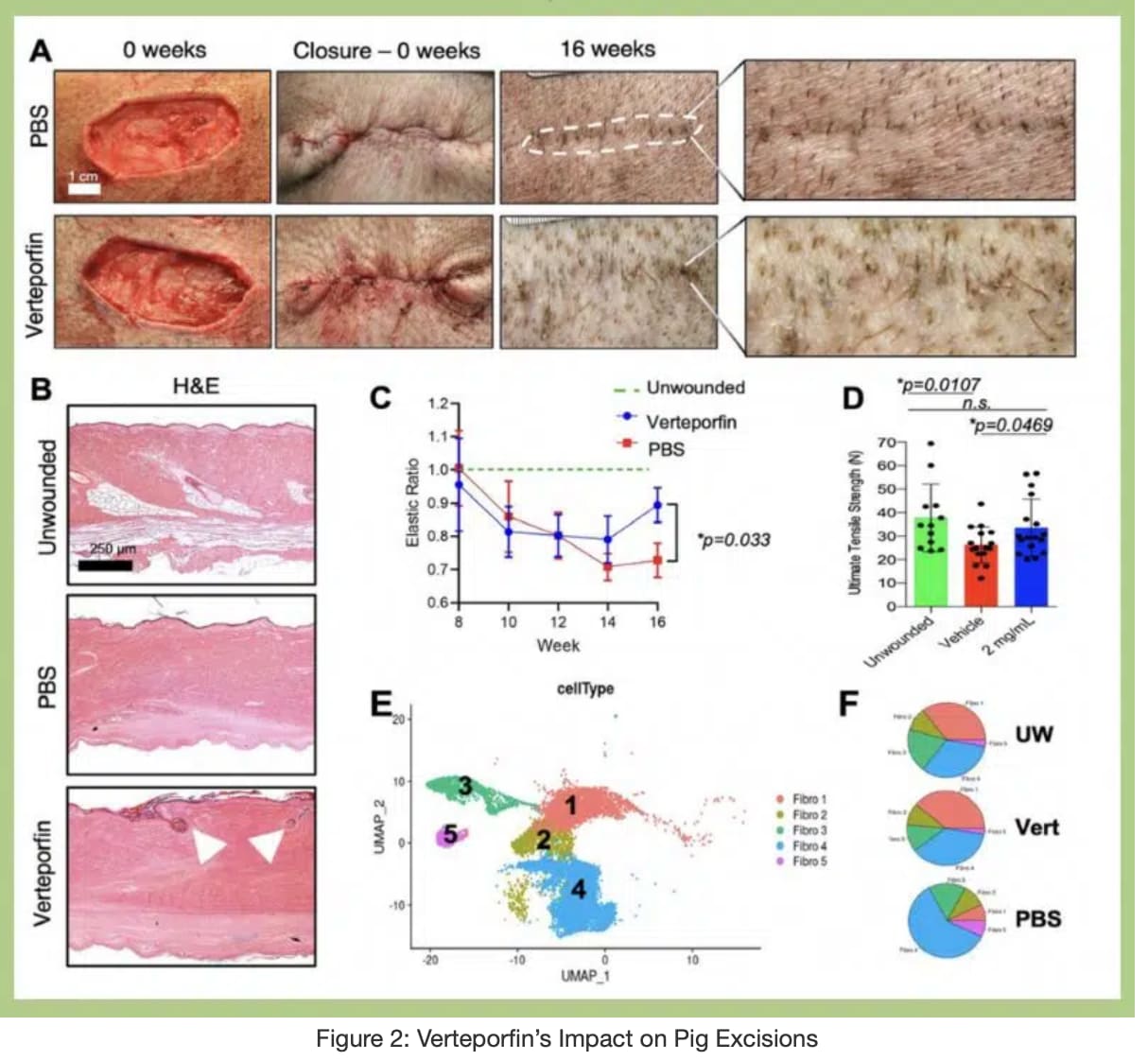
A single local injection of verteporfin, an old macular-degeneration drug, at the moment of wounding stops scars from forming and instead regrows near-normal skin (hair follicles, fat, and proper collagen architecture) in the pig model that most closely mimics human scarring, with the same effect confirmed in grafted human skin and traced to a YAP/IL-33 signaling switch.

Almost every adult human wound heals by scarring. Scar tissue is a biological compromise: it closes the breach but cannot reproduce the strength, flexibility, hair, glands, or sensation of the skin it replaces, and there is still no approved drug that prevents it. A Stanford-led team has now taken a major step toward changing that.

Building on earlier mouse work, the researchers tested verteporfin, a drug already approved for eye disease, in red Duroc pigs, widely regarded as the closest animal stand-in for human scarring because their skin is tight and high-tension like ours. A single injection into the wound edges at the time of surgery was enough. Sixteen weeks later, treated wounds showed almost no visible scar, regrew hair follicles and subcutaneous fat, and recovered the loose “basketweave” collagen pattern and mechanical properties of uninjured skin. Untreated wounds formed the expected dense, stiff, hairless scar.

The drug works by blocking YAP, a protein that translates the physical tension of a wound into a pro-scarring genetic program inside skin fibroblasts. Using single-cell sequencing of more than 75,000 cells plus spatial mapping, the team showed that verteporfin shifts the balance of fibroblast populations away from a scar-forming state and toward a regenerative one, and reroutes incoming immune cells away from fibrosis-promoting “fibrocytes” toward repair-type macrophages.

A striking mechanistic twist: the regenerative state depends on interleukin-33 (IL-33), an immune alarm signal. When the team blocked IL-33 in treated wounds, regeneration collapsed, and some wounds failed to heal at all. IL-33 appears to be a backup healing pathway that becomes essential once the normal tension-driven route is switched off.

Crucially, the effect held up in human skin grafted onto mice, and the relevant fibroblast populations were conserved between pig and human. Reassuringly, the locally injected drug barely entered the bloodstream and caused no detectable organ or skin toxicity.

The “big idea” is that scarring is not an inevitable feature of adult repair but a tension-driven choice that a single, well-timed drug dose can override, pushing the body toward regeneration. This pig and human-graft evidence is what de-risks the leap to people, and a first human trial has now begun.

Actionable Insights

This is a clinician-administered, injectable intervention delivered at the moment of wounding, using a drug that is not approved for scar prevention. Self-injection of verteporfin into wounds is not a supported protocol and is not advisable.

What is genuinely actionable is what to watch and how strong the signal is. The effect size is unusually large for a fibrosis intervention. On the 1 to 10 Visual Analog Scale (1 = severe scar, 10 = normal skin), treated wounds scored roughly 4 to 5 points higher than controls, about 45 to 55 percent of the entire usable scale, at every time point. Mechanically, treatment normalized both ultimate tensile strength and stiffness (Young’s modulus) back to unwounded-skin values, whereas scars are typically capped near 80 percent of normal strength while being abnormally stiff. In grafted human skin, collagen density in treated wounds fell back toward unwounded values, and vascularization (CD31) rose.

The practical watch-item: the same approach has now entered a Phase 2 human trial (SCARFREE-001), the first test of intradermal verteporfin for surgical-scar prevention. For anyone facing elective surgery in coming years, “ask whether a peri-incisional anti-fibrotic is available in trial settings” is the realistic near-term action, not anything to attempt independently.

Context

  • Open Access Paper: Inhibiting mechanotransduction prevents scarring and yields regeneration in a large animal model
  • Institution: Stanford University School of Medicine (Division of Plastic and Reconstructive Surgery; Institute for Stem Cell Biology and Regenerative Medicine), with NYU Langone Health and the Icahn School of Medicine at Mount Sinai.
  • Country: United States.
  • Journal: Science Translational Medicine, 2025, volume 17, issue 786, article eadt6387.
    Impact Evaluation: Current metrics (verified by live search): JCR 2025 Journal Impact Factor of 15.6 (Q1, ranked 3 of 195 in Medicine, Research and Experimental); CiteScore 21.3. Note one Scopus-derived aggregator reports an IF near 13.6; the Clarivate JCR figure of 15.6 is the standard reference, and the journal has been stable in the 14 to 17 band.

The impact score of this journal is 15.6, evaluated against a typical high-end range of 0 to 60+ for top general science, therefore this is a High impact journal

Hey, at the beginning I felt like the rapa cream was working really well, but after about a week the skin thing reversed. So I was like, okay, maybe I was using too much or too often. Or maybe I should have asked for 0,1% concentration… I paused it and then started applying the cream intermittently instead.
Unfortunately, even with the intermittent use, it stopped helping my skin at all…
Just so you don’t lose hope – I express cystic fibrosis. It’s mostly mild and subclinical when I’m doing well and managing my life properly. I’ve been digging into CF biomarkers a lot because medicine doesn’t give much support to people who have the genetics but don’t have the full-blown disease. There are tons of underdiagnosed cases out there. It affects the pancreas, lungs, GI system… it’s a bit complex. But the main thing I want to say is that CF is an epithelial problem. Lab studies show the mTOR pathway is involved in CF, and inhibiting mTOR can sometimes help with CFTR trafficking and stability in cells. So rapamycin might interact in a positive or different way in CF epithelium – but this is all speculative for topical use. My skin’s initial improvement then fade could be related to the CF, inflammation, mucus/skin barrier stuff, or just normal individual variation. A lot of people without CF also say the results aren’t consistent long-term.
If I can give you one tip: start the rapa cream intermittently (maybe twice a week) and with a really thin layer right from the beginning. Don’t take the cream for granted at any point! Hope for the best!

1 Like