I was not on a break from Rapa when I had my Shingrex done. My reaction was pretty normal and mild - mild pain, mild headache - for 2 days which was not so bad.
2 Likes
If the idea of a vaccine is to train the immune system then i want my immune system fully functioning to do the training.
I took a complete break from Rapa when doing the Shingrix pair of injections.
But but…
I don’t remember all the details but Rapamycin increased the effectiveness of a flu vaccine back many years ago.
Then there is this.
https://www.nature.com/articles/s41577-018-0052-0
Enhanced formation of memory CD8+ T cells… By several authors
Rapamycin is an immune modulator rather than an immune suppressant. Not sure the answer regarding your shingles vaccine. But the answer is not clear cut.
flemming2018.pdf (519.5 KB)
5 Likes
You are absolutely right, it is not clear cut and i could be totally wrong. But I don’t stop months in advance of a vaccine, only 3-4 weeks.
Taking a break does no harm.
1 Like
My understanding is that rapamycin lowers innate immunity => side effects like fever, etc.
But boosts formation of CD8+ T cells, etc…
I’m not sure about the antibody responses and how they’re effected while on rapamycin, but yes, the Mannick et. al trial showed that there is a boost after everolimus + a washout period of a week
Yep, here’s a write-up about the 2018 mannick study
2 Likes
I just got mine and I’ve had a rough 24 hours. My HRV tanked and my heart rate didn’t get below 82 during the night.
It better be worth it.
4 Likes
My wife actually got shingles a few years ago, and that looked super brutal. (And she later got the vaccine, and had almost no reaction). Either way, I’d like to believe that shingles is worse than whatever the vaccine can throw at us!
Which reminds me, I also keep intending to get the vaccine, but keep procrastinating it.
Also, @Beth you were going to ask your doctor about HPV vaccination etc, or self-paying. Did you get anywhere with that?
4 Likes
@relaxedmeatball I’ve said the same… you don’t want the side effects from the shingles vax… well, I imagine you won’t enjoy them from a case of shingles either.
I’m always impressed by your memory! Yes, I did run it by my doc, and he said it made a lot of sense because they give the vax to people with throat cancer.
I had it scheduled at CVS (one of the largest US pharmacies) and they cancelled on me for being too old (RUDE)! I even called them and said I have a perscription from my doc, but they said CVS will not give any hpv vax to anyone over age, period (I’m in California, so I found that shocking).
Instead, I walked into Safeway and they happily gave me one and never asked to see my rx. I almost fell over when they told me my insurance would cover it 100% (my insurance is mostly useless)
The young woman giving the shot looked at me and my husband like there was something seriously wrong with us 
On that note, I’ve been meaning to follow up to ask if we should get the second shot in the series. If I recall, you might have said one shot is enough for our ancient selves, or do we just go ahead and get all of them … any downside?
Fwiw, I was told there might be some side effects from the shot that would last a day or two, but there were none for me. I felt a little freaky for about a minute after the shot which was unlike anything I’ve experienced, and nerve wracking, but it quickly dissipated.
1 Like
Multiple large observational studies have found that routine adult vaccines are associated with a reduced risk of dementia, with some showing risk reductions of 25% to 40%.
The strongest evidence exists for shingles, flu, RSV, pneumococcal and diphtheria, tetanus and pertussis-containing (DTP) vaccines.
Researchers believe vaccination may reduce dementia risk by preventing infections that cause brain inflammation, though some evidence points to a more general immune effect.
Associations:
- Shingles vaccine Shingrix 18% lower risk of dementia over 18 months
- RSV vaccine Arexvy 29% lower risk of dementia over 18 months (same AS01 adjuvant as Shingrix)
- Flu vaccine, two doses, 40% lower risk of dementia over 4 years
Flu vaccine high dose: 55% lower risk of dementia - Tetanus, diphtheria and pertussis (Tdap) or Td (without pertussis) 30% lower risk of dementia over 8 years, second study 31% lower risk, third study 33% lower risk
- Pneumococcal vaccine, 27% lower risk of dementia
- Hepatitis A vaccine, 22% lower risk of dementia
- Hepatitis B vaccine, 18% lower risk of dementia
- Typhoid vaccination, 20% lower risk of dementia
5 Likes
lol
Around 90-95% of adults worldwide have been infected with Epstein-Barr virus (EBV)
2 Likes
Nothing new here, just a good summary:
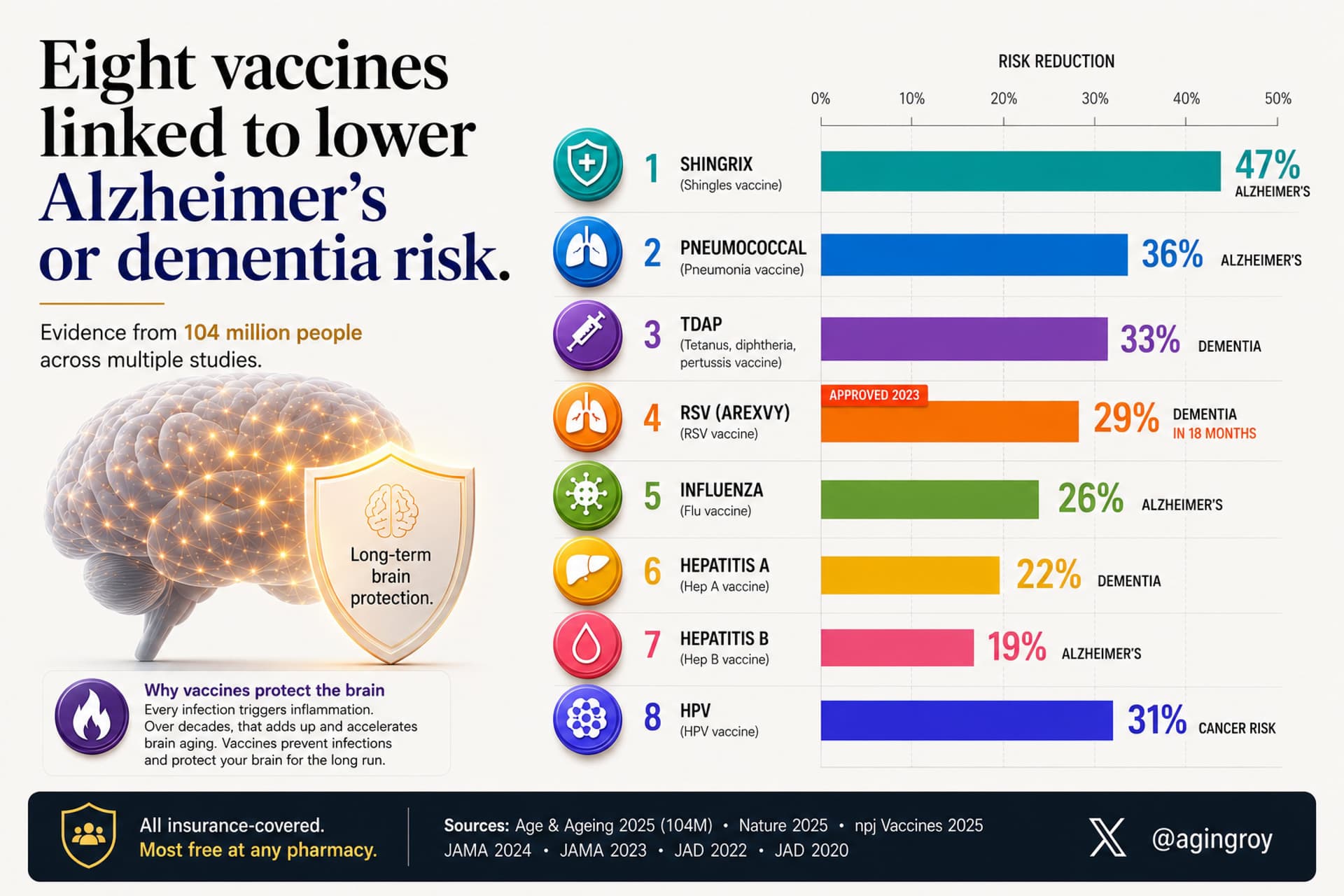
The strongest evidence-based tool for preventing Alzheimer’s and dementia may already be sitting in your shot record.
104 million people. 8 vaccines. All showing protection against brain diseases they were never designed to prevent.
Ranked by how much they lower Alzheimer’s and dementia risk:
→ Shingrix (shingles): 47% lower Alzheimer’s risk. Meta-analysis, 104 million people (Age and Ageing 2025). A separate Wales natural experiment (Nature 2025, n=280,000) confirmed a 20% dementia reduction independently.→ Pneumococcal: 36% lower Alzheimer’s risk. People carrying the APOE risk gene saw a 25-30% reduction in a separate study of 5,146 people.
→ Tdap: 33% lower dementia risk. Same 104-million-person meta-analysis.
→ RSV (Arexvy): 29% lower dementia in 18 months. This vaccine was approved in 2023. It’s one of the newest vaccines in existence, and it’s already generating a brain-protection signal nobody predicted.
→ Influenza: 26% lower Alzheimer’s risk with 1+ year of consecutive annual shots (JAMA 2024).
→ Hepatitis A: 22% lower dementia risk. Same 104M meta-analysis.
→ Hepatitis B: 19% lower Alzheimer’s risk. Observational, n=50,000+.
→ HPV: 31% lower infection-associated cancer risk (JAMA 2023, n=1.4 million women).
All insurance-covered. Most free at any pharmacy.
The hypothesis connecting all eight is that every infection leaves behind a trace of inflammation. Over decades, that chronic low-grade fire accelerates neurodegeneration. Vaccines reduce the number of infections your brain has to weather across a lifetime.
Your vaccine schedule was already an Alzheimer’s prevention protocol. Nobody framed it that way until now.
Source: https://x.com/agingroy/status/2053495233405386901?s=20
5 Likes
The % are way higher than what the papers say (Shingles the average of papers is around 20%). (This doesn’t weaken the message that one should get vaccinated but it’s unprofessional.)
4 Likes
Scientists in Japan say a common amino acid already sold as a dietary supplement may help slow key processes linked to Alzheimer’s disease.
In a study published in Neurochemistry International, researchers found that arginine reduced the buildup of toxic amyloid β (Aβ) proteins in both fruit fly and mouse models of Alzheimer’s disease (AD). The compound also appeared to ease brain inflammation and improve behavioral performance in mice.
Arginine is not a new experimental drug. It is a naturally occurring amino acid involved in functions such as blood flow, immune signaling, and wound healing, and it already has an established medical safety record in several conditions.
2 Likes
Note: Pfizer funded.
Real-world effectiveness of 20-valent pneumococcal conjugate vaccine against all-cause outcomes among Medicare beneficiaries aged 65 years and older in the USA: a retrospective cohort study
https://www.thelancet.com/journals/laninf/article/PIIS1473-3099(26)00115-5/abstract
“PCV20 vaccination was associated with a lower risk of all invasive pneumococcal disease, all pneumococcal pneumonia, all-cause pneumonia, and LRTI among adults aged 65 years or older in the USA compared with no PCV20 vaccination.”
2 Likes
Newly approved mRNA flu vaccine provides a more effective flu shot for older adults
In the pivotal phase 3 trial, the mRNA vaccine was as effective in participants 65 years or older as it was in trial participants overall, although whether its clinical efficacy is superior to that of the high-dose or other enhanced flu vaccines remains to be seen.
With a median follow-up of 181 days, the phase 3 trial found that the mRNA vaccine across all ages was approximately 27% more effective in preventing polymerase chain reaction–confirmed illness caused by any influenza A or B strain than the standard dose comparator vaccine, researchers reported in May. About 2% of participants who received the mRNA vaccine were diagnosed with the flu, compared with 2.8% who received a comparator vaccine.
Among the more than 19 000 trial participants who were at least 65 years of age, the mRNA vaccine’s relative efficacy was the same as that for all ages, which suggests benefits similar to those of high-dose and other enhanced influenza vaccines in the oldest adults, according to the authors. (Previous research has shown that the relative efficacy of high-dose flu vaccines vs standard-dose shots is about the same as that of the mRNA flu vaccine vs standard-dose shots, Goodman explained.)
Overall, those who received the mRNA vaccine were more likely to report experiencing the adverse events researchers asked about, including injection site pain, fatigue, headache, and muscle aches, which have also been seen after immunization with mRNA COVID-19 vaccines. Most adverse events were mild to moderate and transient, the scientists noted.
In another Moderna-sponsored phase 3 trial, researchers studied the immunogenicity of mRNA-1010 compared with a standard-dose comparator vaccine in adults ages 18 through 64 years or the high-dose flu vaccine in about 3000 people 65 years or older. The mRNA vaccine demonstrated an immune response superior to both the comparator vaccines, the scientists reported in February 2025.
“Based on immunogenicity data, this vaccine will perform in a superior manner” to the high-dose vaccine, Osterholm said. “Obviously, they’re going to be doing postmarketing evaluation.”
Accelerated approval is based on surrogate end points, in this case the immunogenicity data for people 65 years or older. Higher immunogenicity, such as increased neutralizing antibody titers, often correlates with better protection, but Moderna must confirm its vaccine’s clinical benefit in a postmarketing trial involving individuals who are at least 65 years old.
According to the FDA briefing document for the June VRBPAC meeting, the postmarket, or phase 4, confirmatory study will enroll approximately 400 000 adults 65 years or older in each of 2 flu seasons. Vaccine clinics that administer the shots will alternate weekly between mRNA-1010 and an agreed upon CDC-recommended vaccine throughout the flu seasons.
4 Likes
not an expert, and not to get political, and I haven’t read on vaccine studies much lately, but I’d like to see if the mRNA vaccines have the same protection as live attenuated in terms of the overall impact on health… Aren’t a lot of the studies on vaccines that promote anti cancer affects and affects against cognition of the more natural to the body vaccines like the dead virus than mRNA? Frontiers | Repurposing Infectious Diseases Vaccines Against Cancer
Will be interesting to see long term data on that. Maybe I’m behind on the studies of how the Covid vaccine is playing out long term
1 Like
No? We have the shingles example. The earlier vaccine, Zostavax, used the live (attenuated) virus, whereas the newer vaccine, Shingrix used only a virus protein fragment, recombinant. Not only is Shingrix vastly more protective and longer lasting against shingles compared to Zostavax, but in comparing the effectiveness at lowering dementia risk Shingrix again outperforms Zostavax.
As to mRNA vaccines, in general they are highly effective, outperforming live or attenuated pathogens based vaccines, though of course each case needs clinical proof - specific cancer etc.
In general however mRNA vax seem to be the bees knees.
1 Like