Vaccines for longevity

I’m really sorry to hear about your daughter. However, I think the “damage to immune system” from vaccines is over-rated. If you actually get a viral infection, that virus enters your cells, multiplies, escapes, spreads etc. The number of viral copies increases over time until you start to deal with it (or die). Many viruses alter your DNA by integrating into the genome (like how HPV or HepB cause cancer). A vaccine exposes your body to a small amount of antigenic material, which does not replicate, does not spread anywhere near as much.

If we take HepB for example (which I understand because I received this vaccine, and did mandatory training about it); a common vaccine dose is 10µg for kids and 20µg for adults. That’s a single protein antigen (HBsAg). However, if you actually get HepB, your HBsAg level in the blood is measured in milligrams per ml - i.e. there are literally grams of it in your body - 1,000x more than the vaccine. Plus of course all the other viral protein aside from HBsAg. And for a vaccinated person, they will generally be negative for HBsAg in the blood even after exposure, because antibodies neutralise it. So as a net, vaccination exposes you to far less viral proteins, and should be less stressful for the immune system.

I don’t disagree with you, but surely that question is far too complex to try answer here, let alone evaluate whether vaccines are related. There are genetic differences, cultural differences, healthcare system differences etc. In the US now, teachers and everybody are hyper-aware and doctors are relatively quick to diagnose autism/ADHD etc. When I was a kid, there were definitely kids in my class who were odd, troublemakers etc. Today they’d all be diagnosed with something.

One theory I’ve heard is maternal and paternal age correlates with neurodevelopment disorders. But I am pretty sure HK has generally older people having kids than the US, which is interesting.

5 Likes

I think some of the neurodevelopment disorders have links to mitochondrial issues and those are associated with the mtDNA germline which is a multigenerational, but maternal only issue as mtDNA is derived only from the mother and not the father.

2 Likes

HPV vaccination was associated with significant reductions in the risk of hypopharyngeal and laryngeal carcinomas (8-year HR: 0.19; 95 % CI: 0.057–0.631; p = 0.0025; 20-year HR: 0.227; 95 % CI: 0.067–0.764; p = 0.0092) and leukemia (8-year HR: 0.461; p = 0.0035; 20-year HR: 0.443; p = 0.0019). No significant protection was observed for rectal, anal, oral cavity, or prostate cancers. All-cause mortality was reduced by nearly half among vaccinated individuals (8-year HR: 0.543; 20-year HR: 0.536; both p < 0.0001). Beyond epithelial malignancies, HPV vaccination may confer systemic cancer protection, particularly in hematologic and potentially neuronal tissues. These findings suggest a broader biological impact of HPV vaccination than previously recognized and underscore the need for mechanistic studies investigating HPV’s oncogenic pathways. If validated, these results could prompt the expansion of vaccination strategies to encompass broader indications and wider population coverage.

HPV vaccination and malignancy risks beyond cervical cancer: A retrospective global cohort study

4 Likes

Key issues include the inability of retrospective studies to prove direct causation, the influence of confounding factors like health-seeking behavior and baseline health status, potential observational biases, insufficient data on prior sexual activity, and limited generalizability of findings from the specific dataset used. The reported protective effect on non-HPV cancers like leukemia also lacks a known biological mechanism, making the finding speculative.

Like I should talk.

Water is wet.‎ ‎ ‎ ‎ ‎ ‎

4 Likes

If we are on the cusp of vaccines that prevent cancer mortality, the impact on quality life years could be huge. It may or may not add many years to life expectancy, but it would be huge for quality of life and preventing tragic premature deaths. Beyond that, the impact on healthcare spending could be huge. Less money for acute cancer care would mean way more resources available for longevity.

4 Likes

Vaccines research has huge potential for all sorts of diseases. If we can induce broadly neutralizing antibodies in adult humans that would eradicate covid and HIV. And various cancer types could also be detected and destroyed.
Still, an aging immune system would end up producing fewer and fewer antibodies so we need to address that too.

3 Likes

People with some cancers live longer after a COVID vaccine

mRNA vaccines seem to boost the effectiveness of an immune therapy for skin and lung cancer ― in an unexpected way.

A vaccine that helps to fight cancer might already exist. People being treated for certain deadly cancers lived longer if they had received an mRNA-based vaccine against COVID-19 than if they hadn’t, finds an analysis of medical records.

Follow-up experiments in mice show that the vaccines have this apparent life-extending effect not because they protect against COVID-19 but because they rev up the body’s immune system1. That response increases the effectiveness of therapies called checkpoint inhibitors, the animal data suggest.

“The COVID-19 mRNA vaccine acts like a siren and activates the immune system throughout the entire body”, including inside the tumour, where it “starts programming a response to kill the cancer”, says Adam Grippin, a radiation oncologist at MD Anderson Cancer Center in Houston, Texas, an co-author of the report published today in Nature. “We were amazed at the results in our patients.”

The findings, which Grippin and his colleagues hope to validate in a clinical trial, suggest further hidden capabilities of mRNA vaccines, even as the administration of US President Donald Trump has slashed about US$500 million in funding for research investigating the technology.

Read the full story: People with some cancers live longer after a COVID vaccine (Nature)

6 Likes

While vaccines for cancer are an exciting idea that may help, such vaccines can only ever be partially effective. We will still need to find cures for all the cancers that would escape such vaccines.

1 Like

I posted this in the Parkinson’s thread, but also wanted to post it here:

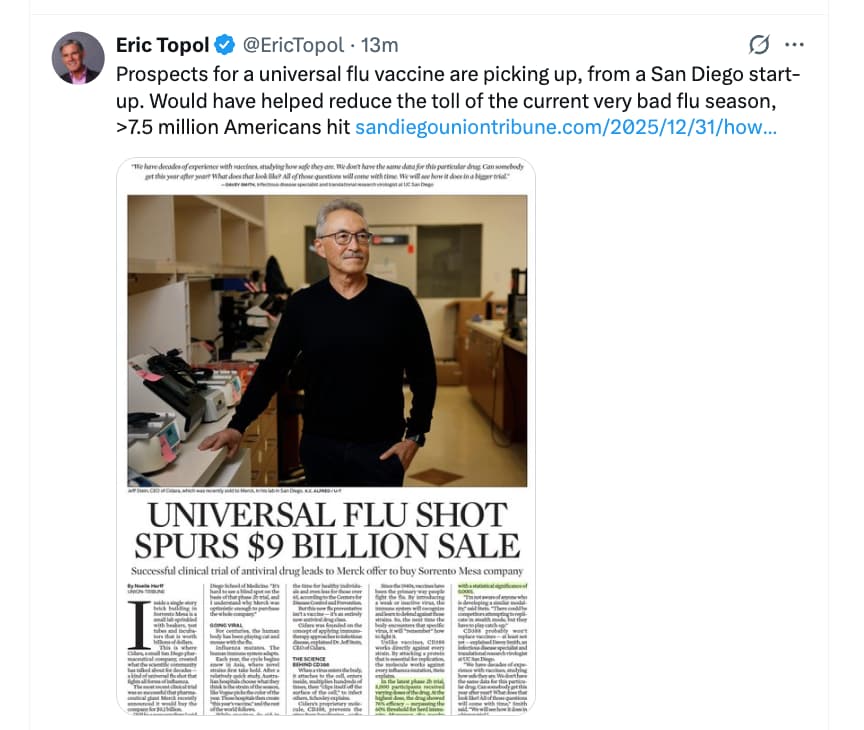
Catching the flu increases your risk of Parkinson’s disease by 90% 14 years later. “The risk was specific for influenza, not any other infectious disease, and this increased risk showed up only a decade or more after the viral infection. Might getting vaccinated for seasonal influenza help stave off Parkinson’s? That’s an open question” Quite simply, if we can avoid infection, will we avoid neurodegeneration? This is a huge downstream benefit of @Centivax’s universal flu vaccine program — one shot to end them all.

Shingles too: “Vaccination had a pronounced protective effect on the incidence of dementia. 1 in 5 new dementia diagnoses among unvaccinated people could have been averted by vaccination. If these are truly causal effects, then getting vaccinated for shingles is far more effective, far less risky and much less expensive than anything else out there now for dementia.” — From the current issue of https://stanmed.stanford.edu/infections-link-later-life-neurodegeneration/ P.S. pregnant women who get influenza in their second trimester give birth to children who are 7x more likely to have schizophrenia in adulthood.

6 Likes

How a childhood virus can contribute to dementia later and what you can do

A new study suggests that the shingles vaccine may help prevent dementia by reducing the risk of varicella-zoster virus reactivation

One of the largest studies ever conducted on the link between the shingles vaccine and brain health offers insight into how the disease increases dementia risk.

People who experienced multiple episodes of shingles had a higher risk of dementia for several years after the second outbreak, the study found, compared with those who had it only once.

The findings, published recently in the journal Nature Medicine, provide additional evidence for why getting vaccinated for shingles could help protect the brain.

Shingles stems from the varicella-zoster virus, which causes childhood chickenpox and hibernates in the nervous system. As people age, the virus reactivates but often is “beaten back down by the immune system,” said Pascal Geldsetzer, a professor of medicine at Stanford University and one of the study’s authors. But sometimes, he said, “it reactivates fully” and then you get shingles’ telltale symptoms, the burning, tingling, painful blisters and rash.

Both versions of the vaccine — one with a version of the live virus and one without — reduce those reactivations and the risk of dementia, the study found.

Full story: How a childhood virus can contribute to dementia later and what you can do (WaPo)

4 Likes

Disappointing. What if you have not had “childhood varicella-zoster virus” that can be reactivated? At that point the vaccine is useless against dementia? If so, I’m disappoint, man, disappoint. Oh well. Got it anyway.

Another day, another virus linked to a horrible disease. This time, EBV linked to Lupus:

“We think it applies to 100% of lupus cases,” said Prof William Robinson, a professor of immunology and rheumatology at Stanford University

EBV is typically a mild illness which causes a sore throat, fever and tonsillitis. By adulthood, about 19 out of 20 people become infected and – since the virus deposits its genetic material into DNA – carry the dormant virus in their cells.

In the control group, fewer than 1 in 10,000 B cells hosted EBV, compared with about 1 in 400 cells for the lupus group – a 25-fold difference. EBV was also more likely to be found in autoreactive B cells.

The presence of the dormant virus appeared to flip these cells into a hyperactive state in which they not only targeted antigens inside the body, but recruited other immune cells, including killer T-cells, to join the attack.

The full paper is here: https://www.science.org/doi/10.1126/scitranslmed.ady0210

Also, the same virus (EBV) has been linked to multiple sclerosis: Epstein–Barr virus as a leading cause of multiple sclerosis: mechanisms and implications | Nature Reviews Neurology

5 Likes

Good news is that vaccines are under development but appear to only be in Phase I.

There is no licensed vaccine for the Epstein-Barr virus (EBV) available to the public. However, several EBV vaccine candidates are in clinical trials, including an mRNA vaccine and nanoparticle-based vaccines that are being tested for safety and their ability to stimulate an immune response. Research is ongoing to develop a vaccine that can prevent EBV infection and associated diseases.

Current status of EBV vaccine development

  • No approved vaccine: As of now, no vaccine has been approved by regulatory bodies like the FDA.
  • Clinical trials: Multiple vaccines are in the early stages of clinical trials, such as Phase I studies.
  • Targeting EBV proteins: Many vaccine candidates are designed to target specific EBV proteins, like gp350, to trigger an immune response that can fight the virus.
  • Different vaccine platforms: Researchers are exploring various platforms, including mRNA and nanoparticle technology.
  • Ongoing research: Studies are continuing to understand how to best prevent EBV infection and EBV-related illnesses like infectious mononucleosis and multiple sclerosis.
3 Likes

Good news for future generations most likely, as most of us have already been exposed. I got mononucleosis my first year of college.

1 Like

More info:

The Epstein-Barr virus (EBV), which resides silently inside the bodies of 19 out of 20 Americans, is directly responsible for commandeering what starts out as a minuscule number of immune cells to go rogue and persuade far more of their fellow immune cells to launch a widespread assault on the body’s tissues, the scientists have shown.

The findings were published Nov. 12 in Science Translational Medicine.

“This is the single most impactful finding to emerge from my lab in my entire career,” said William Robinson, MD, PhD, a professor of immunology and rheumatology and the study’s senior author. “We think it applies to 100% of lupus cases.”

4 Likes

A stunning new study offers early evidence that COVID-19 vaccines might have a secret superpower: a precisely timed mRNA shot could help many cancer patients live longer.

The work still requires validation, but the strength of the signal in the study — which analyzed differences in outcomes between cancer patients who did and did not receive mRNA vaccinations during the pandemic — should be sufficient motivation to direct resources toward quickly obtaining a definitive answer.

COVID-19 vaccines are inexpensive, widely distributed and easily accessible at most local pharmacies, such as CVS. If the findings hold true, they could offer a simple and cost-effective way to improve patients’ lives.

3 Likes

I hope more details were available of this project…

1 Like

Shingles vaccine may actually slow down dementia, study finds

If these findings are confirmed, “then this would be groundbreaking for dementia,” an expert said.

A common vaccine meant to ward off shingles may be doing something even more extraordinary: protecting the brain.

See:
Earlier this year, researchers reported that the shingles vaccine cuts the risk of developing dementia by 20 percent over a seven-year period.

A large follow-up study has found that shingles vaccination may protect against risks at different stages of dementia — including for people already diagnosed.

The research, published Tuesday in the journal Cell, found that cognitively healthy people who received the vaccine were less likely to develop mild cognitive impairment, an early symptomatic phase before dementia.

AI Icon

Crucially, the study suggests that the shingles vaccine — two doses of which are recommended for adults 50 and older or those 19 and older with a weakened immune system — may help people who already have dementia. Those who got the vaccine were almost 30 percent less likely to die of dementia over nine years, suggesting the vaccine may be slowing the progression of the neurodegenerative syndrome.

“It appears to be protective along the spectrum or the trajectory of the disease,” said Anupam Jena, a professor of health care policy at Harvard Medical School and a physician at Massachusetts General Hospital who reviewed the paper.

Read full story: Shingles vaccine may actually slow down dementia, study finds (Washington Post)

2 Likes