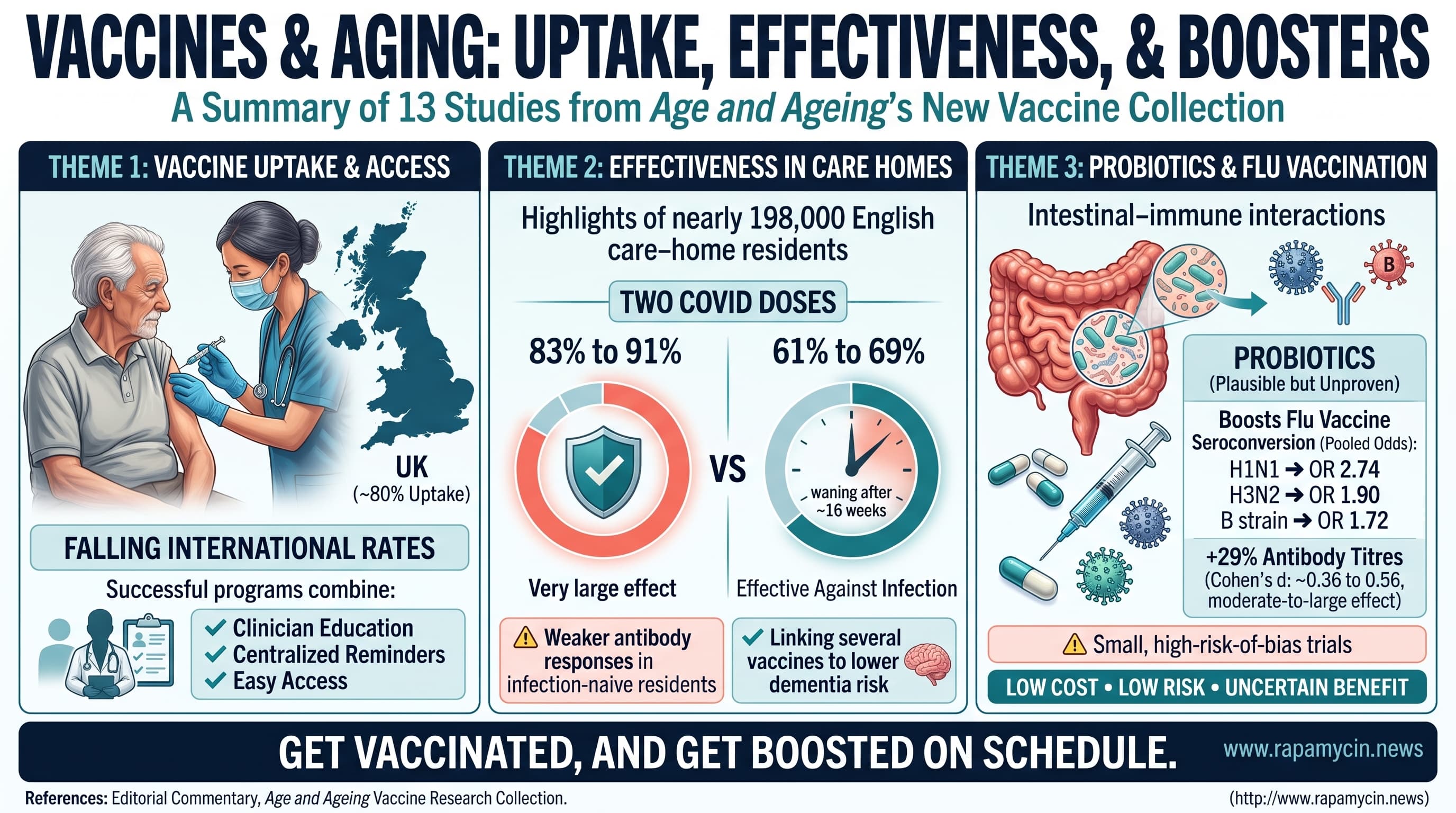
This is a short editorial commentary from the Editor-in-Chief of Age and Ageing and a co-author, written to launch the journal’s new online collection of vaccine research. It summarizes thirteen previously published papers across three themes. On uptake, it notes that influenza vaccination rates are falling internationally and that successful programs combine clinician education, centralized reminders and easy access, reaching roughly 80 percent in countries like the UK. On effectiveness, it cites a study of nearly 198,000 English care-home residents in which two COVID vaccine doses were 83 to 91 percent effective against death, with protection against infection waning after about 16 weeks. It flags weaker antibody responses in infection-naive residents, a meta-analysis suggesting probiotics boost influenza vaccine responses, and observational data linking several vaccines to lower dementia risk. It closes by calling for care-home residents to be included in future vaccine trials.
Vaccination used to be thought of as something for children. That assumption has eroded steadily, and this editorial from the journal of the British Geriatrics Society argues it should be abandoned entirely. Older adults now have their own recommended vaccine schedule covering influenza, COVID-19, respiratory syncytial virus and pneumococcus, with more in development aimed specifically at this population.
The piece is a curated tour of research the journal has published, written to introduce a new online collection. Its value is as a map rather than as new evidence.
The uptake story is the least complicated. Vaccination rates vary widely between countries and have been falling. Hesitancy is driven by personal beliefs about susceptibility, by family and peer attitudes, and by social and mainstream media. The encouraging finding is that healthcare professionals still carry weight, which places a practical obligation on clinicians to stay current. A network meta-analysis of 22 studies covering 385,182 people found that the combination that works is education, centralized reminder systems and easy physical access to vaccination.
The effectiveness section is where the numbers live. A study of nearly 198,000 care-home residents aged 65 and over in England, tested regularly whether or not they had symptoms, found that a single dose of either vaccine gave moderate protection and a second dose improved it considerably. Against infection, peak effectiveness was 61 percent for the AstraZeneca vaccine and 69 percent for the Pfizer vaccine. Against COVID-related death, the figures were 83 and 91 percent. Protection against infection clearly waned from roughly 16 weeks after the second dose.
Immunology helps explain why. A Spanish study measured antibodies in care-home residents three months after vaccination. Those never previously infected had lower antibody levels than younger adults and markedly weaker virus-neutralizing capacity, barely detectable against the Delta variant. Residents who had been infected showed so-called hybrid immunity, matching or exceeding younger adults. The authors argued boosters should go first to infection-naive residents, and noted that total antibody level is a poor stand-in for actual protection in old age.
Two findings in the piece are more speculative. Ten randomized trials of oral probiotics in 1,560 adults aged 60 and over reported antibody titres about 29 percent higher, with roughly doubled or tripled odds of seroconversion. The editorial concedes that many of those trials were small and at high risk of bias. Separately, a pooled analysis of 21 observational studies covering over 104 million people linked herpes zoster, influenza, Tdap and pneumococcal vaccination to lower dementia risk. A second review found the influenza association held only in high-risk subgroups, and only for vascular dementia, not Alzheimer’s.
The big idea is that vaccination belongs in the healthy-aging toolkit alongside exercise and nutrition, with effects that may reach beyond infection into cardiovascular and cognitive outcomes. The dementia link, though, remains observational, and there is conflicting research.
Actionable Insights
This is a narrative commentary, not primary research. The numbers below come from the studies it cites.
- Get vaccinated, and get boosted on schedule. In care-home residents, two doses of COVID vaccine were 83 to 91 percent effective against death. That is a very large effect, far larger than protection against infection alone (61 to 69 percent). Protection against infection waned noticeably from about 16 weeks after the second dose.
- If you have never had COVID, boosters matter more. Infection-naive older residents had substantially weaker neutralizing antibody responses than those with prior infection.
- Antibody titre is not protection. The cited immunology work found total antibody levels are a poor proxy in older adults, so a high titre on a commercial test should not reassure you.
- Probiotics around flu vaccination are plausible but unproven. The pooled odds of seroconversion were 2.74 for H1N1, 1.90 for H3N2 and 1.72 for B strain, with titres about 29 percent higher. These are moderate-to-large effects (Cohen’s d of roughly 0.36 to 0.56), but drawn from small, high-risk-of-bias trials. Low cost, low risk, uncertain benefit.
- Do not take a vaccine for dementia prevention. The influenza-dementia association was null in the general population (HR 0.93, CI 0.86 to 1.01) and present only in high-risk subgroups, only for vascular dementia. No trial has tested this.
- Ask your clinician. Healthcare professional recommendation is one of the strongest documented drivers of uptake.
Context and Source
- Paywalled Article: Recent research on vaccines for older adults, 9 October 2026
- Institutions: University of Aberdeen School of Medicine and NHS Grampian, Aberdeen Royal Infirmary (UK); Saint Camillus International University of Health and Medical Sciences, Rome
- Countries: United Kingdom and Italy
- Journal: Age and Ageing (Oxford University Press for the British Geriatrics Society)
- Impact evaluation: The impact score of this journal is 7.4 (2025 Journal Impact Factor; CiteScore 11.2; ranked 9th of 72 in Geriatrics and Gerontology), evaluated against a typical high-end range of 0 to 60+ for top general science, therefore this is a Medium impact journal.