Thanks for the suggestion. I’ll try it.
1 Like
You are taking Sodium, balancing with Potassium and Magnesium is a good idea, Calcium can help, but at the moment I go for NaKMg.
I sell this in the UK
5 Likes
I do balance the citrate. I get about 2,000 mg of potassium from food, 400 mg of magnesium glycinate in capsule form, and 1000 mg of calcium carbonate as an antacid.
From reading your paper on citrate, which warned about taking too much too soon, and from my own experimentation, I think that 2 tsp/day is a safe but effective dose.
It lowers my serum CO2, an acid, and raises my GFR and HGB. As an acid neutralizer, it is far better than sodium bicarbonate, which is by comparison a blunt instrument.
2 Likes
You will get sodium from food as well. If you increase the dosage also you will need to continue balancing cations. I have taken the dosage quite high and intend doing that again in the near future (probably Saturday).
The alkalinising effects are quite good. It is worth getting pH strips to monitor the level.
2 Likes
I know you’ve taken high doses in the past, up to a 100 mg. But you’re a walking chemistry set. I’m just a tourist, quite happy with the lower doses.
1 Like
And drinking
1 Like
Again, you’re a professional and I’m just a tourist. But you seem to have largely mitigated the effects of your drinking, a point in your favor.
1 Like
A summary of UA purity tests that may be helpful to some. SuppCo’s report says it anonymously purchased and lab-tested 10 popular Urolithin-A products; 6/10 failed label claim, and the results were verified by independent ISO-certified labs. ConsumerLab’s public page has not itself published an independent ConsumerLab urolithin-A test, but it notes that a separate group found 60% of popular products contained almost no urolithin-A and that the covered products include Timeline, CodeAge, Pure Encapsulations, and Neurogan.
Passed in the SuppCo report
| Brand / product tested | Label claim | Tested amount | % of label | Result |
|---|---|---|---|---|
| CodeAge Liposomal Urolithin A Capsules | 500 mg | 660.94 mg | 132.19% | Passed |
| Timeline Mitopure Urolithin A | 500 mg | 602.41 mg | 120.48% | Passed |
| Pure Encapsulations Renual | 250 mg | 283.07 mg | 113.23% | Passed |
| Neurogan Health Pro+ Urolithin A | 1,000 mg | 1,097.82 mg | 109.78% | Passed |
The Neurogan result should not automatically be generalized to every Neurogan SKU. SuppCo’s public product pages distinguish multiple Neurogan products, including 700 mg capsules, gummies, Pro+, and liposomal versions; some pages say product-specific testing is not currently verified for that SKU.
Failed in the SuppCo report
| Brand / product tested | Label claim | Tested amount | % of label | Result |
|---|---|---|---|---|
| PureHealth Max Urolithin A+ | 500 mg | 10.4 mg | 2.08% | Failed |
| Pepeior Urolithin A 3-in-1 Proprietary Blend 2000MG | 1,000 mg | 0.22 mg | 0.02% | Failed |
| Migcopat NAD+ Urolithin A | 300 mg | 0.22 mg | 0.07% | Failed |
| Sundhedsliv Urolithin A 1500 mg | 1,000 mg | 0.14 mg | 0.01% | Failed |
| Totaria Health Urolithin A NAD+ CoQ10 Resveratrol PQQ | 1,000 mg | 0.12 mg | 0.01% | Failed |
| CystoRebalance Urolithin A 2000 mg | 2,000 mg | 0.1 mg | 0.01% | Failed |
SuppCo’s public failed-products list independently confirms several of these failures, including Totaria, CystoRebalance, Sundhedsliv, Migcopat, Pepeior, and PureHealth Max, with the same striking under-delivery figures.
9 Likes
NIH has several studies in which Rapa halted induced eye disease in mice. …just stopped it cold. But i dont have tolerance for the fatigue that Siraboon Rapa gave me. I am on to other supements like Urolithin A. Spermidine and Astaxanthin for my macular degeneration.
2 Likes
Do you think there is anything special about Timeline’s formulation, or is this just about making sure we get a product that actually contains UA.
This has been discussed long ago, but I’m here asking for an updated opinion on lower cost brands now that I’m finally out of my Timeline Urolithin A gummies. (I stocked up on a huge sale last year, and even though they have since lowered the price, they also no longer offer sales that are as good) 
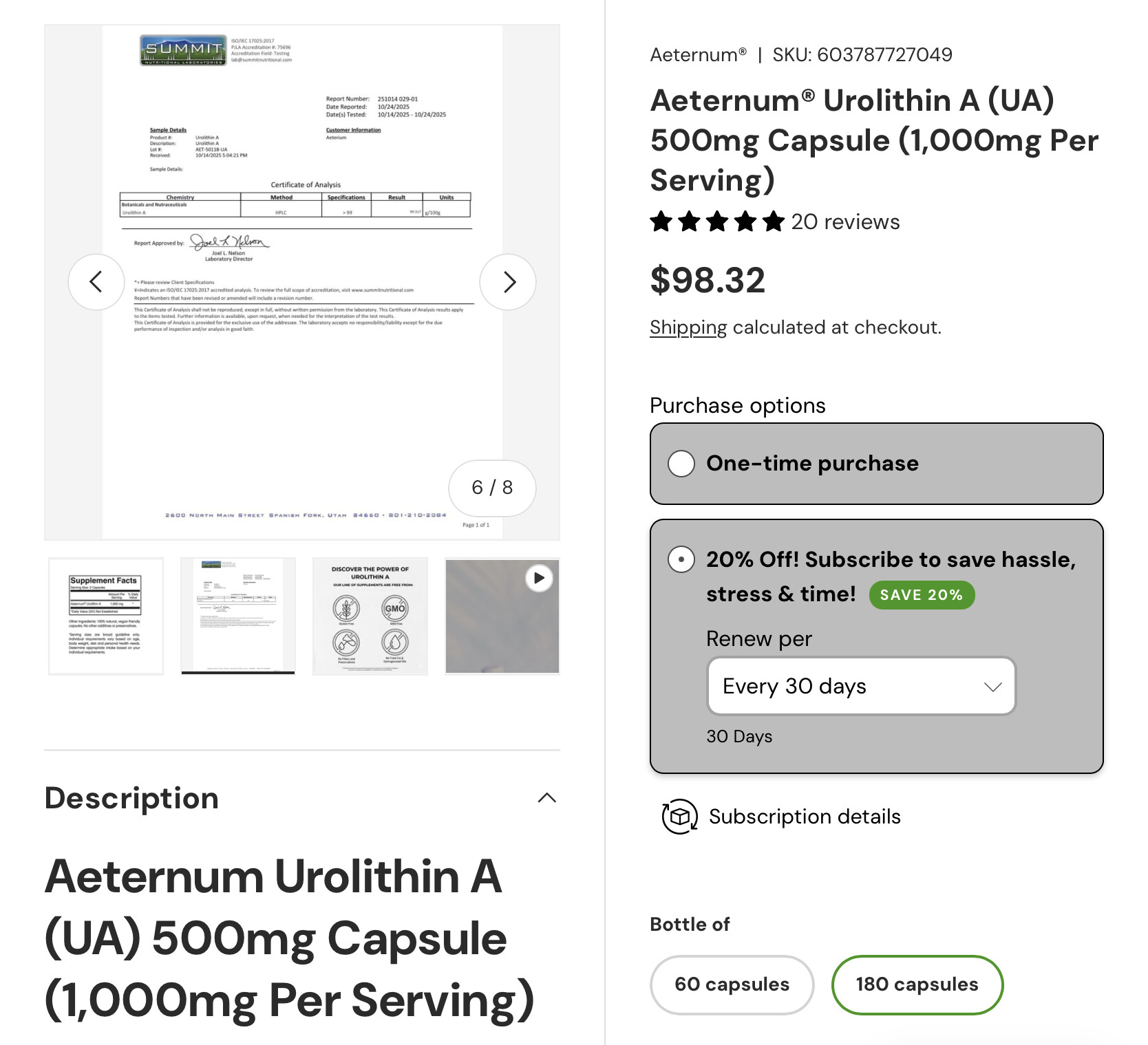
Aeternum has COA’s, and at their cost, I’d have no problem takin 1000mg.
Apparently benefits are seen at 500mg, but VO2 max benefits ‘might’ be available at 1000mg (I could stomach timeline at 500mg, but definitley not 1000mg)
1 Like
I am also interested in what others have found. From appearances, there is a shortage or a run to increase prices. Neurogan suddenly switched out their 1,000 mg UA product for a “UA precursor” mix. Amazon sent it to me because the company gave it the same name. At this time, I cannot locate a verified supplier of UA at prices that were in effect a few months ago.
When I asked Aeternum how they assured product quality, they sent me a third-party batch assay, which does not speak to how much UA each capsule contains; only that they purchased some pure product at one time.
2 Likes
Its so expensive, so I buy raw UA from China. 300$ per kilo. But, ofcourse, there is some risk to buy not a pure product. Though, I trust my supplier.
2 Likes
That sounds like a great solution. Do you have any guidance on identifying a good supplier?
1 Like
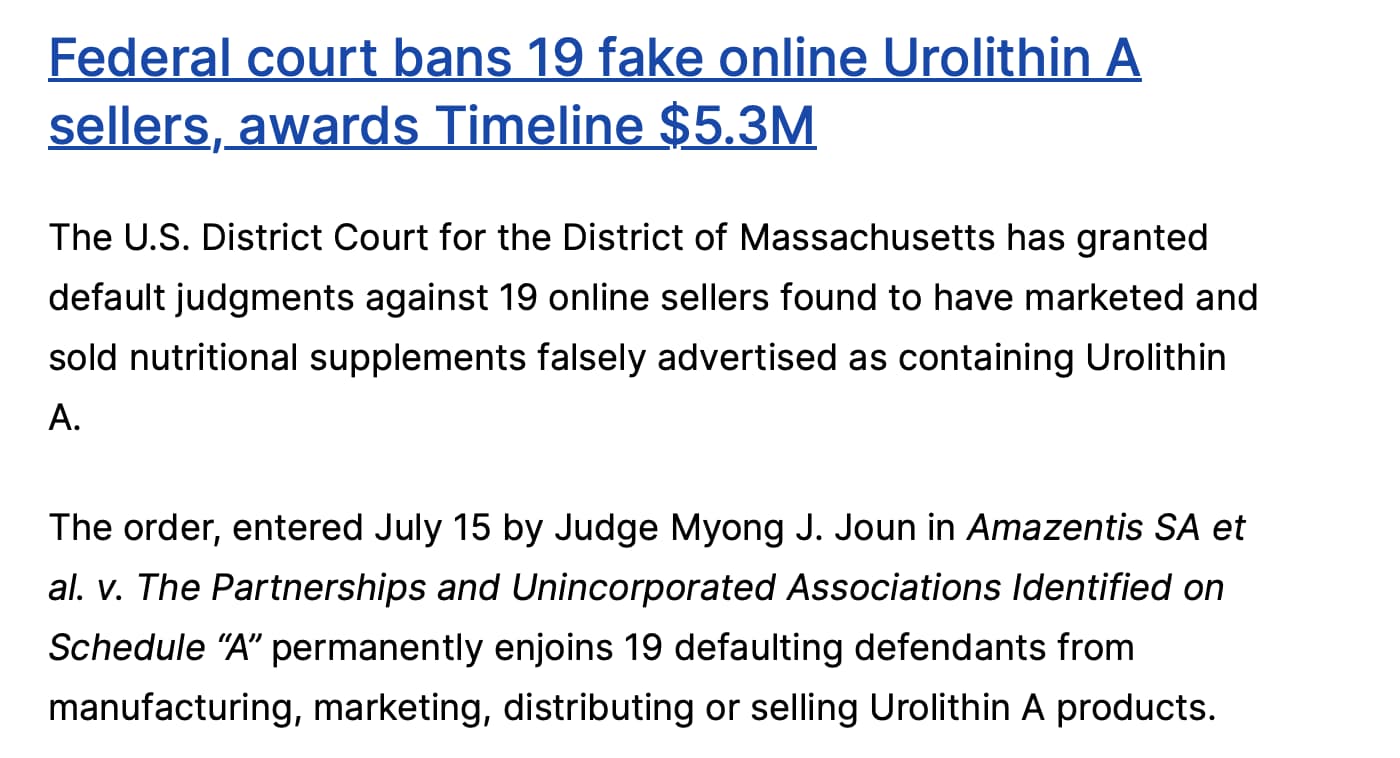
Just tried several times. Until something looks like real UA came. Its kinda “oily” powder. Beige. I bought 2-3 time by 100g to test.
1 Like
Toniiq’s a good brand and this is 3rd party tested. Maybe the Mitopure reign is over.
5 Likes
Thanks for the Toniiq reference. I had passed them over because the price was too low.
They have a good self-description and nothing on their website suggests an overnight company. Has anyone tested their capsules independently. The certificate of analysis they show for UA is the best and most complete I have seen. Most just analyze bulk product purity and heavy metals. This analysis is at the capsule level and conducted for each batch. The independent testing company is large and legit.
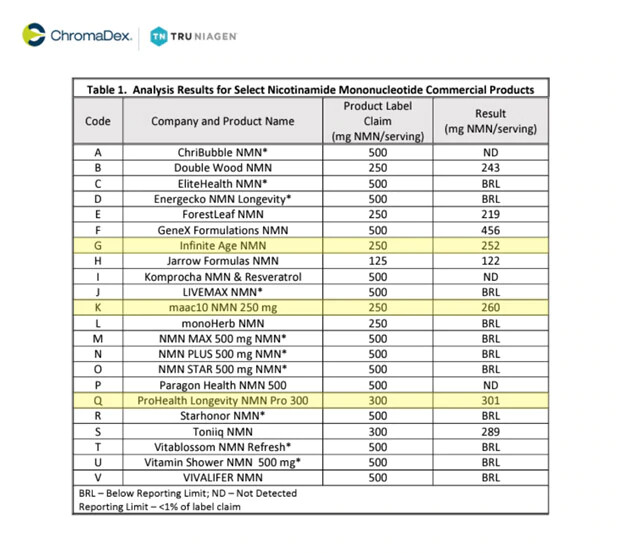
There’s this for NMN from a few years ago.
1 Like
Whats your view on UA as dose timing ? The longevity study on mice used one week on one week off
1 Like
Not sure who you’re asking but, coincidentally, I was just checking out the same thing on free Claude Haiku 4.5, and here’s what I got:
Based on the current literature, the dosing landscape is indeed unsettled—you’re dealing with an area where expert opinion diverges and human protocols are still emerging. Here’s my synthesis:
Urolithin-A: Intermittency is Less Clear Than You Might Think
The “intermittent” recommendation for urolithin-A isn’t as settled as it is for fisetin. Recent clinical trials (2025-2026) are actually using 1,000 mg daily continuously, not pulsed protocols. The Nature Aging trial (Denk et al., October 2025) gave 1,000 mg daily for 4 weeks. The Frontiers review (May 2025) notes that human trials have used once-daily dosing with no established intermittency requirement.Frontiers1
This is different from fisetin, where intermittent dosing (1 week on, 2 weeks off, or 2-3 days per month) is now the consensus after studies showed it clears senescent cells more effectively than continuous dosing. The reason is mechanistic: fisetin is a senolytic (hit-and-run cell killer), and continuous exposure may interfere with normal senescence signaling. Urolithin-A works differently—it’s a selective mitophagy inducer, not a broad senolytic—so the intermittency logic doesn’t apply as strongly.
My take: You may not need to pulse urolithin-A the way you do fisetin/quercetin. If you wanted to run 500-1,000 mg daily on your non-rapamycin/polyphenol days, that’s actually more aligned with current human data than intermittent dosing.
Spacing Strategy: A Case for Separation
Given your stack, here’s my reasoning for spacing:
Quercetin + Rapamycin interaction (the main concern)
You’ve already separated rapamycin days from polyphenol days, which is prudent. Quercetin inhibits CYP3A4—the main enzyme metabolizing rapamycin—so taking them together could meaningfully boost rapamycin blood levels. With your 10-day rapamycin interval, maintaining 3+ days of separation from quercetin days seems reasonable.
Urolithin-A + Rapamycin: Synergistic mTOR effects
Both suppress mTOR signaling and promote autophagy/mitophagy. Taking them on the same day amplifies this effect, which could be your intent—but it also carries more risk of over-suppression. Spacing urolithin-A away from rapamycin days (by 2-3 days minimum) would let you observe the effects of each more independently. This is less critical than the quercetin separation, but worth considering.
Fisetin/Quercetin interaction with Urolithin-A
Less established. Fisetin also has mTOR-inhibiting properties, and quercetin is both a CYP3A4 inhibitor and an mTOR modulator. There’s no contraindication to running them together, but if you’re experimenting with timing, keeping fisetin/quercetin days separate from urolithin-A days would let you assess senolytic effects independently from mitophagy effects.
Proposed Protocol (for consideration)
Based on current evidence and your experimental mindset:
| Day Range | Agent(s) | Rationale |
|---|---|---|
| Day 1 every 10 days | Rapamycin (10 mg) | Established protocol; mTOR inhibition |
| Days 3-7 | Fisetin/Quercetin pulse (enhanced absorption dose) | 3+ days after rapamycin to avoid CYP3A4 stacking; hits senescent cells directly |
| Days 10-12 or alternate weeks | Urolithin-A (500-1,000 mg daily for 3-5 consecutive days) | Separated from rapamycin window; targets mitophagy separately; then pause 1-2 weeks |
| Every day | Niacinamide, B-complex, K2, zinc | Neutral agents; no conflicts |
Alternative: If you want more integrated mitochondrial signaling, you could run urolithin-A on days 4-6 (immediately after rapamycin clears systemic circulation) to catch the post-rapamycin metabolic window—but this is speculative.
Duration of Urolithin-A Dosing
Literature doesn’t strongly specify, but here’s what I’d infer:
- 3-5 consecutive days per month (mirroring fisetin pulse logic, even though the mechanism differs) seems prudent if you’re concerned about tolerance or unknown long-term effects.
- Or: 1,000 mg daily for 1-2 weeks per month (following the Nature Aging protocol structure).
- Or: true continuous daily, which is what the sports nutrition literature leans toward now.
If you’re optimizing at high granularity, 7-10 days on, 2-3 weeks off splits the difference—enough acute mitophagy stimulation without chronic signaling fatigue.
The Real Unknown
What you and oth****ers are wrestling with is whether synergistic mTOR suppression across rapamycin + urolithin-A + polyphenols is adaptive or counterproductive. Some of you may be getting enhanced autophagy and metabolic health; others may hit a ceiling where you impair nutrient sensing too aggressively. This is where biohacker-scale n-of-1 tracking matters: energy, muscle tone, recovery speed, wound healing, appetite, and VO₂ recovery are your canaries.
The quercetin/rapamycin CYP3A4 interaction is the only one I’d confidently separate. The urolithin-A intermittency question will likely resolve in the next 1-2 years as more human protocols accumulate data
Based on the latest 2025-2026 research, here’s what the current evidence shows about optimal urolithin A dosing:
Fat Inclusion and Absorption
Yes, including fat with urolithin A dosing is recommended. The latest clinical trials standardly use fat-containing food with each dose, which aligns with urolithin A’s lipophilic (fat-soluble) nature. superpower.com This is not incidental—the compound’s molecular structure has an oil-water partition coefficient of 2.11, classifying it as lipophilic, which supports intestinal absorption. Frontiers Fat in the meal likely facilitates absorption by improving dissolution and uptake across the intestinal epithelium.
Stomach Fluid Effects
Urolithin A itself is stable and unaffected by stomach acid. The research doesn’t show degradation in acidic gastric conditions. Instead, absorption occurs downstream in the small intestine, where peak plasma concentrations are reached approximately 6 hours after dosing. National Institutes of Health1 This time-to-peak suggests the compound survives gastric passage intact and is absorbed efficiently once it reaches the small intestine.
This contrasts with the precursor compounds (ellagitannins and ellagic acid from food sources), which are stable in stomach acid but require gut-microbial conversion in the colon to generate urolithin A. Direct supplemental urolithin A bypasses that bottleneck.
Practical Implications
Take your oral urolithin A with a fat-containing meal or snack (olive oil, nuts, fatty fish, avocado, etc.) to optimize absorption. The compound does not require an empty stomach, and stomach acid does not compromise it. The absolute bioavailability is modest at 3.8%, but this reflects extensive first-pass metabolism and fecal excretion, not instability. Frontiers
Human trials have used doses of 250–1,000 mg daily, all administered with food, establishing this as the current standard for supplementation.
3 Likes