The oddball here, I’ve been taking Urolithin B @ 100 mg/day for about a month. I buy two grams for $20 from Everychem.com, a fairly trustworthy source. U-B is less well studied but apparently not less effective than its U-A counterpart.
Urolithin A vs Urolithin B, which is better
Neither is universally better. They pull on different levers that matter for performance and healthy aging.
• Choose Urolithin A if your priority is mitochondrial quality control, endurance capacity, recovery, and systemic inflammatory tone. The human trials that measured those outcomes used Urolithin A.
• Choose Urolithin B if your interest leans toward muscle protein preservation, anti-catabolic support, and complementary cellular resilience, noting that most evidence is preclinical.
• Choose a combination if you want the maintenance plus capacity model, clearing inefficient mitochondria while supporting an anabolic environment inside muscle.Why stacking both often makes sense
Mitochondria remodel through two linked phases, cleanup and rebuild. Urolithin A supports cleanup through mitophagy, which lowers the oxidative cost of producing ATP. Urolithin B supports the rebuild side by nudging muscle protein turnover toward synthesis and by calming inflammatory signals that slow repair. Training amplifies both, since exercise naturally stimulates mitochondrial biogenesis and muscle remodeling. When these inputs are aligned, the average quality of the mitochondrial network rises and muscle tissue has an easier time keeping up with daily demands.
1 Like
Both are broad-spectrum, multi-organ, bioactive compounds.
Free Claude Haiku 4.5 addresses the Mitopure question:.
The prompt: For several years, the only legitimate, readily-available consumer source of Urolithin A was the Mitopure brand, which was and is expensive. Now, in July, 2026, Amazon also sells a brand of equivalent strength, Toniiq, that is less than a third of the Mitopure price. Is there any reason why the Mitopure version should be considered superior to the Toniiq version? The Mitopure label shows no additional active ingredients. Does Mitopure deal with the first pass metabolism or some other aspect of systemic absorption?
Based on the available information, Mitopure’s premium pricing is not justified by superior bioavailability technology or special mitigation of first-pass metabolism. Rather, the price difference reflects clinical validation and research investment, not formulation advantages.
The Key Distinction
Mitopure’s value proposition centers on clinical evidence, not bioavailability enhancement. timeline.com It is the first and only Urolithin A to undergo gold-standard, double-blind, placebo-controlled human trials, with results published in top-tier journals like Nature and JAMA Network . timeline.com This extensive research backing—over 15 years of development and 25+ human studies—is what commands the premium price. mitopure.com
The Bioavailability Clarification
Neither Mitopure nor generic Urolithin A formulations employ special technology to mitigate first-pass metabolism. In fact, Timeline (Mitopure’s maker) explicitly states that “some brands claim that liposomal (or other) Urolithin A formulations enhance absorption, but there is no published scientific evidence supporting this claim.” timeline.com This means the liposomal and nano-formulations are largely marketing claims without clinical substantiation.
Both Mitopure and Toniiq deliver essentially the same active ingredient—pure Urolithin A—to the systemic circulation. toniiq.com Toniiq’s formulation (99.4% purity, third-party tested) is functionally equivalent to Mitopure’s in terms of the core pharmacokinetics. The conjugation to glucuronide and sulfate metabolites occurs equally with both products.
What You’re Actually Paying For
The Mitopure premium reflects:
- Clinical validation across 25+ human studies backing specific dose-response outcomes (muscle strength, endurance, etc.)
- FDA GRAS status affirmed in 2018 and renewed
- NSF Certified for Sport (important if you’re tested for banned substances)
- Sustained research partnership with longevity institutions like the Buck Institute
- Brand credibility from the original Urolithin A discoverers (Amazentis)
Toniiq, conversely, offers a lower-cost alternative with equivalent purity and third-party testing but lacks the clinical trial backing. Both will deliver Urolithin A to your bloodstream and undergo the same Phase II conjugation. The biological activity differences, if any exist, are likely negligible.
Bottom Line
Unless you value the clinical trial evidence or the NSF Certified for Sport certification, Toniiq represents substantially better value. Neither product addresses first-pass metabolism through formulation magic—that’s a physiological reality inherent to oral dosing of lipophilic compounds. Both achieve systemic bioavailability in the same way: direct absorption, followed by hepatic conjugation, which doesn’t eliminate the compound from circulation but does alter its metabolic form.
1 Like
Hey Rob, I’ve tried Mitopure Timeline, obviously expensive but then the have done all the lab trials. Toniiq. I tried Aeternum (pure powder) as its from a local Australian company (not convinced).
I’ve been happy with the Neurogan Health Pro+ Urolithin A 1000mg (2x capsules). It is well rated, reasonably priced and I think its a solid option over Mitopure.
1 Like
The Rapamycin/UA/Quercetin “stacking” issue caught me off guard. I put the question to Claude Fable 5 with these results. Spoiler summary: UA interaction should not be concerning but higher doses of quercetin could alter the rapamycin concentration curve slightly. Steady lower doses might have the opposite effect. Nothing much different from what has already been outlined here but some interesting detail.
Urolithin-A is a PK non-issue; the quercetin question is the whole question.
UA has essentially no signal as a CYP3A4/P-gp perpetrator. The available safety work — a 90-day rat study at doses up to ~3826 mg/kg/day and human dosing at 1000 mg/day for four months — turned up no alteration in drug-metabolizing enzyme activity and no documented interactions, and its clearance routes (glucuronidation/sulfation of the microbial metabolite) don’t overlap the CYP3A pathway that governs rapamycin. So any argument for cycling UA off during early rapamycin is pharmacodynamic, not pharmacokinetic: it’s really the question of whether you want your mitophagy pulse (UA) temporally stacked on or offset from your autophagy pulse (mTORC1 inhibition). That’s a legitimate but second-order design choice, and I don’t think there’s a PK reason to touch it. Conflating it with the quercetin CYP concern is a category error the threads keep making.
Quercetin is a real but bidirectional and timing-dependent actor.
The in vitro CYP3A4 inhibition is genuine but the potency estimates are all over the map depending on system and marker substrate — reported IC50s range from ~2 µM in one doxorubicin model up to ~38 µM classically, and 17–55 µM across CYP3A4 allelic variants. It also inhibits intestinal P-gp, and in rodent models it raises Cmax and AUC of assorted CYP3A4/P-gp substrates (doxorubicin, pioglitazone, several PIs, tamoxifen, paclitaxel). Crucially for your question, there’s also a “scanty” but real report of CYP3A4 induction in human hepatocytes via AhR/PXR ligand activity. That bidirectionality is, I’d argue, a big part of why the community can’t converge: acute co-administration biases toward inhibition (↑ exposure), chronic daily use biases toward possible net induction or wash (↓ or neutral exposure). Same molecule, opposite signs, dose- and chronicity-gated.
Why this maps onto rapamycin specifically, and why “peak” is affected more than “decline.”
Rapamycin’s oral bioavailability is low and dominated by gut wall CYP3A4 + P-gp (this is exactly why grapefruit roughly doubles-plus its AUC and is used deliberately by some as a dose-sparing enhancer). That’s the lever quercetin could pull. But the relevant concentration for gut inhibition isn’t systemic — quercetin aglycone has notoriously poor systemic bioavailability from first-pass glucuronidation/sulfation, so plasma levels sit sub-micromolar to low-micromolar even at gram doses. Luminal/enterocyte concentrations from a 500–1000 mg oral dose are far higher and can plausibly reach the inhibitory range at the apical membrane. The consequence: quercetin should perturb the absorption phase — a higher, possibly slightly later Cmax and a modestly higher early AUC — much more than it perturbs the terminal slope. Rapamycin’s decline is governed by hepatic CYP3A4 clearance and biliary excretion over a ~60-hour half-life, and sustained hepatic inhibition would require systemic quercetin exposure it mostly doesn’t achieve. So of the two things you named, expect the peak to move and the decline to stay largely intact, unless the quercetin formulation is a high-bioavailability one (phytosome, isoquercitrin) — in which case the hepatic contribution, and the interaction generally, goes up.
Also relevant to the “peak and decline” worry: quercetin is predominantly a reversible/competitive (mixed-mechanism) inhibitor, unlike grapefruit’s furanocoumarins, which are mechanism-based and knock out gut CYP3A4 for 24–72h until enzyme resynthesis. Reversible inhibition means the effect tracks the inhibitor’s transient gut presence — a few hours — rather than persisting across the week. That single fact is what makes temporal separation such a clean solution and is exactly what the “stop vs continue” binary obscures.
My read on the early-cycle question.
For the titration/early-cycle phase specifically, I lean toward pausing quercetin — not on safety grounds but on measurement grounds. The entire point of an early cycle is to characterize your rapamycin exposure and tolerability so you can titrate rationally. Running a variable, timing-sensitive gut CYP3A4/P-gp modulator alongside it means you’re titrating against a moving baseline, and if you later drop the quercetin your effective exposure silently shifts. Clean the variables first, establish the dose-response, then decide deliberately.
The “is it adaptive to continue” framing does have a real steelman, though: some practitioners treat quercetin (or frank grapefruit) as an intentional bioavailability enhancer, given how poor and variable rapamycin absorption is — the compounded formulations in PEARL absorbed worse than commercial, which is part of why the primary endpoint (visceral fat) missed. If you’re going to exploit that, the right move is to co-dose it consistently and titrate rapamycin against that as your baseline. The genuinely bad pattern — worse than either “always on” or “always off” — is random overlap, where quercetin sometimes lands on your rapamycin day and sometimes doesn’t, injecting exposure variance you can’t see.
Where dose (your cut-off thought) actually decides things.
Three dose axes matter, and I suspect this is where you were headed:
The quercetin axis is dose × formulation, not dose alone. Plain aglycone (most bulk supplements) is poorly soluble and may not even reach assumed enterocyte concentrations; a 500 mg vs 1000 mg difference matters, but a phytosome/Sophora-derived isoquercitrin at nominally lower mg could be the bigger perpetrator. And if the quercetin is coming from a D+Q senolytic protocol — ~1000 mg for 2–3 consecutive days, intermittently — that’s a high transient pulse you’d specifically want off your rapamycin day during titration.
The rapamycin axis is about headroom. The current longevity envelope is intermittent weekly dosing, ~3–10 mg/week (PEARL ran 5 and 10 mg/week; the AD PK pilot used 3 mg escalating to 7 mg weekly), explicitly aiming for a transient partial mTORC1 inhibition with recovery between pulses — the opposite of the 1–5 mg daily transplant regimen. At 5–6 mg/week you can absorb an unexpected 1.5–2× AUC bump with little consequence; at 8–10 mg/week the same bump is what pushes people toward mouth sores, lipid shifts, or enough sustained mTOR suppression to erode the “intermittent” rationale. So the interaction’s clinical weight scales with where you sit on the rapamycin ladder, which is the missing denominator in most of these threads.
The synthesis I’d offer: this isn’t really a stop-vs-continue problem, it’s a timing and titration-hygiene problem wearing a PK-interaction costume. Drop UA out of the CYP conversation entirely (offset it or not on PD grounds). Keep quercetin off the rapamycin day during titration, then make a deliberate consistent choice afterward. Temporal separation exploits quercetin’s reversible, transient gut action to buy you the PD stack without confounding the rapamycin PK.
(Speculative, flagged: if someone insisted on stacking, I’d bet the least-bad concrete regimen is rapamycin as the weekly pulse on an empty stomach, quercetin/UA dosed on the following day and thereafter, never the same morning — and if they want the grapefruit-style enhancement, do it consistently with a fixed low quercetin dose and re-titrate rapamycin down to compensate, rather than treating the enhancer as optional.)
If you have a specific dose pair in mind — say 6 mg/week rapamycin against 500 mg vs 1000 mg quercetin, or a D+Q overlap scenario — I can reason through the likely exposure shift more concretely.
an issue to be resolved.
Identified empirical pathway to resolve dosage uncertainties
Identified empirical pathway to resolve dosage uncertainties
Right — and I’d push on what “resolved” can even mean here, because the way the threads pose it, it’s structurally unresolvable, whereas the way an individual should pose it, it’s cheaply resolvable.
The unresolvable version is “does quercetin meaningfully alter rapamycin PK?” as a general claim. It can’t converge because the answer is a surface, not a point: it depends on quercetin dose and formulation, on acute-vs-chronic (the inhibition/induction sign flip), on timing relative to the rapamycin pulse, on where you sit on the rapamycin ladder, and on individual CYP3A4/5 genotype and baseline gut expression. Any two people arguing are often standing on different points of that surface and both reporting accurately. No amount of forum consensus collapses it.
The resolvable version is N-of-1, and the tool already exists commercially: whole-blood sirolimus levels. This is the piece the discussions skip entirely. Instead of arguing the interaction in the abstract, an individual can measure it — take a timed rapamycin level (say 1–2 h post-dose for the peak effect, or a standardized 24 h point) on a quercetin-free week, then repeat the identical protocol with their actual quercetin dose/formulation/timing in place. The delta is the answer for that person, at that dose pair, and it retires the theoretical dispute for them specifically. A peak-ish sample plus a later sample brackets both of the things you originally flagged — whether the peak moves and whether the tail moves. It costs two draws.
If someone wanted to actually resolve it as a research question rather than personally, the clean design is a crossover PK study: fixed weekly rapamycin dose, participants as their own controls, arms for (a) rapamycin alone, (b) rapamycin + quercetin co-dosed same morning, (c) rapamycin + quercetin offset 24 h, each after both acute and 4-week chronic quercetin exposure to capture the induction drift, stratified by CYP3A5 expressor status and by quercetin formulation. Full AUC sampling, not troughs. That would map the surface. Nobody’s run it because there’s no commercial sponsor — rapamycin is generic, quercetin is a supplement, and the longevity use is off-label, so the interaction sits in exactly the funding dead zone where these questions go unanswered. That absence, more than any genuine scientific difficulty, is why it stays “unresolved.”
So my actual answer to “an issue to be resolved” is: resolved for the field, no, and probably not soon, for structural funding reasons. Resolved for a given person, trivially — measure it rather than argue it, which also happens to be the only version of the answer that accounts for their specific dose, the variable everyone omits.
Speculative, flagged: I’d bet that if that crossover study were ever run, the same-morning acute arm would show a real but modest AUC bump (order of 1.3–1.8×, driven by Cmax), the 24 h-offset arm would show near-null, and the chronic arm would partially wash the acute effect as low-grade induction creeps in — which would mean the community’s “stop vs continue” fight is mostly an artifact of people unknowingly comparing the acute-overlap point against the chronic-offset point and generalizing from opposite corners of the surface.
Here is Fable 5 on the UA/UB issue with what might be important information suggesting prudence when electing to take UB and not to take it during a rapamycin cycle.
UA is a mitochondrial-quality agent, not an anabolic one — and the human data say so explicitly. Its mechanism is mitophagy: clearance of damaged mitochondria via PINK1/Parkin-dependent and -independent routes, downstream of AMPK, with a mild rise in mitochondrial content and OXPHOS complex proteins. A randomized trial in middle-aged adults showed ~12% improvement in muscle strength, plus gains in aerobic endurance (peak VO2) and the 6-minute walk, though it missed its primary endpoint of peak power output. The 2025 systematic review of the human RCTs found that the one study measuring muscle mass found no improvement in mass with urolithin A. So UA’s “strength” gains are really quality gains — more usable output per unit muscle, better fatigue resistance, faster mitochondrial recovery — which is precisely the recovery-on-strenuous-hikes benefit you observed. What UA does not do in humans is add tissue. Cell PressmedRxiv
Now the three caveats that keep this from being a clean “add UB” recommendation, in descending order of importance.
First, the evidence asymmetry is enormous. UA has multiple human RCTs, characterized PK (peak plasma at 6–8 h, 17–22 h half-life, no accumulation, food-independent), and a commercial bioavailable form solving the metabotype problem — relevant because only ~40% of people produce meaningful urolithin A from dietary ellagitannins, and only ~12% have detectable baseline levels. UB has, functionally, few studies.[Edited out]
Second, and this is a translational red flag people gloss over: the mouse hypertrophy was produced by continuous delivery via mini-osmotic pump at 10 µg/day over 28 days — a steady infusion, not an oral bolus. Whether an oral UB supplement produces the sustained tissue exposure that drove the effect is unknown, and UB’s oral bioavailability and PK aren’t meaningfully characterized. A once-daily oral capsule is a very different exposure profile from a subcutaneous infusion, and for an mTORC1-anabolic effect that may depend on sustained signaling, the difference could be the whole ballgame. Wiley Online Library
Third — and this connects directly to your earlier thread — UB and rapamycin are mechanistic antagonists. UB works by activating mTORC1; rapamycin works by restraining it. If you’re using or considering intermittent rapamycin, UB would be pushing on exactly the pathway rapamycin is trying to pulse down, at least locally in muscle. UA, by contrast, sits on the AMPK/mitophagy axis that’s broadly aligned with mTOR-inhibition longevity logic — UA + rapamycin is mechanistically harmonious, UB + rapamycin is a tug-of-war. So the choice between the two urolithins isn’t just about which symptom you’re targeting; for you specifically it’s entangled with whatever you decide on the rapamycin question. (This is also, incidentally, a nice illustration of why “muscle aging” is the wrong resolution — the mitochondrial-quality decline and the anabolic/mass decline pull toward opposite pharmacology.)
One genuinely open pharmacological question worth flagging on UB: because its mechanism runs through the androgen receptor, its tissue selectivity is uncharacterized. Whether muscle-selective (SARM-like) or broader AR engagement, in the absence of any human data, is simply unknown — and that’s the kind of thing that matters before chronic use, independent of efficacy.
I won’t post the whole thing here, but for all-round mitochondrial health, free Claude Haiku suggested Urolithin-A, Niacinamide and, with fat, Ubiquinol or CoQ10.
Seems like I saw somewhere (not above) that intermittent Urolithin-A dosing could be more effective than daily dosing - damaged mitochondria could become more obvious after a pause than if mitophagy were continuous, allowing the mitophagy process to better see them and destroy them. Maybe it was two weeks on and two off.
I located additional UB research that corrects a limitation originally stated by Claude above. It is edited out now.
The tissue-selectivity question — this is the substantive payoff. I ended last time flagging that UB’s androgen-receptor mechanism made its tissue selectivity unknown, and that this mattered before any chronic use. The review speaks directly to it, and the answer is encouraging in a specific, mechanistically coherent way. In muscle, UB acts through the AR to drive anabolism (Rodriguez’s genetic/pharmacological AR dependence). But in prostate, the picture inverts: Sánchez-González et al. found UB suppresses AR expression and PSA secretion, and Stanisławska et al. found it anti-proliferative in both androgen-dependent (LNCaP) and -independent (DU-145) lines — and notably UB, unlike UA, actively inhibited PSA secretion. On top of that, Adams et al. showed UB is a competitive aromatase inhibitor in breast tissue, blunting both estrogen- and testosterone-driven proliferation. So the emerging endocrine profile is tissue-divergent in exactly the direction you’d want: androgen-receptor-agonistic/anabolic in skeletal muscle, but androgen-receptor-suppressive and anti-proliferative in prostate, with anti-aromatase (anti-estrogenic) behavior in breast. That’s a SARM-like signature — the selective pattern that, if it held in vivo, would resolve the worry I raised: the AR mechanism wouldn’t carry the prostate-stimulation risk you’d fear from a systemic androgen, and might even run protective there. Crucially, Rodriguez also found plasma testosterone unchanged in the UB-treated mice, so this is receptor-level tissue modulation, not systemic androgen elevation. I’d flag two restraints on how far to run with this: the prostate and breast data are all cancer-cell-line work at 40 µM, and the muscle data at 15 µM — all supraphysiological — so what’s established is the qualitative direction of tissue divergence, not that it operates at achievable doses. But as a partial answer to the exact question I said was open, it’s a good one, and it’s the most important thing in the paper for your situation.
The problem that turns out to be decisive: the concentration gap. The review lays out UB pharmacokinetics starkly enough to reframe the whole practical question. Dietary UB plasma levels are minute — Seeram et al. measured peak total urolithins after pomegranate juice at ~0.14 µmol/L for UA and ~0.01 µmol/L for UB, with UB-glucuronide detectable in the urine of only 5 of 18 subjects. Even the aggressive 1 L/day-for-5-days protocol reached ~18 µmol/L total urolithins with enormous interindividual variability, and that’s dominated by UA. Now put that against the concentrations where UB actually does things: 15 µM for the myotube anabolism, 5–40 µM for the anti-inflammatory and anti-cancer effects. That’s a two-to-three-log gap between physiologically achievable free UB and the in vitro active range. And it’s compounded by conjugation: circulating UB is overwhelmingly glucuronide/sulfate, and the review repeatedly notes the conjugates are far less active than the aglycone for most endpoints — including, importantly, that the muscle/anabolic work depends on the free form. So the anabolic mechanism needs a free-aglycone tissue concentration that oral dosing struggles to reach, of a metabolite most people barely produce, in a form that’s mostly conjugated away. This is a larger translational barrier than I conveyed last time, and it’s the thing that, for now, keeps UB in the “mechanistically fascinating, practically unreliable” column regardless of the attractive selectivity profile. The review’s own future-directions section effectively concedes this — it’s calling for nanoparticle/particle-carrier delivery precisely because unformulated UB can’t reach target tissue concentrations, and flagging UB’s poor solubility as a delivery-limiting property.
A few smaller threads from the paper worth pulling, since they connect back to earlier parts of our discussion:
The AMPK detail deepens the UA/UB opposition into a near-mirror-image. The review proposes UB drives mTORC1 anabolism via a decrease in AMPK activity (relieving AMPK’s brake on mTORC1). UA does the opposite — it activates AMPK. So on the single AMPK→mTORC1 node, these two metabolites of the same parent compound push in opposite directions: UA toward AMPK-on / mTOR-restrained / mitophagy, UB toward AMPK-off / mTOR-active / anabolism. That sharpens the earlier point about UB antagonizing rapamycin: it’s not just that UB activates mTOR, it’s that UB and rapamycin (and UA, and metformin, and fasted training) all sit on opposite sides of the same regulatory switch. Anything you’re doing to push AMPK up for longevity reasons is working against UB’s muscle mechanism, and vice versa. That’s a real design tension, not a hypothetical one.
There’s also direct validation of your original observation buried in the reference list: Trombold et al. showed ellagitannin consumption improved strength recovery 2–3 days after eccentric exercise in humans. That’s the parent-compound-class evidence for exactly the recovery-after-strenuous-loading benefit you reported — it’s a real, human, functional signal at the level of the dietary precursor, independent of which downstream urolithin you happen to produce.
And one note that reaches back to our very first conversation about CYP interactions: the review reports that both UA and UB induce CYP1A1, CYP1B1, and UGT1A10 in colon at ~40 µM. That’s the CYP1 family and a UGT, not CYP3A4 — so it doesn’t touch the rapamycin/sirolimus picture, and my earlier “no meaningful CYP3A4 signal” stands. But it’s a fair correction to any impression that urolithins are globally CYP-inert; they’re not, they just don’t hit the enzyme that matters for rapamycin. (Separately, the review notes UB is a fairly potent MAO-A inhibitor — Singh et al., IC ~0.88 µM with ellagic acid — which is a genuine pharmacodynamic activity at near-achievable concentrations and worth keeping in mind as evidence UB isn’t a bystander metabolite.)
Where this leaves the integrated judgment, updated: the paper strengthens the mechanistic case that UB is the metabolite aimed at mass/atrophy dimension, and it removes my main safety-flavored objection by supplying a SARM-like selectivity signal that points away from the prostate/androgen worry. But it simultaneously hardens the practical objection — the free-aglycone concentration required for the anabolic effect is far above what unformulated oral UB can deliver, in a metabolite whose dietary production is even sparser and more conjugated than UA’s. So my recommendation holds its shape but with the reasoning made crisper: keep UA for the mitochondrial-recovery axis it demonstrably serves and where you’ve already seen benefit and regard UB as the mechanistically-matched but delivery-limited option to watch — specifically watch for a formulated (phytosome/nanoparticle) UB with actual human PK showing free-aglycone plasma levels approaching the low-micromolar range, because absent that, you’re taking a supplement whose active concentration the best available review says it probably can’t reach. If such a formulation appears with a human muscle endpoint, the selectivity profile makes it genuinely worth revisiting.
Speculative, flagged: the tissue-divergent AR behavior, if it survives translation, would make UB more interesting than most “natural anabolic” candidates precisely because the usual disqualifier — androgenic off-target risk — appears inverted here. The rate-limiting scientific step isn’t efficacy or safety mechanism, it’s a delivery-chemistry problem, and those are the kind that get solved when a sponsor decides it’s worth solving. Given Amazentis owns the UA franchise and UB is the metabolite that does the thing UA can’t, I’d bet the delivery problem is being worked on quietly by someone — but that’s inference from the commercial logic, not from anything in this review.
Looked around a little more and found a better Urolithin-A deal. Perpetualife.bio also has 3rd party testing and is mentioned here and elsewhere (do a search and see what you think) as being legitimate: https://www.directintegrativecare.com/post/best-urolithin-a-supplements-evidence-backed-brand-recommendations
Free AI says this:
Why Perpetualife.bio Stands Out
Perpetua.Life’s Urolithin A is verified legitimate because:
- Legitimate third-party testing: Both Twin Arbor Labs and Veritas Analytic are real, independent labs. Veritas is ISO/IEC 17025:2017 accredited, which is the international standard for lab competence—the same standard that ensures quality in pharmaceutical testing.
- No legal red flags: Unlike the 19 companies banned in July 2026, Perpetua.Life has zero federal court cases against them and is not among the fraudulent sellers.
- Positive user feedback: Independent reviews mention third-party testing, fast shipping, and effective products. The owner (Prof. Michael Morgan) reportedly responds personally to customer emails.
- Industry recognition: The company is mentioned in SEC filings as a legitimate competitor alongside Timeline (Mitopure), NOVOS, and other established longevity brands.
- Real company infrastructure: Physical offices in multiple locations (AL, NV, GA, Australia), FDA-registered manufacturing, and 9 years of business history.
Seems Mitopure’s trials got the best results with 1,000 mg, instead of the 500 in their and Toniiq’s recommended daily dose amounts if the bottles are to furnish 30 days of pills (My free AI also tells me that the extra Toniiq ingredients are unlikely to have any effect.). Two of these Perpetualife.bio capsules provide 1,000 mg, where it takes six of the Toniiq capsules for that much. So, Toniiq was $31.29 for half as much potency as Perpetualife.bio at $42.48 (I’d guess that the $4.72 discount is a one-time thing and it probably goes up to regular $47.20 per month subscription price after the first month - the non-subscription price is $59.00.). A bottle of Toniiq is fifteen days at 1,000 mg per day and a bottle of Perpetualife.bio is thirty days at 1,000 mg per day. Couldn’t find it on Amazon and bought direct. I now have a bottle of each - we’ll see how it goes.
Order summary
 Urolithin-A Liposomal 1,000mg × 1
Monthly Delivery $47.20
Discount  INNERBODYRESEARCHWWWINNERBODYCOM -$4.72
Subtotal $42.48
Shipping $0.00
Taxes $0.00
Total $42.48 USD
You saved $4.72
1 Like
I opened the brand’s capsules and discovered they contained nothing except oil, without any detectable urolithin A. I discarded them right away.
That’s weird. I opened one of the Toniiq capsules and it was full of powder. When the Perpetua Life pills I ordered yesterday get here, I’ll report back with what I found. This is the 3rd party lab test they posted on their website:
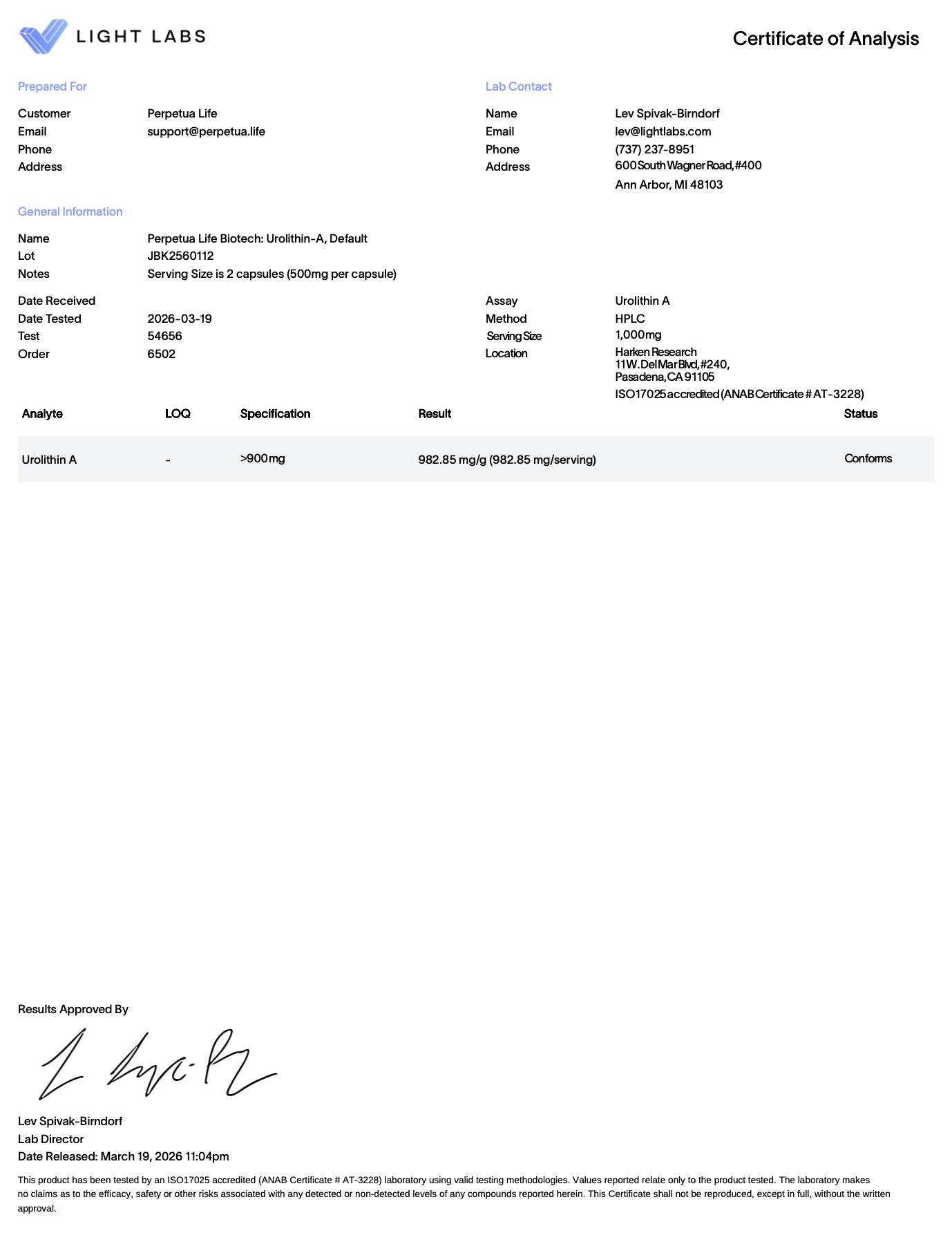
how do you know what’s in the oil? or you labtested?
I’ve opened capsules from Timeline before; they contained material with a distinct deep yellow hue characteristic of urolithin A. By contrast, this one only holds milky white emulsified oil once opened.
My last batch of Timeline had some crushed capsules and it held white material. It wasn’t yellow hued.
Switching over from Toniiq (6 capsules = 1,000 mg) to Perpetualife (2 softgels = 1,000 mg) today. I punctured one of them and it was like you said, a white substance came through the pinhole. But there is a however.
The label states that the Urolithin-A is in a liposomal delivery matrix which drastically enhances its absorbtion. Listed on the label as other ingredients are: phoshatidylcholine (liposomal delivery matrix), methylcelulose capsules and non-gmo sunflower oil.
Incidemtally, a few days after placing my order, I still hadn’t recieved notice that it had shipped. I sent an email to customer service and the CEO replied immediately, apologized and shipped it right then.
2 Likes
If anyone wants Timeline and has American Express platinum, I just received an email that you’ll get $30 back from a $150 purchase.
I love the gummies, so I think I’ll get them with the thinking that I’m paying extra for candy …
I’d still like to spend less, but I’m not just sure on sourcing. Neurogan, which passed testing, no longer offers UA at all.
“Quercetin inhibits CYP3A4—the main enzyme metabolizing rapamycin—so taking them together could meaningfully boost rapamycin blood levels.”
How does this compare with drinking Grapefruit juice for those who try to maximize their Rapamycin consumption? Why drink Grapefruit juice with it’s unknown potency when Quercitin could do the job in a quantifiable dosage?
1 Like
Rob Tuck’s AI deep dive above says quercetin’s effect on rapamycin absorption isn’t always the same: “The in vitro CYP3A4 inhibition is genuine but the potency estimates are all over the map depending on system and marker substrate …”
And I believe, for any real effect, it’s referring to high dosage, which is hard to accomplish due to quercetin’s low bioavailability. For a more thorough understanding, you may want to read the whole response. The AI knows all and tells all.
True, grapefruit or grapefruit juice won’t be exactly the same every time either, but unless you’re trying to measure precisely, it’ll probably get the job done.
1 Like