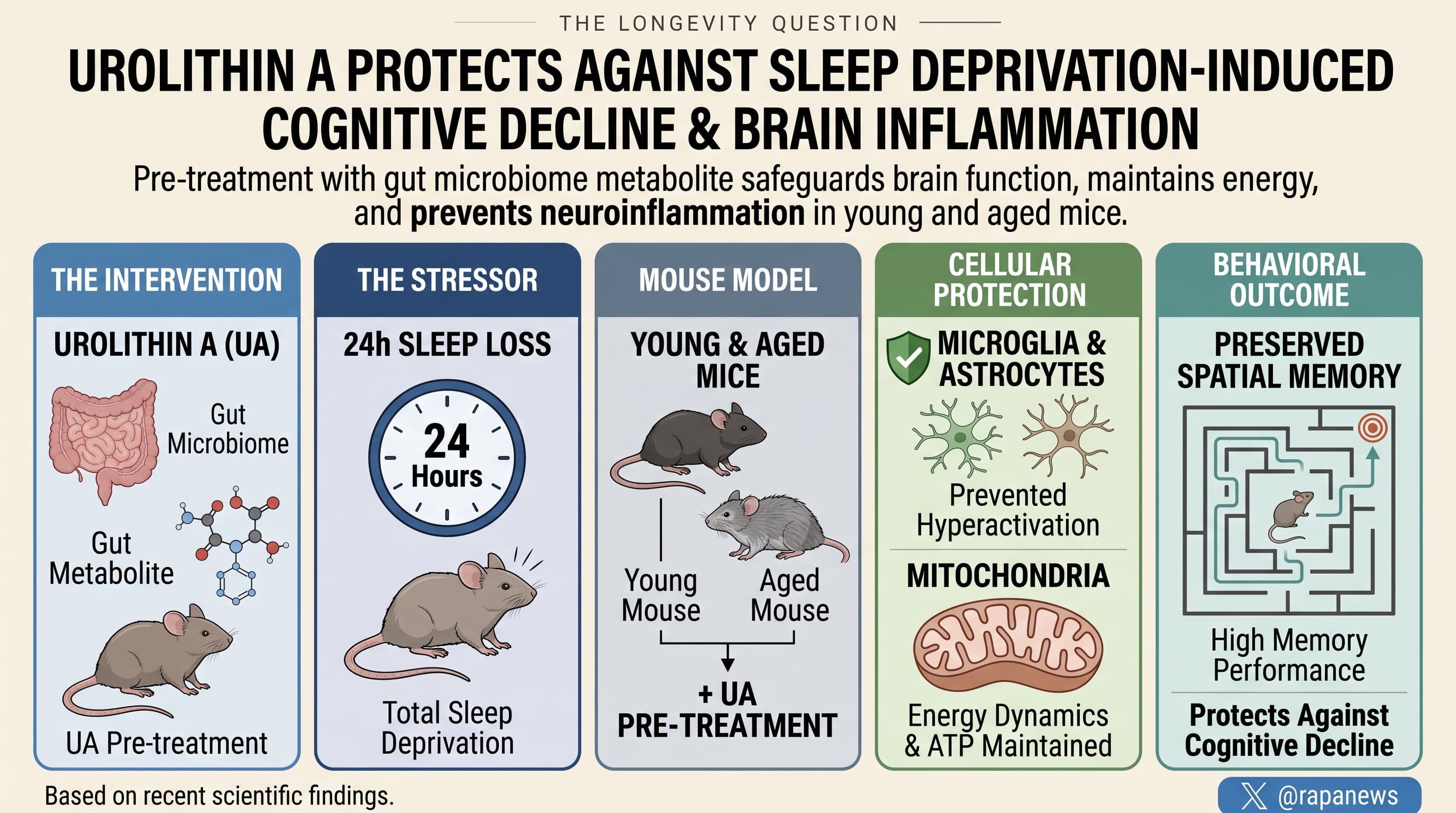
A new study demonstrates that the gut microbiome metabolite Urolithin A protects against the cognitive decline and brain inflammation caused by acute sleep deprivation. In young and aged mice, pre-treatment with Urolithin A prevented the hyperactivation of microglia and astrocytes, maintained mitochondrial energy dynamics, and preserved spatial memory following 24 hours of total sleep loss.
Sleep loss is an inescapable feature of modern life that accelerates brain aging and impairs memory. During periods of extended wakefulness, the brain accumulates metabolic waste and cellular damage. Normally, sleep acts as a biological cleaning cycle, allowing the brain to clear debris and reset energy pathways. When organisms are subjected to severe sleep loss, this biological system enters a state of panic. Microglia and astrocytes, the primary immune cells of the central nervous system, morph into highly reactive states. They begin pumping out inflammatory cytokines that attack the neural architecture they are meant to protect, particularly in the hippocampus, a region critical for memory consolidation. While researchers have long known that acute sleep deprivation inflames the brain and damages the energy-producing mitochondria inside neurons, clinical interventions to block this process have remained limited. Now, researchers have shown that a single natural compound can effectively decouple sleep loss from its neurological consequences.
Urolithin A is a downstream metabolite produced by specific gut bacteria when they digest ellagitannins, which are compounds naturally found in pomegranates, walnuts, and strawberries. Prior pharmacological work established Urolithin A as a potent inducer of mitophagy, the cellular clean-up process that identifies and clears out damaged mitochondria. This new study tests whether these protective effects extend to the severe metabolic stress induced by total sleep deprivation.
The research team subjected 3-month-old and 12-month-old mice to 24 hours of treadmill-induced sleep deprivation. Half of the animals received intraperitoneal Urolithin A injections for seven days prior to the sleep loss protocol. The untreated sleep-deprived mice exhibited massive spikes in brain inflammation. Glial cells became hypertrophic and aggressively pro-inflammatory, releasing interleukin-6 and tumor necrosis factor-alpha. Simultaneously, the neuronal mitochondria lost their structural integrity and fragmented, leading to reduced dendritic branching and severe spatial memory deficits in water maze testing.
In stark contrast, mice pre-treated with a 10 mg/kg dose of Urolithin A showed almost no signs of this neural chaos. The compound completely blocked the activation of the NF-kB and NLRP3 inflammatory pathways. Furthermore, Urolithin A preserved the expression of PGC-1a, a master regulator of mitochondrial biogenesis, and kept mitophagy running smoothly through the Pink1 pathway. Behaviorally, the treated mice acted as if they had never lost a night of sleep, displaying fully intact spatial and fear-conditioned memory.
The Big Idea here is that the cognitive penalty of sleep deprivation is not solely due to the physical absence of the sleep state, but rather the cascading inflammatory and metabolic damage that sleep loss subsequently triggers. By fortifying mitochondrial quality control before the stress occurs, Urolithin A creates a dense molecular buffer. This points to a highly practical pharmacological strategy for shift workers, medical professionals, and aging populations to shield their brain architecture from the inflammatory insults of irregular sleep [Confidence: High].
Actionable Insights For individuals looking to optimize cognitive resilience against inevitable sleep deficits, this paper provides a compelling rationale for prophylactic Urolithin A supplementation. The behavioral rescue observed in the study was absolute. When measuring spatial memory retention via the time spent in the target quadrant of a water maze, unmedicated sleep-deprived mice dropped from a baseline of 35 seconds down to 15 seconds. Mice pre-treated with 10 mg/kg of Urolithin A retained a search time of 32 seconds. This represents an absolute functional recovery of 17 seconds (a 113% relative increase over the impaired state) and a standardized effect size (Cohen’s d) of approximately 2.7, indicating a massive, highly visible rescue of cognitive ability.
Because human microbiomes are highly variable, an estimated two-thirds of the population do not possess the specific bacterial strains required to convert dietary pomegranates or walnuts into Urolithin A. Direct supplementation bypasses this intestinal bottleneck. While human trials are required to confirm the exact dosing equivalent to the 10 mg/kg intraperitoneal mouse dose, the data strongly suggests that Urolithin A acts as an acute prophylactic neuroprotectant. Taking a bioavailable Urolithin A supplement in the days leading up to an expected period of sleep deprivation may prevent the subsequent brain fog and neuroinflammatory cascade.
Context/Source
Paywalled Paper: Urolithin A Prevents Sleep-deprivation-induced Neuroinflammation and Mitochondrial Dysfunction in Young and Aged Mice. (March, 2024)
Institution: South China Normal University and Panyu Central Hospital.
Country: China.
Journal Name: Molecular Neurobiology.
Impact Evaluation: The impact score of this journal is 5.5, evaluated against a typical high-end range of 0–60+ for top general science, therefore this is a Medium impact journal.