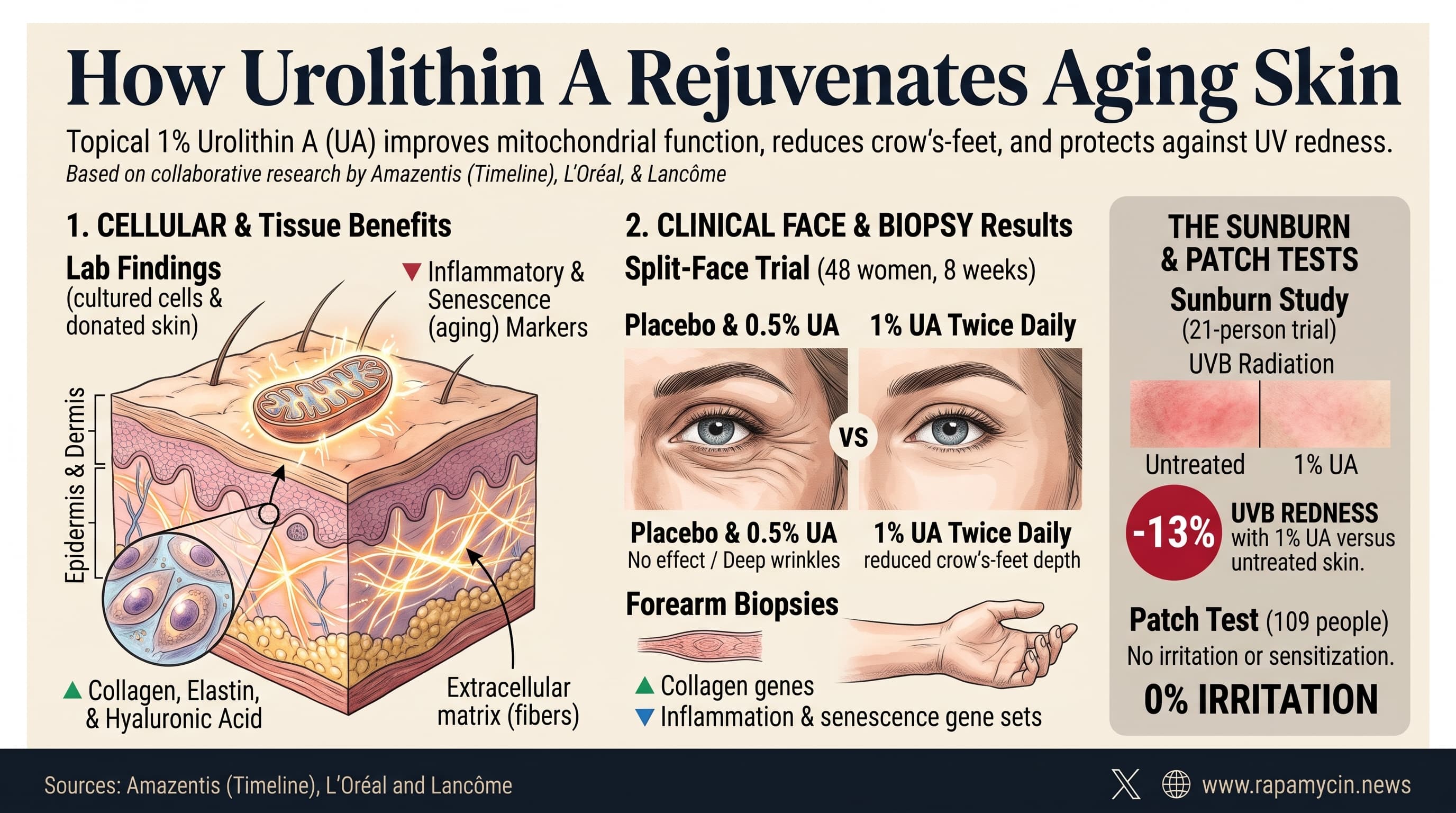
Researchers from Amazentis (Timeline), L’Oréal and Lancôme tested urolithin A (UA, sold as Mitopure) as a topical skin ingredient. In cultured skin cells, lab-grown skin and donated skin explants, UA raised mitochondrial respiration and mitophagy markers, lowered inflammatory and senescence markers, and increased collagen, elastin and hyaluronic acid staining. In a split-face trial of 48 women, a 1% UA cream applied twice daily for 8 weeks produced a small but statistically significant reduction in crow’s-feet depth versus placebo, while 0.5% UA did nothing. Forearm biopsies showed collagen genes going up and inflammation and senescence gene sets going down. In a 21-person sunburn study, 1% UA reduced UVB redness by 13% versus untreated skin. A 109-person patch test found no irritation or sensitization.
Urolithin A built its reputation as a pill. Gut bacteria make it from ellagitannins in pomegranates, walnuts and berries, and in purified supplement form it has been shown in several company-sponsored trials to nudge muscle endurance, mitochondrial markers and immune aging in middle-aged and older adults. Its headline trick is mitophagy, the cell’s process for tagging worn-out mitochondria and recycling them. A new study from Amazentis, the Swiss company that sells urolithin A as Mitopure, working with L’Oréal and Lancôme, asks a simpler question. What happens if you rub it on your face?
The team built a stack of evidence that climbs from dish to person. In cultured human keratinocytes and fibroblasts, urolithin A at around 1 micromolar raised mitochondrial oxygen consumption, increased a molecular tag that marks mitochondria for disposal, and lowered the inflammatory messenger IL-6. In lab-grown skin built from an elderly donor’s cells, it cut the senescence marker p16 by more than half and roughly doubled collagen III staining. In fibroblasts from a 69-year-old, it partly restored the focal adhesions that let cells grip their surroundings, which loosen with age. In donated abdominal skin hit with urban dust and UVA light, it reduced oxidative damage to nuclear proteins.
Then came people. Forty-eight women aged 50 to 75 with visible crow’s feet applied a plain cream twice daily for eight weeks, with one side of the face getting placebo and the other getting urolithin A. Half the women tested a 0.5 percent cream, half a 1 percent cream. Forearm biopsies taken before and after went for RNA sequencing. In a separate study, 21 adults had small patches of back skin given a mild sunburn under a solar simulator and were then treated.
The results are real but small. On the 1 percent side, crow’s-feet depth fell by 3.4 percent over eight weeks while the placebo side got 4.0 percent deeper, a gap that only just cleared statistical significance. The 0.5 percent cream did nothing measurable. In the sunburn study, skin treated with 1 percent urolithin A was 13 percent less red than untreated skin a day later, though the plain cream alone accounted for much of that difference. The biopsies were more striking. Collagen-building gene programs rose, and genes tied to chemokine signaling and a standard senescence panel fell, a pattern the authors read as the reverse of how skin gene expression drifts with age.
The big idea is that a wrinkle cream might work upstream, by refreshing the cell’s power supply and calming the low-grade inflammation of aged skin, rather than by plumping or exfoliating the surface. That is an appealing story, and the molecular data line up with it. But the clinical payoff so far is modest, the trials are small and short, every author works for a company selling the ingredient, and nobody measured how much urolithin A actually gets through the skin. Lancôme already has urolithin A products on shelves. Independent replication has yet to happen.
Actionable insights
- The tested regimen was 1% urolithin A in a basic moisturizer, applied morning and evening for 8 weeks. The 0.5% version showed no benefit, so concentration appears to matter.
- Size of the wrinkle effect: the 1% side ended about 7.4 percentage points better than placebo (minus 3.4% versus plus 4.0%). In standardized terms that is a moderate effect (Cohen’s d roughly 0.5 to 0.7, where 0.2 is small and 0.8 is large), but the plausible range runs from almost zero to about 15 points. The paper does not report absolute depths. If a typical crow’s-foot line were 100 micrometers deep, 7% would be about 7 micrometers, roughly a tenth of the width of a hair. A 3D scanner can detect that; a mirror probably cannot.
- Sunburn: 13% less redness than untreated skin, but plain moisturizer delivered most of that. This is not a sunscreen, and in the trial it was applied after UV exposure.
- Tolerability looks good: zero reactions in 109 people who completed a patch test.
- To my knowledge, retail Lancôme Absolue Longevity MD products do not state a matching UA concentration and combine it with other actives, so these results do not transfer directly. Daily SPF and retinoids remain the better-supported first choices.
Context and source
- Open Access Paper: Topical application of urolithin A activates mitophagy and enhances mitochondrial function to promote skin longevity
- Institutions: Amazentis SA (Timeline), EPFL Innovation Park, Lausanne; L’Oréal R&I, Clichy; Lancôme, Levallois-Perret; SGS Proderm GmbH, Hamburg (clinical site); Genevia Technologies, Tampere (bioinformatics)
- Country: Switzerland (lead), with France, Germany and Finland
- Journal: iScience (Cell Press / Elsevier)
- Conflicts: All authors are employees of the sponsor (Amazentis), L’Oréal or Lancôme. Three authors hold related patents. Lancôme launched its Mitopure-containing Absolue Longevity MD range in 2026, priced around 150 to 190 GBP/EUR per product.
- Impact evaluation: The impact score of this journal is 4.1 (2025 Journal Impact Factor; Scopus CiteScore 7.2), evaluated against a typical high-end range of 0 to 60+ for top general science journals, therefore this is a Medium impact journal.