Unlocking Cellular Cleanup: New Pharmaceutical Approaches to Chaperone-Mediated Autophagy (CMA)

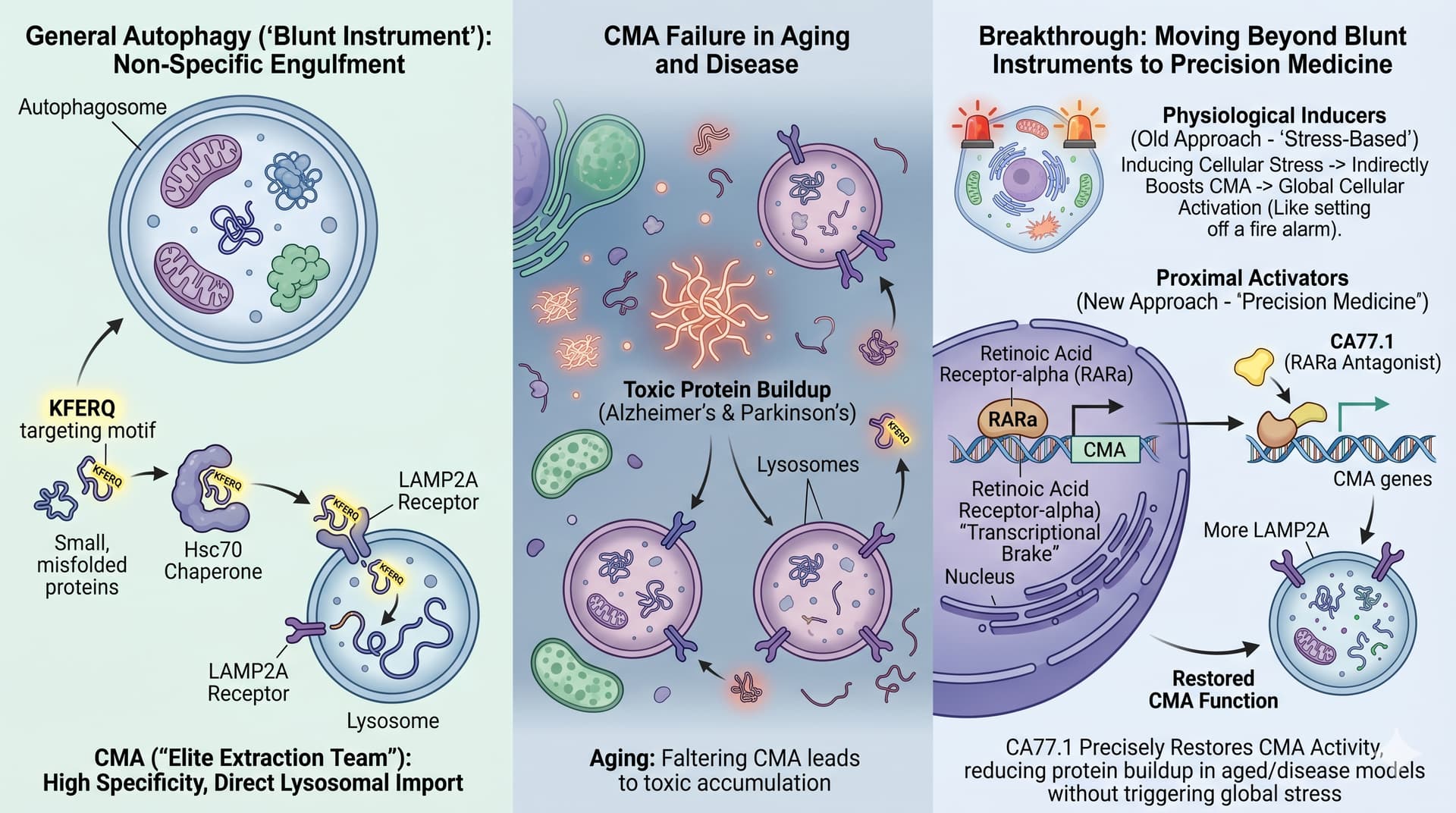
The biological “garbage disposal” of the cell just received a major upgrade in pharmacological theory. For decades, Chaperone-Mediated Autophagy (CMA) was the overlooked sibling of macroautophagy—the bulk recycling process popularized by intermittent fasting. However, a new review published in Trends in Pharmacological Sciences argues that CMA is not just a secondary stress response, but a surgical tool for maintaining proteostasis that is finally becoming “pharmacologically tractable”.

Unlike other forms of autophagy that swallow large chunks of cellular material, CMA is an elite, protein-specific extraction team. It identifies individual misfolded or damaged proteins using a “KFERQ” targeting motif and shuffles them directly into the lysosome for destruction. As we age, this system falters, leading to the toxic protein buildup characteristic of Alzheimer’s, Parkinson’s, and metabolic collapse.

The breakthrough lies in moving beyond “blunt instruments”. Early attempts to boost CMA relied on inducing cellular stress—essentially trying to clean a house by setting off the fire alarm. This review introduces a three-tier classification system to guide drug discovery: physiological inducers (stress-based), permissive potentiators (signaling-based), and proximal activators (transcriptional-based).

The most promising frontier is the “proximal activator” class, specifically Retinoic Acid Receptor-alpha (RARa) antagonists. Researchers have identified that RARa acts as a “transcriptional brake” on the CMA machinery. By neutralizing this brake with synthetic compounds like CA77.1, scientists have successfully restored CMA activity in aged tissues and disease models without triggering global stress or interfering with other cellular pathways. This marks a transition from empirical “biohacking” toward high-precision medicine aimed at extending the human healthspan.


Actionable Insights

Current evidence suggests that CMA can be modulated through three primary avenues:

  • Calorie Restriction (CR) and Mimetics : CR remains the most robust physiological inducer of CMA in vivo. Compounds like Spermidine and Hydroxycitrate act as CR-mimetics by altering the acetylation of chaperone networks (HSC70), effectively lowering the threshold for protein recognition and degradation.

  • Repurposed Compounds : Common longevity drugs like Metformin and Trametinib have been identified as permissive potentiators. Metformin facilitates CMA via the TAK1/IKK pathway, while Trametinib (a MEK inhibitor) stabilizes the lysosomal receptor LAMP-2A, though both have significant pleiotropic effects beyond CMA.

  • The RARa Frontier : While not yet available for general use, RARa antagonists (e.g., QX77, CA77.1) represent the most “pathway-selective” approach to increasing cellular cleaning capacity. These compounds specifically increase the expression of LAMP-2A , the rate-limiting receptor for CMA, providing a potential future pharmaceutical route to combat age-related proteotoxicity.


Context

  • Paper: Pharmacological strategies targeting chaperone-mediated autophagy
  • Institutions : Karolinska Institutet (Sweden), University of New Mexico Health Sciences Center (USA).
  • Journal : Trends in Pharmacological Sciences (TIPS).
  • Impact Evaluation : The CiteScore for this journal is 24.5 (2024), evaluated against a typical high-end range of 0–60+ for top general science; therefore, this is a High impact journal in the field of pharmacology

Related Reading:

Novelty

This paper introduces the Functional Selectivity Index (FSI) to quantify the “cleanliness” of CMA drugs. It establishes that most “CMA activators” in current use (like Metformin) are actually pleiotropic signaling modulators with low FSI, whereas the newer CA-series RARa antagonists show high functional selectivity for the CMA pathway.

Critical Limitations

  • Lack of Direct Ligands : There are currently no known small molecules that directly bind to and activate the core CMA machinery (HSC70 or LAMP-2A); all existing drugs act on upstream regulators.

  • Developmental Risk : Both RARa and TGFb signaling—primary targets for proximal activation—are essential for fertility and embryonic development. The teratogenic risk of chronic CMA activation has not been evaluated. [Confidence: High]

  • Biomarker Gap : There is a critical lack of validated biomarkers to monitor CMA flux in humans, making clinical trial design difficult. [Confidence: High]

  • Contextual Reversibility : Severe stress can actually suppress CMA, suggesting the dose-response curve for CMA induction may be bell-shaped rather than linear

Following the guidelines for external verification and hierarchy of evidence, the following claims from the research on Chaperone-Mediated Autophagy (CMA) have been assessed against live research databases (PubMed, Google Scholar, Cochrane Library).

Claims & Verification

1. CMA activity declines with age in human tissues.

  • Evidence Level: Level C (Human Observational/Cohort Studies).
  • Verification: Significant human cohort data confirms a progressive decline in LAMP-2A expression in human skeletal muscle, liver, and fibroblasts as a function of age.
  • External Citation: Age-related decline of chaperone-mediated autophagy in skeletal muscle leads to progressive myopathy (2025).
  • Translational Gap: While decline is verified in human tissue biopsies, the functional rate of “CMA flux” in live humans remains unmeasured due to a lack of dynamic biomarkers.

2. Metformin enhances CMA via HSC70 phosphorylation.

3. RARa antagonism (CA77.1) restores CMA and clears neurotoxic aggregates.

4. Spermidine acts as a “CR-mimetic” to increase CMA via deacetylation.

  • Evidence Level: Level B (Human RCTs) for cognitive outcomes; Level D for CMA mechanism.
  • Verification: While Spermidine is a verified autophagy inducer in human RCTs (improving memory in older adults), the specific mechanistic reliance on CMA (via SIRT2/HSC70 deacetylation) is largely demonstrated in rodent models.
  • External Citation: Cardioprotection and lifespan extension by the natural polyamine spermidine (2016).
  • Translational Gap: Moderate. Human data supports the outcome (longevity/cognition), but the pathway(CMA vs. Macroautophagy) is not yet distinguished in human subjects.

5. Trametinib increases CMA to improve metabolic health and lifespan.


Summary of Evidence Hierarchy

Claim Category Top Evidence Level Primary Source Type Confidence
CMA & Aging Level C Human Tissue Biopsies High
CMA & Neurodegeneration Level C Post-mortem Brain Analysis Medium
Metformin / Spermidine Level B/D Human Outcome / Mouse Mechanism High (Outcome) / Low (Path)
RARa Activators (CA77.1) Level D Rodent/In Vitro only Low (Translational)
Trametinib for Longevity Level D Mouse Lifespan Studies Low (Safety Risk)

Translational Uncertainty Flag: There is currently Zero Level A evidence (Meta-analysis of human RCTs) specifically for pharmacological “CMA activation” in humans. All clinical translation remains speculative based on proxy biomarkers (e.g., LAMP-2A levels) rather than direct flux measurement. [Confidence: High]