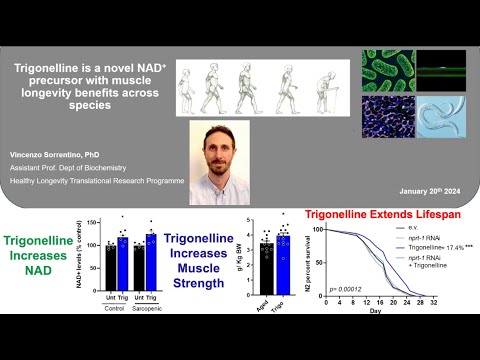
Dr. Vincenzo Sorrentino (National University of Singapore) presents a translational study identifying Trigonelline(methylated nicotinic acid) as a novel, stable NAD+ precursor with specific benefits for muscle resilience and sarcopenia. Unlike the popular NAD+ boosters Nicotinamide Riboside (NR) and Nicotinamide Mononucleotide (NMN), which are unstable in serum and degrade rapidly into Nicotinamide (NAM), Trigonelline exhibits superior stability, remaining intact in serum for over 48 hours.
The research establishes that Trigonelline levels correlate positively with muscle function (grip strength, gait speed) and NAD+ levels in human sarcopenic cohorts. Mechanistically, it bypasses the Salvage Pathway used by NR/NMN, instead utilizing the Preiss-Handler pathway (via the enzyme NAPRT) to generate NAD+. While it does not increase peak muscle force, it significantly improves muscle fatigue resistance in aged mice and extends lifespan in C. elegans.
Critical Caveat: The human equivalent dose required to match the murine efficacy is approximately 1.6–1.8 grams. Achieving this via dietary sources (coffee, fenugreek seeds) is currently unfeasible without consuming toxic loads of raw material. While promising, Trigonelline represents a “next-generation” molecule that currently lacks a pure, standardized human supplement form.
Bullet Summary
Sarcopenia Link: Sarcopenia (age-related muscle loss) is molecularly characterized by mitochondrial dysfunction and significant NAD+ depletion.
Trigonelline Identification: In a Singaporean cohort, Trigonelline was the only Vitamin B3-related metabolite significantly downregulated in sarcopenic individuals.
Correlation: Serum Trigonelline correlates positively with appendicular lean mass, grip strength, and gait speed in humans.
Chemical Structure: Trigonelline is N-methylnicotinate (methylated Vitamin B3). It is naturally found in coffee beans and fenugreek seeds.
Superior Stability: Unlike NR and NMN, which degrade into Nicotinamide within hours in serum, Trigonelline is stable for >48 hours and does not spontaneously degrade.
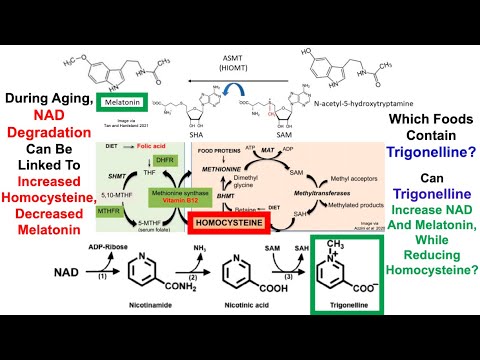
Mechanism of Action: It functions as an NAD+ precursor but requires the Preiss-Handler pathway; specifically, the enzyme NAPRT is rate-limiting.
Pathway Distinction: Blocking the Salvage pathway (NAMPT enzyme) prevents NR/NMN efficacy but notTrigonelline efficacy. Blocking NAPRT abolishes Trigonelline efficacy.
Mitochondrial Rescue: Trigonelline restores mitochondrial membrane potential and respiration in NAD-depleted human myotubes.
Longevity Data: Supplementation extended median lifespan in C. elegans (worms) by ~17.4%.
Murine Bioavailability: Oral gavage in mice (300mg/kg) raised NAD+ levels in muscle, liver, kidney, and blood within 2 hours.
Muscle Performance: In aged mice (2 years old), chronic supplementation did not increase peak force but significantly preserved muscle function during repeated contraction (fatigue resistance).
Kidney Safety: Contrary to concerns about it being a uremic toxin, emerging data suggests Trigonelline may reduce fibrosis in diabetic nephropathy models.
Dosing Reality: The effective human dose is estimated at ~1.8g. A cup of coffee provides only ~2-3mg; thus, dietary sourcing is insufficient for therapeutic NAD+ restoration.
Claims & Evidence Table (Adversarial Peer Review)
Role: Longevity Scientist & Peer Reviewer. Context: Evaluating Dr. Sorrentino’s claims against the hierarchy of evidence.
Human data is purely observational (correlation). No RCTs exist showing reversal of sarcopenia in humans.
D(Mouse/Cell) C (Human Cohort)
Speculative(Translational Gap)
“Trigonelline increases NAD+ levels”
Increased NAD+ in liver, muscle, kidney of mice; human myotubes.
Validated in preclinical models. Human pharmacokinetics and NAD+ flux confirmation are pending.
D(Animal/In Vitro)
Strong Support(in animals)
“Better stability than NR/NMN”
Serum assay showing NR/NMN degradation vs. Trigonelline stability >48hr.
Chemically accurate. The N-methyl group protects against degradation by serum enzymes (e.g., CD38).
D (Ex Vivo Serum)
Fact (Chemical Property)
“Extends Longevity”
C. elegans study showing ~17% median lifespan increase.
Worm longevity rarely translates to mammals. The NIA ITP has not tested Trigonelline in mice for lifespan.
D (Worm only)
Weak/Speculative
“Coffee/Fenugreek are sources”
Cites presence in beans/seeds.
Bioavailability is low. Therapeutic dose (1.8g) is impossible to reach via diet (requires ~400 cups of coffee).
E(Theoretical)
Impractical(Actionable Gap)
“Safe for Kidneys”
Cites recent diabetic nephropathy study showing reduced fibrosis.
Trigonelline is a known uremic toxin that accumulates in CKD. High-dose safety in humans with compromised renal function is unknown.
D (Animal Disease Model)
Safety Warning
Export to Sheets
Verdict Key:
Translational Gap: The jump from mouse “fatigue resistance” to human “sarcopenia reversal” is significant.
Safety Warning: High-dose methylated B3 analogs can tax the methyl pool (homocysteine cycle).
Actionable Insights (Pragmatic & Prioritized)
Based on the evidence grade, there is currently no Level A/B evidence to support a high-dose Trigonelline protocol for humans. The following are risk-adjusted takeaways.
Top Tier (High Confidence)
Stick to Exercise: The “Positive Control” in sarcopenia prevention remains resistance training. Trigonelline only improved endurance in mice; it did not increase peak force. Weight lifting remains the gold standard for sarcopenia.
Experimental (Risk/Reward)
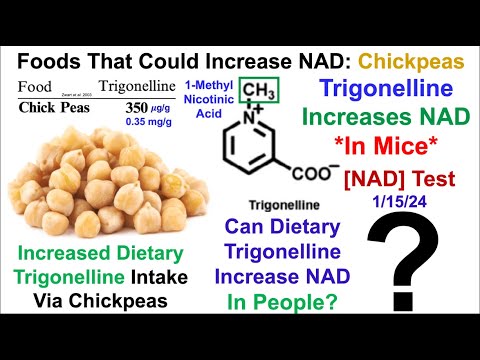
Coffee Consumption: Regular coffee drinkers (3-4 cups/day) have higher plasma Trigonelline. While not a therapeutic “NAD+ Booster” dose, it correlates with better muscle metrics. This is a low-risk intervention.
Dietary Legumes: Incorporating chickpeas, lentils, and fenugreek leaves (methi) into the diet provides low-level exposure to Trigonelline along with fiber and folate, which supports the methyl-pool required for NAD+ metabolism.
Avoid (Safety Risks)
Do Not Megadose Fenugreek Extracts: To achieve the 1.6g human equivalent dose, you would need to consume ~15g of wild fenugreek extract. This carries high risks of liver toxicity, heavy metal contamination, and gastrointestinal distress.
Do Not Assume “Methyl” = Better: Trigonelline is a methylated niacin. Its metabolism releases a methyl group. In people with MTHFR mutations or high homocysteine, the fate of this methyl group is unclear and requires monitoring.
Technical Deep-Dive: The Preiss-Handler Pathway
Dr. Sorrentino’s work highlights a critical divergence in NAD+ biosynthesis pathways.
Mechanism: Trigonelline enters the cell and is likely demethylated to Nicotinic Acid (NA). NA is then converted to Nicotinic Acid Mononucleotide (NaMN) via NAPRT, then to Nicotinic Acid Adenine Dinucleotide (NaAD), and finally amidated to NAD+.
Significance: By utilizing NAPRT, Trigonelline bypasses the bottleneck of the Salvage pathway (NAMPT). If NAMPT is impaired in aged muscle, Trigonelline provides an alternative “fuel line” to the mitochondria that NR/NMN cannot access.
The Methylation Puzzle: Trigonelline is N-methylnicotinate. To become NAD+, it must lose that methyl group.
Question: Does this methyl group feed into the methionine cycle (creating SAMe)?
Risk: Or does it require a methyl donor to process, or accumulate as a byproduct?
Current Data: The transcript admits they do not yet know the fate of the methyl group. This is a crucial missing piece of the metabolic puzzle.
Give me time to poke around. But Vincenzo Sorrentino has applied for a patent for a trigonelline supplement.
CLAIMS The invention is claimed as follows:
A composition consisting essentially of trigonelline or consisting of trigonelline.
The composition of Claim 1, wherein the composition is formulated for enteral administration.
The composition of Claim 1 or 2, wherein the composition is selected from the group consisting of a food product, a food supplement, an oral nutritional supplement (ONS), a medical food, and combinations thereof.
The composition according to any one of preceding claims, wherein at least a portion of trigonelline is isolated.
The composition according to any one of preceding claims, wherein at least a portion of trigonelline is provided by a plant or algae extract in the composition.
The composition according to any one of preceding claims, wherein at least a portion of trigonelline is provided by a trigonelline-enriched plant or algae extract in the composition.
The composition according to any one of preceding claims, wherein the trigonelline is selected from an extract of coffee, fenugreek or algae.
The composition according to any one of preceding claims, wherein trigonelline is selected from an extract of fenugreek which contains at least about 25% - 50% trigonelline.
The Composition according to any one of preceding claims, wherein trigonelline is chemically synthesized and which contains at least about 90% trigonelline.
A method for increasing intracellular nicotinamide adenine dinucleotide (NAD+) in a mammal, the method comprising administering a composition consisting essentially of trigonelline or consisting of trigonelline to the mammal in an amount effective to increase NAD+ biosynthesis in one or more cells of the mammal.
Thats actually a good sign… if the guy is going through the hassle and cost of of filing a patent (I vaguely recall that the cost is typically around $5K working with IP lawyers in the US for a basic patent), it means he thinks it is worth the investment in time and money.
Unfortunately, you are probably not going to get a large enough dose of trigonelline from a Fenugreek supplement. One Fenugreek extract supplement on Amazon claims to have 2.5% trigonelline in each 500mg. capsule. That would amount to ~12.5 mg. per capsule.
I have tried Fenugreek in the past with no discernible result in lowering blood glucose.
I don’t know how much you would have to take to get the other claimed benefits.
The lowest effect dose in rat studies that I could find was 50mg/kilogram. This would amount to ~ 3.5 grams of trigonelline for a human equivalent dose in a 70 Kg man.
“Overall, the animal research indicates that trigonelline doses of 50-100 mg/kg appear effective at lowering blood glucose in diabetic rodent models.”
Human Equivalent Dose (mg/kg) = Animal dose (mg/kg) x (Animal Km / Human Km)^0.33
Where Km is a correction factor based on body surface area. For a rat, Km is 6, and for a human, Km is 37
Chickpeas did not move the needle. Lustgarten tried 24 g of fenugreek. Data will be available in a few weeks.
If the aim is to increase NAD, Lustgarten’s experience shows the best approach is to take 600 mg of nicotinic acid (NAD 67.4); better than 2,000 of NMN (NAD 61.0).
2 tablespoons of ground fenugreek seeds
2 tablespoons of chlorella
All mixed in almond milk
I have no idea how this will taste, but I think it’ll be yummy. Do I have evidence for this belief/hope? No. But I’ll let you all know if this recipe works.
Where’d you get the idea for chlorella? The mention of algae in the patent?
The patent actually states Laminariaceae - kelp.
SUMMARY
[004] The present disclosure provides a composition consisting essentially of trigonelline or consisting of trigonelline. In some embodiments, at least a portion of the trigonelline is provided by a plant extract in the composition, such as one or more of a coffee extract, a hemp extract, a pumpkin seed extract and/or a fenugreek seed extract, for example a plant extract enriched in trigonelline.
[005] In a preferred embodiment, at least a portion of trigonelline is provided from a fenugreek extract. [006] In some embodiments, at least a portion of the trigonelline is provided from an algae source, for example, a Laminariaceae extract.
Oh sorry for not being clear. The Chlorella is just something I bought a while ago and been trying to figure out a way to incorporate into my daily regime. The chlorella is for the spermidine content (approximately 300ppm or 0.06%). So two tablespoons (30 grams) should give me roughly 18mg of spermidine per day (I think )
The highest content of spermidine was found in the fruiting bodies of unprocessed brown and white mushrooms (367.22 ± 14.19 and 266.47 ± 13.38 mg/kg, respectively).
That is 3.67 mg per 10 grams, or 11.01 mg per 30 grams. One needs to take more, but it is more palatable, and more sustainable long-term.
That was one of the most disgusting things I have ever drunk. Trying to squeeze 4 tablespoons of powder into a single drink results in a thick sludge. Which would have been okay if that sludge was sweet like melted chocolate or salted caramel.
This was NOT the case.
It tasted like I was drinking bitter curry flavoured seaweed.
It was also luminous green!!! OMG
I imagine 1 in a billion humans will find this tasty. I am not one of those 8 people.
Two lessons.
I will only try less powder maybe over two or three drinks.
I will add something sweet. I am thinking Treehalose,
Will update again.
Please, if you have a healthy recipe proposal - I am all ears
Often fenugreek seed powder is made into a “tea” by straining it, but who knows how much trigonelline is in the tea, and does it depend on the fineness of the straining? I saw one estimate that a serving of prepared coffee contains about 5mg, but likely that varies by brewing method.
I haven’t found any good source for higher dosage supplementation.
 )
)

 )
)