Train Your Visual Search: How Sharpening Spatial Focus Preserves Reading Speed into Your Eighties

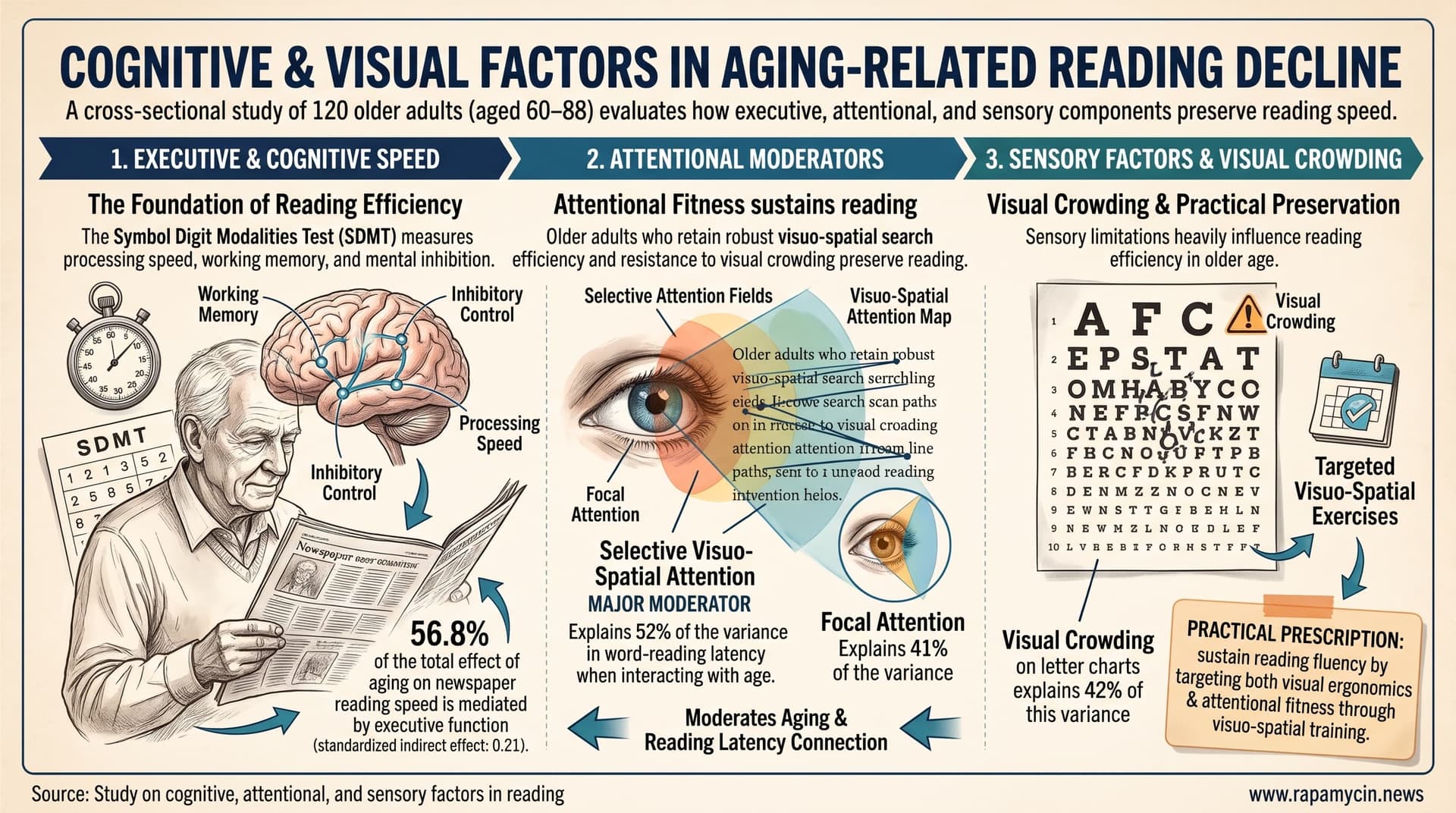
Italian researchers tested 120 neurologically healthy adults aged 60 to 88 on a large battery of reading, attention, vision and cognitive tasks to find out what drives slower reading with age. Using statistical mediation, they found that general cognitive speed matters most. The Symbol Digit Modalities Test, which combines processing speed, working memory and inhibition, accounted for roughly a quarter to more than half of the age effect on reading speed, outperforming simpler reaction-time and Stroop measures. Visual acuity explained a small share of slowing on simple word lists. Visuo-spatial attention did not mediate the age effect but moderated it: people with poorer selective and focal attention showed steeper age-related slowing on word and pseudoword lists. Sustained attention and attentional orienting played no role.

Reading gets slower with age, even in healthy, well-educated people who read every day. Most of us assume the eyes are to blame. A new study from the University of Milano-Bicocca suggests the brain’s general processing speed is the bigger story, and that a specific kind of attention decides who slows down most.

The team tested 120 healthy Italians aged 60 to 88. Each spent up to two hours on reading tasks: lists of real words and invented pseudowords, presented tightly or widely spaced; a passage from a news magazine; and a test of reading unrelated words as fast as possible. They also completed vision charts, reaction-time tests, the Stroop color-word test, a finger-tapping test of sustained attention, a visual search task that separates different kinds of spatial attention, and the Symbol Digit Modalities Test, in which people match symbols to numbers against the clock.

Age predicted slower reading on every task. The question was why. Using a statistical method called mediation analysis, the researchers asked which abilities sit on the path between age and reading. The symbol-digit test came out on top. It explained more than half of the age-related slowing in reading the magazine passage and a large share for the other tasks. When it was analyzed alongside the reaction-time and Stroop tests, it absorbed their contribution entirely. The authors argue this is because the symbol-digit test bundles processing speed, working memory and the ability to ignore distraction into one demanding task, which is also what fluent reading requires.

Vision mattered too, but less. Visual sharpness explained a small slice of slowing on simple word lists, where cognitive load is light. For harder material such as pseudowords and continuous text, cognition dominated.

The authors’ main hypothesis concerned selective visuo-spatial attention, the brain’s ability to spotlight one location and suppress clutter around it. They expected it to sit on the causal path. It did not. Instead, it changed the strength of the age effect. Among people with weaker selective attention, reading time climbed steeply with age; among those with strong attention, the age slope was much flatter. At around 80, the difference on a word list amounted to roughly ten seconds out of thirty to forty. A narrower “focal” component of attention behaved similarly, while the ability to shift attention between locations had no effect. Sustained attention, the capacity to stay on task, was also irrelevant.

The practical message the authors draw is that general processing speed is hard to train, but visual attention may be a more specific and trainable target. The same group has already piloted eye-controlled video games for older readers.

There are limits. The study compares different people at different ages rather than following anyone over time, which makes causal language about “decline” premature. Many of the tests share a dependence on speed, which can inflate apparent links. The attention findings emerged only after the planned analysis failed, and several rested on borderline statistics.

Still, the study reframes reading in later life as a readout of attentional health, not just eyesight.

Actionable insights

The study tests no intervention, so these points follow from its associations plus one related trial.

How big is the age effect? On the speed-reading test, scores fell by roughly 18 words per minute per decade, about 14% of the group average. For simple word lists, reading time rose about 8 seconds per decade, roughly 30% of the average. [Confidence: Medium, back-calculated from standardized coefficients]

Processing speed is the main channel. The symbol-digit test carried about 57% of the age effect on reading a news passage and about 43% on speed reading. Habits that preserve general cognitive speed are therefore the most relevant lever, though none were tested here. [Confidence: Medium]

Keep your vision corrected. Visual acuity explained only about 6 to 7% of the age effect, and only for simple word lists. It is still the cheapest factor to fix: get regular eye exams that include near-vision correction. [Confidence: Medium]

Attention training is plausible but unproven. The same lab enrolled 40 healthy participants over 65 in an eye-guided video game pilot. Reading improved, but attentional measures did not change.

Noticeable slowing in reading unfamiliar or dense text is worth tracking as a cognitive signal, not as a diagnosis.

Context and source

  • Open Access Paper: Reading in healthy aging: how attentional components drive age-related changes
  • Institutions: Department of Psychology, University of Milano-Bicocca; NeuroMI Milan Centre for Neuroscience; Golgi Cenci Foundation (Abbiategrasso); Mercatorum University (Rome); LUMSA University (Rome)
  • Country: Italy
  • Journal: Aging Clinical and Experimental Research (Springer). DOI 10.1007/s40520-026-03535-9
  • Impact evaluation: The impact score of this journal is 4.7, evaluated against a typical high-end range of 0 to 60+ for top biomedical journals, therefore this is a Low impact journal.

Attention Training Resources for Older Adults

Only one type of attention training has durable evidence in healthy older adults: visual speed-of-processing training, also called Useful Field of View (UFOV) training. Everything else is promising but thinly supported. The resources below are grouped by strength of evidence, and all links are in the reference section at the bottom.

Tier 1: Speed-of-processing (UFOV) training

The ACTIVE trial, 20-year follow-up (2026)

This is the strongest evidence for any cognitive training program. ACTIVE randomized 2,802 healthy adults aged 65 and older to speed training, memory training, reasoning training or no training, then tracked dementia diagnoses through Medicare claims from 1999 to 2019.

  • About 48.7% of the control group received a dementia diagnosis over 20 years.
  • Memory and reasoning training did not reduce risk.
  • Speed training plus booster sessions was associated with about 25% lower risk than control.
  • The total dose was modest: roughly 10 to 23.5 hours over the first three years.

The weaknesses matter:

  • Speed training without boosters showed no benefit (HR 1.01, 95% CI 0.81 to 1.27).
  • Booster completion was not randomized, so healthier or more motivated people may have self-selected into the group that benefited.
  • Dementia was identified from billing codes, not clinical assessment.
  • The final analytic sample was about 2,000 after excluding Medicare Advantage enrollees.

[Confidence: Medium]

BrainHQ and its “Double Decision” exercise (Posit Science)

This is the commercial version of the UFOV training developed by Karlene Ball and Daniel Roenker, the basis of the ACTIVE speed arm. It is the practical way for an individual to do this kind of training. It is a subscription product, and Posit Science has an obvious commercial interest in the ACTIVE results. Much of the media coverage of ACTIVE is republished on BrainHQ’s own site, so read the primary papers rather than the marketing. [Confidence: Medium for the exercise itself]

Iowa Healthy and Active Minds Study (IHAMS)

This independent replication randomized 681 adults aged 50 and older to three versions of speed training (10 hours on-site, 14 hours on-site, or 10 hours at home) or a crossword-puzzle control. Training stabilized or improved several cognitive measures at one year, and the at-home version worked about as well as supervised training. Posit Science did not fund it. [Confidence: Medium]

Senior living trial and a safety signal

A University of Iowa trial enrolled 351 residents of independent and assisted living, aged 55 to 102 (mean 81). Processing speed improvements were small (Cohen’s d 0.25 to 0.40), about 39 to 63 milliseconds on the UFOV test.

A follow-up paper from the same trial found the opposite of what was hoped on mood. Among assisted living residents, the training significantly increased depressive symptoms at 12 months. The authors advised avoiding this program in assisted living and monitoring for depression with other speed training programs. This is the only published harm signal I found. It deserves more attention than it gets, and Posit Science’s press coverage of the trial omits it. [Confidence: Medium]

Tier 2: Multitasking and cognitive control games

NeuroRacer (UCSF, Gazzaley lab)

This is a 3-D driving and sign-detection game in which adults aged 60 to 85 reduced their multitasking costs, with gains extending to untrained sustained attention and working memory. The trial was small: 46 participants randomized to three groups, 12 hours of training over four weeks at home, with gains persisting six months. It is scientifically influential, but the sample is too small to support strong conclusions. NeuroRacer is a research tool, not a consumer product. [Confidence: Low to Medium]

Akili and EndeavorRx

Akili was co-founded by Adam Gazzaley to commercialize the NeuroRacer approach. Its EndeavorRx was the first FDA-authorized video game treatment, cleared for children with ADHD. A companion app, EndeavorOTC, targets adults with inattentive ADHD.

Neither product has been tested for healthy cognitive aging. Their relevance here is as proof that game-based attention training can meet a regulatory evidence bar, not as a recommendation for older readers. [Confidence: Low for aging use]

Tier 3: Reading-specific training

Pedrini et al. 2025, eye-guided video games (University of Milano-Bicocca)

This is the pilot from the same lab as the reading study. It enrolled 40 healthy adults over 65, with 21 in the training group. Reading improved, but attentional measures did not change, so the mechanism is unclear. The games were custom-built and, as far as I can find, are not commercially available. The full paper is open access and useful mainly for its training design: saccades, fixations and pursuit tracking. Safety Data Absent in the accessible material. [Confidence: Low]

Skeptic’s resources (read these first)

Cochrane review, Gates et al. 2020

This review pooled 8 RCTs with 1,183 participants aged 65 and older who trained for at least 12 weeks.

  • It found a slight improvement in global cognition at the end of training versus active controls (SMD -0.31).
  • There was no clear evidence the benefit persisted at 12 months.
  • Effects on processing speed could not be determined because the evidence was of very low quality.
  • Overall evidence quality was rated low.

This is the necessary counterweight to brain-training marketing. [Confidence: High that generic brain training is oversold]

Lampit et al. 2014, PLoS Medicine

This meta-analysis of computerized cognitive training in healthy older adults focuses on effect modifiers: which design features (supervision, session frequency, training type) are associated with better or worse results. It is useful for judging whether a given product is likely to resemble the programs that worked.

Edwards meta-analysis (summarized in the senior living paper)

The senior living paper’s introduction summarizes a review by Edwards and colleagues of 17 RCTs of speed training. It reported a large effect on the trained UFOV task (Cohen’s d 0.71), along with some transfer. Large gains on the trained task are expected. The question that matters is transfer to daily life, and that evidence is much thinner.

Practical guidance

  • If someone wants to try one thing, it should be speed-of-processing training such as Double Decision, scheduled like ACTIVE: an initial block of about 10 hours, then periodic booster sessions over the following years. The booster pattern is where the dementia signal appeared, although that subgroup was self-selected.
  • Monitor mood, especially in frail or assisted living populations.
  • Pair training with a current eye exam that includes near-vision correction.
  • Be skeptical of any product that cites ACTIVE but trains something other than visual speed of processing. Memory and reasoning training in ACTIVE showed no effect on dementia risk.
  • Do not expect training to fix reading directly. The best-supported benefits are faster visual processing and, possibly, delayed dementia diagnosis. Reading-specific benefits rest on one 40-person pilot.

References and links

Speed-of-processing training

  1. Coe NB, et al. Impact of cognitive training on claims-based diagnosed dementia over 20 years: evidence from the ACTIVE study. Alzheimer’s & Dementia: Translational Research & Clinical Interventions. 2026. https://doi.org/10.1002/trc2.70197
  2. Full text PDF of the ACTIVE 20-year paper (hosted by BrainHQ): https://www.brainhq.com/wp-content/uploads/2026/02/A20-journal.pdf
  3. ReachMD summary of the ACTIVE 20-year results: Speed-Focused Cognitive Training With Booster Sessions Linked to Lower Dementia Diagnoses Over 20 Years - ReachMD
  4. EMJ summary, including the no-booster hazard ratio: 20-Year Study: Cognitive Training Cuts Dementia Risk - EMJ
  5. Psychiatrist.com summary, including analytic sample details: Brain Training Could Delay Dementia for Years
  6. OnTheBrain summary of ACTIVE speed training dose: New Study Means the Age of Dementia Prevention Begins Now - "On the Brain" with Dr. Michael Merzenich
  7. BrainHQ (Posit Science): https://www.brainhq.com
  8. BrainHQ, UFOV development history and Double Decision: The Development of UFOV - BrainHQ
  9. Wolinsky FD, et al. A randomized controlled trial of cognitive training using a visual speed of processing intervention in middle aged and older adults (IHAMS). PLoS ONE. 2013;8(5):e61624. A Randomized Controlled Trial of Cognitive Training Using a Visual Speed of Processing Intervention in Middle Aged and Older Adults
  10. IHAMS trial registration, NCT01165463: ClinicalTrials.gov
  11. Smith M, Jones MP, Dotson MM, Wolinsky FD. Speed-of-processing training in assisted and independent living: a randomized controlled trial. J Am Geriatr Soc. 2018;66(8):1538-1545. https://doi.org/10.1111/jgs.15423 (full text: Speed of Processing Training in Assisted and Independent Living: A Randomized Controlled Trial - PMC)
  12. Smith M, Jones MP, Dotson MM, Wolinsky FD. Speed of processing training and depression in assisted and independent living: a randomized controlled trial. PLoS ONE. 2019;14(10):e0223841. Speed of processing training and depression in assisted and independent living: A randomized controlled trial

Multitasking and cognitive control games

  1. Anguera JA, et al. Video game training enhances cognitive control in older adults. Nature. 2013;501:97-101. Video game training enhances cognitive control in older adults | Nature (full text: Video game training enhances cognitive control in older adults - PMC)
  2. UCSF news release on NeuroRacer: https://www.ucsf.edu/news/2013/09/108616/training-older-brain-3-d-video-game-enhances-cognitive-control
  3. Neuroscape, Gazzaley’s UCSF center (URL not live-verified): https://neuroscape.ucsf.edu
  4. Akili: https://www.akiliinteractive.com
  5. EndeavorRx: https://www.endeavorrx.com
  6. ADDitude overview of EndeavorRx and EndeavorOTC: https://www.additudemag.com/treatment/endeavorrx/

Reading-specific training

  1. Pedrini R, Costantini C, Polato S, Lira C, Facchin A, Daini R. Eye-guided video games improve reading in healthy older adults. Int J Hum Comput Stud. 2025;202:103540. https://doi.org/10.1016/j.ijhcs.2025.103540
  2. Open-access PDF, University of Milano-Bicocca repository: https://www.boa.unimib.it/retrieve/d91d69f8-9415-4947-bbfc-c86278b38aed/Pedrini%20et%20al-2025-International%20Journal%20of%20Human-Computer%20Studies-VoR.pdf

Systematic reviews

  1. Gates NJ, et al. Computerised cognitive training for 12 or more weeks for maintaining cognitive function in cognitively healthy people in late life. Cochrane Database Syst Rev. 2020;2:CD012277. https://doi.org/10.1002/14651858.CD012277.pub3 (full text: Computerised cognitive training for 12 or more weeks for maintaining cognitive function in cognitively healthy people in late life - PMC)
  2. Lampit A, Hallock H, Valenzuela M. Computerized cognitive training in cognitively healthy older adults: a systematic review and meta-analysis of effect modifiers. PLoS Med. 2014;11:e1001756. Computerized Cognitive Training in Cognitively Healthy Older Adults: A Systematic Review and Meta-Analysis of Effect Modifiers