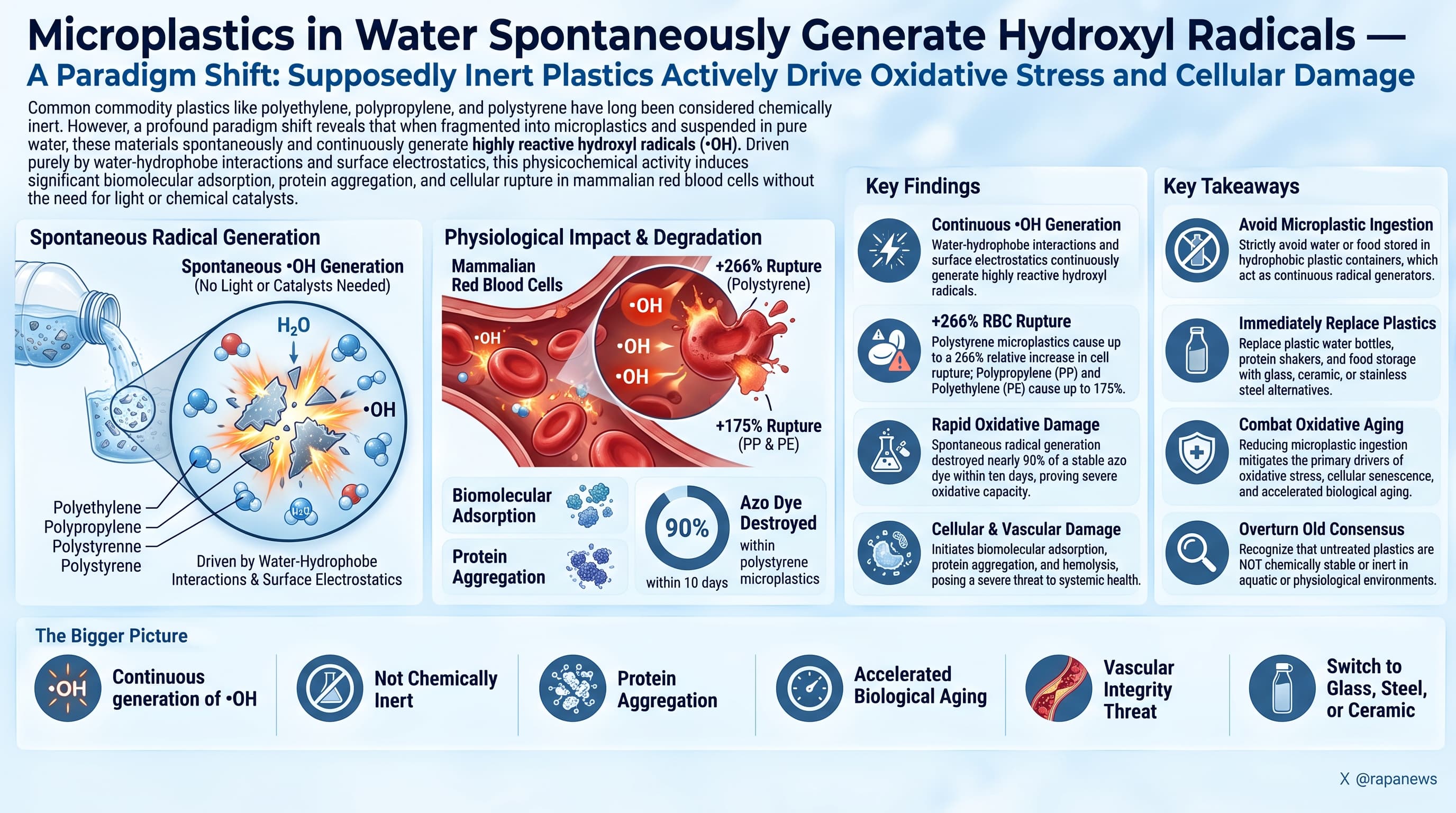
Commodity plastics have universally been considered chemically inert. This study reveals a profound paradigm shift: when fragmented into microplastics and suspended in pure water, common materials like polyethylene, polypropylene, and polystyrene spontaneously and continuously generate highly reactive hydroxyl radicals. This physicochemical activity is driven purely by water-hydrophobe interactions and surface electrostatics, directly inducing significant biomolecular adsorption, protein aggregation, and cellular rupture in mammalian red blood cells without the need for light or chemical catalysts.
Commodity plastics are universally valued for their chemical resistance and physical durability. The prevailing assumption across materials science and biology has been that these polymers remain largely inert under normal physiological and environmental conditions. This research dismantles that foundational assumption. When solid plastics fragment into microplastics and nanoplastics, their surface area to volume ratio increases exponentially. Placing these fragmented hydrophobic materials in pure water triggers spontaneous, sustained chemical reactivity.
The fundamental mechanism relies on how water behaves when forced against a surface it cannot bind with. Hydrophobic polymers possess no inherently reactive functional groups. However, their surfaces disrupt the normal hydrogen bonding networks of surrounding water molecules. This creates an undercoordinated water network characterized by dangling hydroxyl groups and partial solvation. Simultaneously, the microplastic-water interface spontaneously accumulates a negative electrical charge, creating a strong localized electric field. Ab initio molecular dynamics simulations demonstrate that this specific combination of structural strain and electrical charge drastically lowers the vertical ionization energy required to strip an electron from a hydroxide ion. Consequently, the water interface itself becomes a catalyst, continuously oxidizing hydroxide ions into highly reactive hydroxyl radicals without external energy inputs.
The researchers systematically analyzed six common commodity plastics: polystyrene, polyethylene, polypropylene, polyvinyl chloride, poly(methyl methacrylate), and polyethylene terephthalate. They discovered a direct correlation between the physical hydrophobicity of the material and its chemical reactivity. Polyolefins such as polyethylene and polypropylene exhibit the highest hydrophobicity and correspondingly produced the most intense free radical generation. To prove this phenomenon originates precisely at the physical boundary, the team introduced Triton X-100, a non-ionic surfactant. Coating the plastic effectively blocked the interaction between the pristine polymer surface and the water. This collapsed the localized electric field and completely suppressed the generation of hydroxyl radicals. This suppression confirms the reactive oxygen species are an emergent property of the microplastic-water boundary itself, not a result of chemical leaching.
This intrinsic physicochemical activity bridges the gap between environmental plastic pollution and acute biological toxicity. The plastic-water interfaces act as physical sinks for charged biomolecules, readily adsorbing proteins and DNA. Once bound to the surface, the continuous barrage of newly generated hydroxyl radicals damages these structures. In tests with lysozyme, the microplastics induced rapid protein aggregation. When introduced to live mammalian red blood cells, physical contact with the reactive plastic surfaces led directly to cellular fragmentation and rapid hemolysis. The data strongly indicates that microplastics cause harm by acting as persistent, solid-state engines for oxidative stress.
Actionable Insights
The practical takeaway for longevity and metabolic health is the strict avoidance of microplastic ingestion, particularly from water stored in hydrophobic plastic containers. The scientific consensus that untreated plastics are chemically stable is fundamentally incomplete. When plastic contacts water, it acts as a continuous generator of hydroxyl radicals. These radicals are primary drivers of oxidative stress, cellular senescence, and accelerated biological aging.
To mitigate this risk, individuals should replace all plastic water bottles, protein shakers, and food storage containers with glass, ceramic, or stainless steel alternatives. The magnitude of this oxidative threat is substantial. When researchers mixed polystyrene microplastics with water containing a stable azo dye, the spontaneous radical generation destroyed nearly 90 percent of the chemical dye within ten days.
In physiological tests using mammalian red blood cells, exposure to polystyrene microplastics caused a 266 percent relative increase in cell rupture compared to the baseline control group. Polypropylene and polyethylene, which are universally used in food packaging, caused up to a 175 percent relative increase in cellular destruction. This level of continuous, low-grade oxidative damage from ubiquitous environmental particles poses a severe threat to vascular integrity and long-term systemic health.
Context and Source
- Open Access Paper: Intrinsic physicochemical activity at microplastic-water interfaces
- Institution: Columbia University, University of California Berkeley, Lawrence Berkeley National Laboratory, Washington University in St. Louis, Rutgers University
- Country: USA
- Journal Name: Nature
- Impact Evaluation: The impact score of this journal is 64.8, evaluated against a typical high-end range of 0 to 60+ for top general science, therefore this is an Elite impact journal.