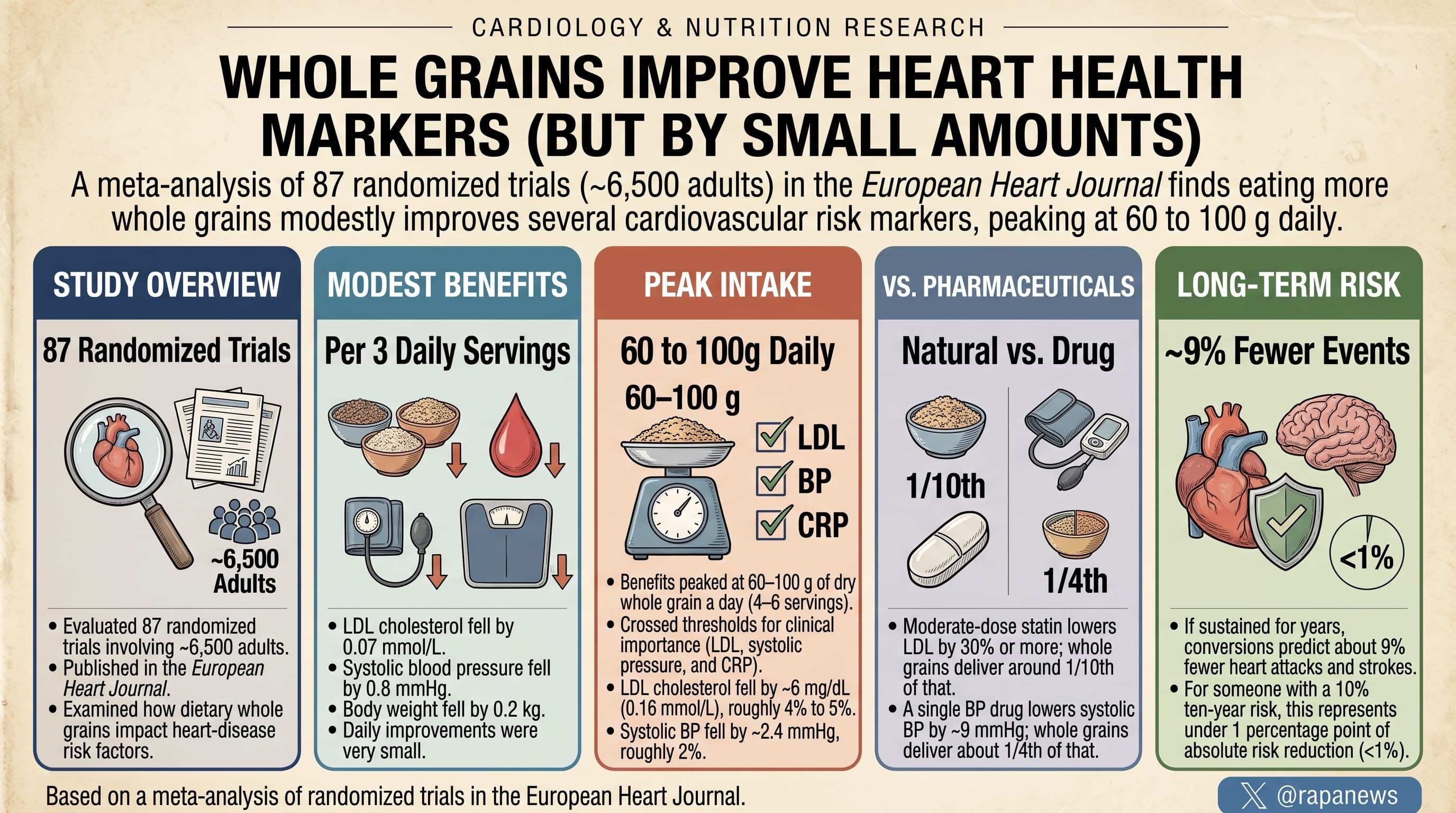
A meta-analysis of 87 randomized trials (about 6,500 adults) in the European Heart Journal finds that eating more whole grains improves several heart-disease risk markers, but by small amounts. Per three daily servings, LDL cholesterol fell 0.07 mmol/L, systolic blood pressure 0.8 mmHg and body weight 0.2 kg. Benefits peaked at 60 to 100 g of dry whole grain a day (four to six servings). At that intake, LDL cholesterol, systolic pressure and C-reactive protein crossed the authors’ thresholds for clinical importance.
Whole grains have one of the best reputations in nutrition. Large population studies that follow people for decades link about three servings a day to roughly a fifth fewer heart attacks and cardiovascular deaths. The weakness of that evidence is that people who eat oats and brown rice also tend to exercise, avoid smoking and see their doctors. A new analysis in the European Heart Journal asks a harder question. When people are randomly assigned to eat more whole grains, what happens to the measurements that drive heart disease?
The team, led from Tabriz University of Medical Sciences in Iran with collaborators at Imperial College London, pooled 87 randomized trials involving about 6,500 adults. Unlike earlier reviews, they did not simply compare whole-grain eaters with controls. They modeled the dose, asking how much each risk factor shifted per 48 g of dry whole grain a day, which is about three servings.
The answer is that whole grains work, but modestly. Three servings a day lowered LDL cholesterol by 0.07 mmol/L (about 3 mg/dL), systolic blood pressure by under 1 mmHg, body weight by 200 g and waist size by 2 mm. The authors compared each result with a preset threshold for the smallest change that matters to a patient. Most outcomes fell short. Weight, waist size, fasting glucose, HbA1c and the inflammatory marker interleukin-6 were all rated clinically irrelevant.
That changes how the abstract should be read. It reports reductions in weight, waist size and interleukin-6 “with high certainty.” In the grading system used, this means the authors are highly certain the effects are close to the reported small size. It does not mean a meaningful benefit is well established.
The more useful result comes from the dose curve. Benefits did not rise in a straight line. They appeared at 30 to 40 g a day and peaked at 60 to 100 g of dry whole grain, equal to four to six servings. At about 80 g, LDL cholesterol fell 0.16 mmol/L (6 mg/dL). At 60 g, systolic pressure dropped 2.4 mmHg and C-reactive protein fell 0.58 mg/L. These peak values crossed the thresholds for clinical importance. Beyond roughly 100 g the curves flattened or drifted back toward zero, though few trials tested such high intakes.
There is a gap the paper cannot close. Using standard conversions from drug trials, cholesterol and blood pressure changes of this size predict roughly 3 to 9 percent fewer cardiovascular events. Population studies report about 20 percent. The authors suggest benefits may accumulate over decades or add up across several pathways. A less comfortable explanation is that the population studies overstate the effect because whole-grain eaters are healthier in other ways. The trials offer little support for the accumulation idea. Those running 16 weeks or longer showed smaller effects, not larger ones.
Grain type matters too. Oats showed the strongest cholesterol lowering, consistent with their soluble fiber, while rye was linked to lower adiposity. The authors rated those subgroup findings as low credibility.
The practical message is that swapping refined grains for whole grains is a low-risk move that nudges several risk factors in the right direction. It is not a substitute for treating high cholesterol or high blood pressure.
Actionable Insights
The trials point to a target of 60 to 100 g of dry whole grain a day, which is four to six servings. A bowl of oatmeal made from 40 g of dry oats plus two slices of 100 percent whole-grain bread comes to roughly 70 to 80 g. Eating more than that showed no clear added benefit.
At that intake, LDL cholesterol falls by about 6 mg/dL (0.16 mmol/L), roughly 4 to 5 percent for a typical adult. Systolic blood pressure falls by about 2.4 mmHg, roughly 2 percent. For comparison, a moderate-dose statin lowers LDL by 30 percent or more, and a single blood pressure drug lowers systolic pressure by about 9 mmHg. Whole grains deliver around a tenth of the first and a quarter of the second.
If both changes held for years, standard conversions predict about 9 percent fewer heart attacks and strokes. For someone with a 10 percent ten-year risk, that is under 1 percentage point.
Do not expect weight loss (0.5 kg on average) or better blood sugar (HbA1c down 0.05 points). Choose oats or barley if cholesterol is the goal, and replace refined grains instead of adding calories.
Context/Source
- Open Access Paper: Whole-grain consumption and cardiometabolic risk: a meta-analysis of randomized trials
- Institutions: Tabriz University of Medical Sciences (lead and funder), Imperial College London, University of Western Ontario, Norwegian Institute of Public Health, Oslo New University College
- Countries: Iran (lead), United Kingdom, Canada, Norway
- Journal: European Heart Journal (Oxford University Press, for the European Society of Cardiology)
- Impact evaluation: The impact score of this journal is 45.6, evaluated against a typical high-end range of 0 to 60+ for top general medical and science journals, therefore this is an Elite impact journal.