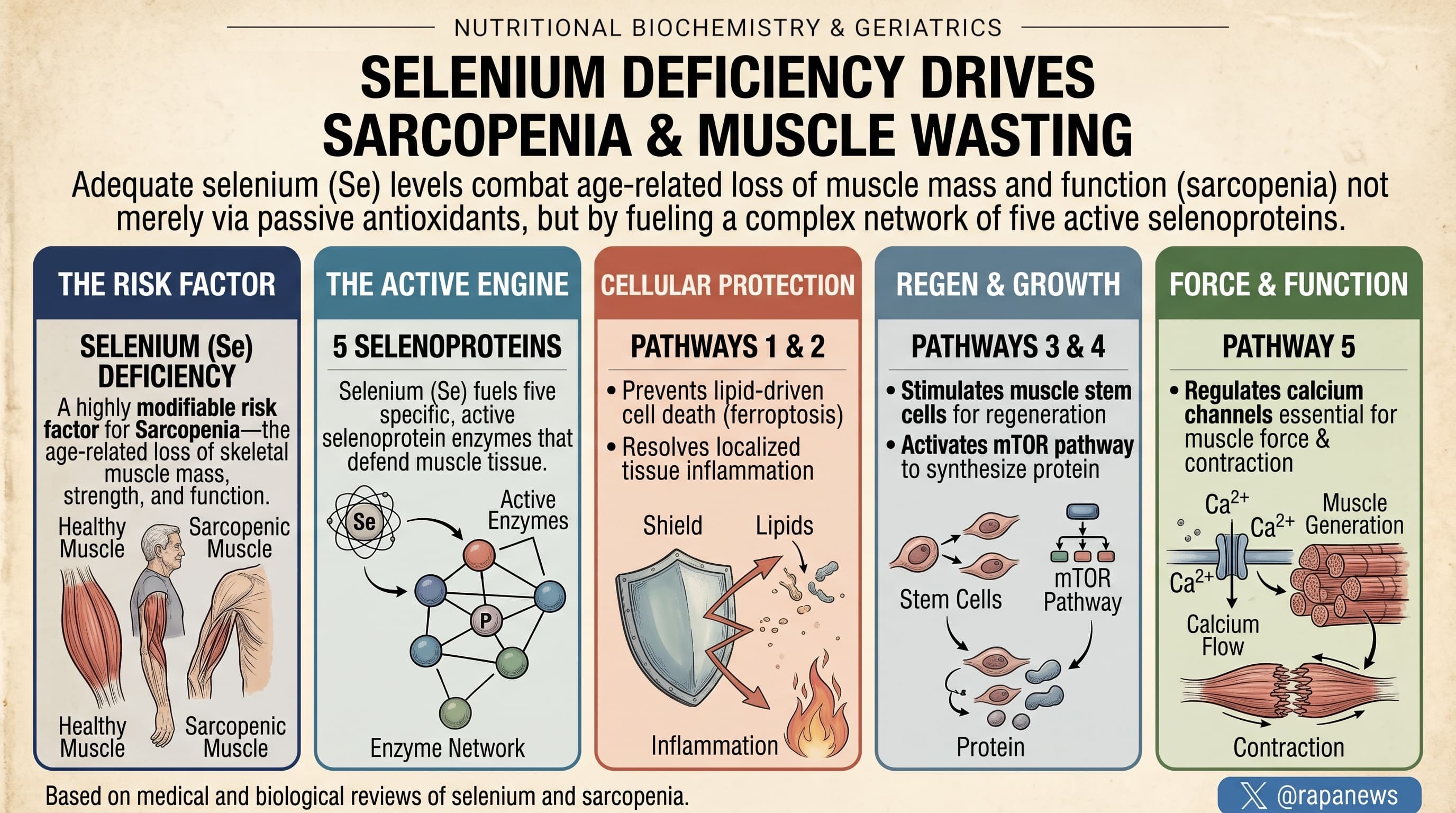
Selenium deficiency is a significant, modifiable risk factor for the development of sarcopenia, the age-related loss of skeletal muscle mass and function. This comprehensive review demonstrates that adequate selenium levels combat muscle wasting not merely through passive antioxidant activity, but by fueling a complex network of five specific selenoproteins. These active enzymes prevent lipid-driven cell death, resolve localized inflammation, stimulate muscle stem cells, activate the mTOR protein synthesis pathway, and regulate the calcium channels required for force generation.
Sarcopenia involves the progressive loss of skeletal muscle mass and strength during aging. While the medical community frequently points to resistance training and protein consumption as primary countermeasures, current evidence strongly suggests that micronutrient deficiencies play an equally critical role in muscle catabolism. Specifically, this review highlights selenium as a foundational element for maintaining muscle integrity.
The central premise is that skeletal muscle requires massive oxygen consumption and mitochondrial activity, making it exceptionally vulnerable to oxidative stress and lipid peroxidation. Selenium is not merely a passive antioxidant. It is physically incorporated into selenoproteins as the amino acid selenocysteine, forming active enzymes that directly regulate cellular homeostasis. Five primary selenoproteins drive these physiological benefits.
First, Glutathione Peroxidase 4 protects against ferroptosis, a distinct form of programmed cell death driven by the accumulation of lipid peroxides. Transgenic mice overexpressing this enzyme show remarkable resistance to age-related muscle atrophy and cancer-induced cachexia. The enzyme neutralizes reactive oxygen species at the mitochondrial membrane, preventing the downstream inflammatory cascade that degrades muscle tissue.
Second, SELENOP operates as both a systemic selenium transport vehicle and an extracellular antioxidant. During the aging process, a measurable decline in macrophage-secreted SELENOP directly impairs the local resolution of inflammation. This microenvironmental failure compromises muscle stem cell activation, severely limiting the capacity of muscle tissue to repair itself after injury or mechanical stress.
Third, SELENOW is highly expressed in skeletal muscle tissue and is directly integrated into the critical mTOR anabolic signaling pathway. It regulates the fundamental balance between protein synthesis and degradation by interacting with RAC1. Deletion of this protein in animal models rapidly accelerates muscle wasting, underscoring its absolute necessity for baseline muscle maintenance.
Finally, SELENOT and SELENON manage critical calcium signaling within the cellular endoplasmic reticulum. Normal muscle contraction relies entirely on precise rapid calcium gradients. Deficiencies in these specific selenoproteins result in disrupted calcium fluxes and abnormal ryanodine receptor activity, directly leading to impaired muscle force generation and physical weakness.
Epidemiological data strongly aligns with these identified mechanistic pathways. Multiple international cohorts demonstrate that individuals in the lowest quartiles for systemic selenium exhibit significantly higher rates of physical frailty, reduced gait speed, and degraded grip strength. The synthesis of massive human observational data with highly specific animal knockout models elevates the status of selenium from a simple dietary variable to a critical target for longevity. However, a major translational gap remains regarding the ideal biochemical form of selenium for human supplementation and the exact physiological dosage required to maximize selenoprotein saturation without triggering biological toxicity.
Actionable Insights
For longevity-focused individuals seeking to optimize healthspan, maintaining adequate selenium status is a highly actionable intervention to mitigate physical frailty. Dietary data indicates a clear protective dose-response relationship. Adults consuming more than 124.61 micrograms of dietary selenium per day experience a 39 percent lower relative risk of developing sarcopenia compared to those consuming less than 80.10 micrograms. Furthermore, in populations aged 80 and older, every 1 microgram increase in daily dietary selenium reduces the prevalence of low gait speed by 3 to 5 percent.
To apply these findings practically, individuals should monitor their whole blood selenium levels rather than standard plasma or serum markers, as whole blood concentrations provide a more accurate reflection of long-term cellular exposure. The magnitude of the clinical benefit is substantial: a two-fold increase in whole blood selenium correlates with a massive 75 percent reduction in physical frailty risk.
However, selenium supplementation strictly follows a U-shaped risk curve, meaning excessive intake causes direct biological toxicity. You must test baseline blood levels before initiating supplementation protocols.
Context/Source
- Paywalled Paper: Selenium Deficiency is a Significant Risk Factor for Sarcopenia: Evidence and Selenoprotein-Mediated Mechanisms
- Institution: Shanghai General Hospital, Shanghai Jiao Tong University, China
- Journal: Biological Trace Element Research
- Impact Evaluation: The impact score of this journal is 3.9, evaluated against a typical high-end range of 0 to 60 for top general science, therefore this is a Medium impact journal.