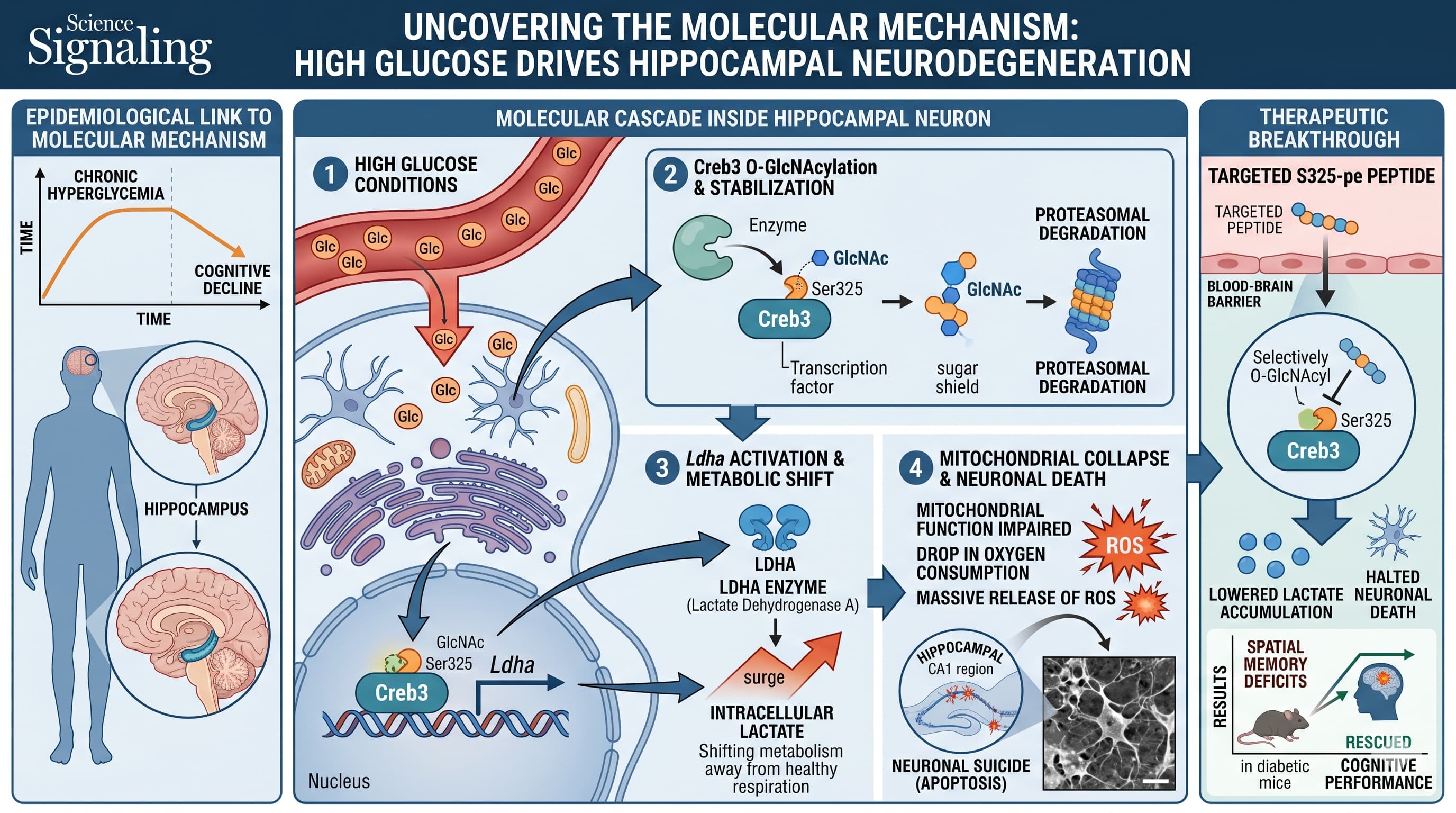
Chronic hyperglycemia has long been epidemiologically tied to cognitive decline, yet the precise metabolic architecture driving this neurodegenerative process has remained elusive. A breakthrough study published in Science Signaling uncovers a direct molecular cascade showing that high glucose levels force hippocampal neurons into a destructive metabolic trap. By combining a large-scale human prospective cohort study with robust rodent models, the research team demonstrated that excess glucose shifts brain metabolism away from healthy respiration toward hyper-glycolysis. This shift results in an overproduction of lactate and triggers a specific post-translational protein modification known as O-GlcNAcylation, which directly damages memory centers.
The investigators tracked the precise molecular pathway inside mouse hippocampal neurons. Under high-glucose conditions, an enzyme attaches a sugar molecule to a specific site (Ser325) on the transcription factor Creb3. This modification acts as a stabilizing shield, preventing the protein from being flagged for destruction by cellular waste-clearance systems. Consequently, stabilized Creb3 builds up and aggressively activates the Ldha gene, which encodes lactate dehydrogenase A—the enzyme responsible for converting pyruvate into lactate.
The resulting surge in intracellular lactate severely impairs mitochondrial function, forcing a drop in cellular oxygen consumption and triggering a massive release of destructive reactive oxygen species. This structural collapse in the hippocampal CA1 region ultimately drives neuronal suicide (apoptosis) and manifests as profound spatial learning and memory deficits. Crucially, the researchers designed a targeted, cell-penetrating short peptide called S325-pe that effectively crosses the blood-brain barrier. By selectively blocking Creb3 O-GlcNAcylation, this peptide successfully lowered lactate accumulation, halted neuronal death, and completely rescued cognitive performance in diabetic mice.
Actionable Insights
This research delivers critical, practical takeaways for individuals optimizing for metabolic health, cognitive preservation, and longevity:
-
Identify and Monitor Lactate Thresholds: Plasma lactate serves as a powerful early warning metric for cognitive decline. Biohackers should monitor baseline fasting plasma lactate levels alongside continuous glucose tracking. The human data reveals that the risk for developing Mild Cognitive Impairment (MCI) escalates dramatically when plasma lactate exceeds 2.58 mM for individuals not taking metformin, and 2.71 mM for metformin users.
-
Mitigate Postprandial Glycemic Spikes: Because high-glucose exposure directly triggers the O-GlcNAcylation pathway and downstream mitochondrial damage in neurons, suppressing sharp post-meal blood sugar spikes is an absolute priority for neuroprotection. Implementing rigorous glucose disposal strategies—such as post-meal zone 2 walking, resistance training, or using insulin-sensitizing agents—is structurally validated to prevent neuronal apoptosis.
-
Acknowledge Metformin-Induced Lactate Elevation: Clinicians and biohackers must account for the fact that metformin use significantly increases baseline plasma lactate levels. While metformin remains highly valuable for longevity, users should be extra vigilant regarding neuroprotection, ensuring their lactate levels do not breach the 2.71 mM safety threshold.
Source:
- Paywalled Paper: High glucose impairs cognitive function through Creb3 O-GlcNAcylation and increased lactate production
- Institution: Affiliated Hospital of Guilin Medical University (Department of Endocrinology and Metabolism).
- Country: China.
- Journal Name: Science Signaling.
- Impact Evaluation: The impact score of this journal is 7.3, evaluated against a typical high-end range of 0–60+ for top general science, therefore this is a High impact journal.