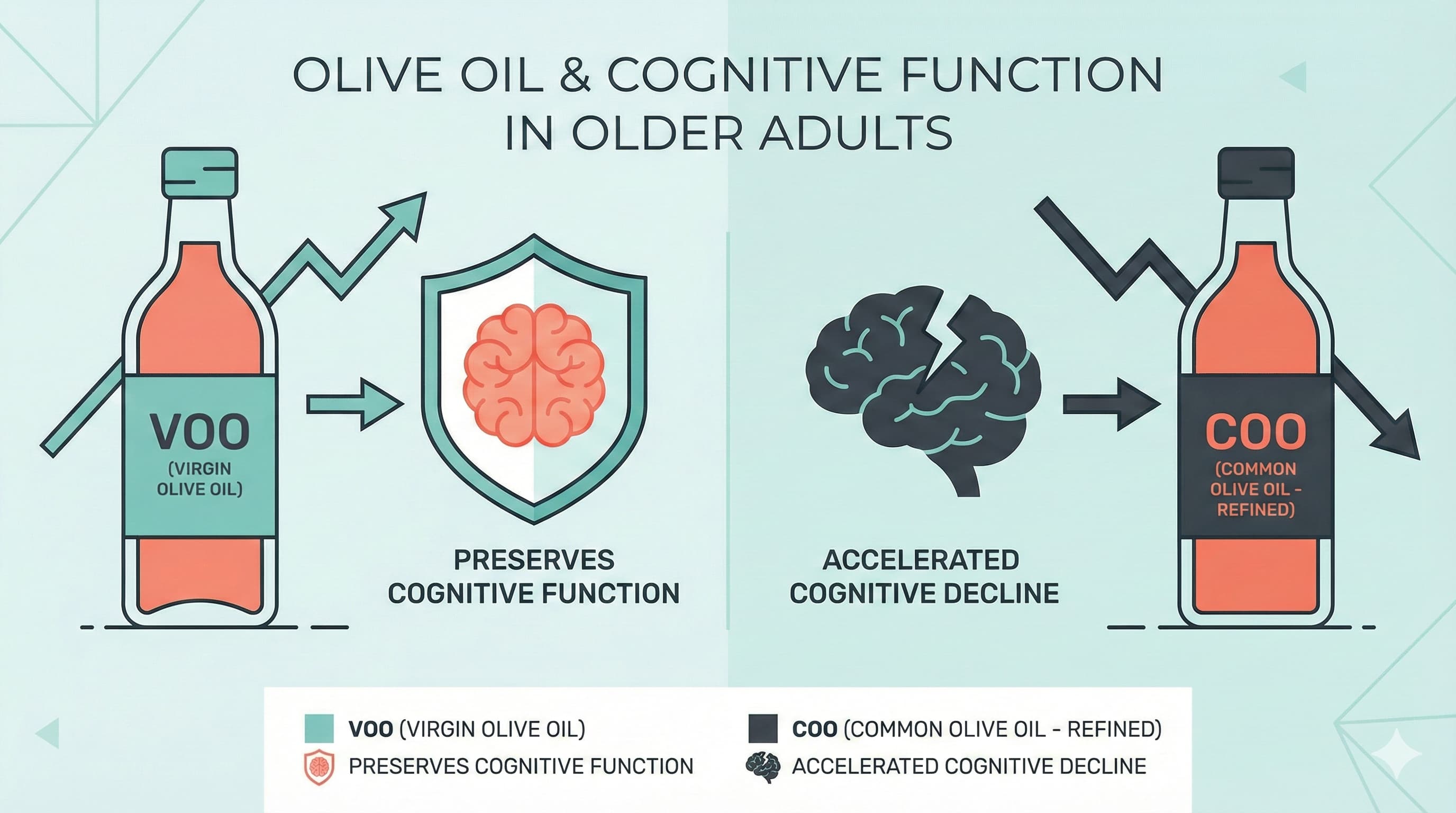
In an interesting new finding for longevity nutrition, a new study from the Universitat Rovira i Virgili in Spain has drawn a hard line between “healthy” fats and “empty” lipids. While olive oil is a cornerstone of the Mediterranean longevity blueprint, this research reveals that not all olive oils are created equal. For the first time, scientists have demonstrated that Virgin Olive Oil (VOO) preserves cognitive function in older adults, whereas Common Olive Oil (COO)—the refined, processed variety often labeled as “Pure” or “Light”—is associated with accelerated cognitive decline.
The mechanism appears to be rooted in a specific gut-brain axis pathway. High-phenolic VOO was found to suppress a specific gut bacterium, Adlercreutzia, which the study identified as a potential driver of cognitive deterioration in this population. Conversely, the consumption of refined olive oil, which lacks the potent polyphenols found in VOO, allowed this bacterium to thrive, correlating with poorer executive function and memory. This suggests that the “health halo” of olive oil depends entirely on its processing grade: the presence of bioactive compounds like hydroxytyrosol and oleuropein is not just a bonus, but the primary engine of neuroprotection.
Source:
- Open Access Paper: Total and different types of olive oilconsumption, gut microbiota, and cognitivefunction changes in older adults
- Context & Impact Institution: Universitat Rovira i Virgili, Spain
- Journal: Microbiome (2026)
- Impact Evaluation: The impact score of this journal is ~12.7–15.0 (JCR/CiteScore), evaluated against a typical high-end range of 0–60+ for top general science. Therefore, this is a High/Elite impact journal, particularly in the specialized field of microbiology.
Part 2: The Biohacker Analysis
Study Design Specifications
- Type: Prospective Cohort Study (Human).
- Subjects: 656 older adults (Age 55–75, mean ~65y) with overweight/obesity and metabolic syndrome.
- Timeline: 2-year follow-up.
-
Intervention:
- Group 1: High Virgin Olive Oil (VOO) consumption.
- Group 2: High Common Olive Oil (COO) consumption (Refined/Pomace oil).
- Controls: Low consumers of respective oils.
Mechanistic Deep Dive
The study isolates the Gut-Brain Axis as the critical mediator of olive oil’s cognitive effects.
- Polyphenol-Mediated Suppression: VOO contains high levels of hydroxytyrosol and oleuropein. The data suggests these compounds actively modulate the gut microbiome, specifically reducing the abundance of Adlercreutzia.
- The Adlercreutzia Paradox: While some previous literature suggests Adlercreutzia is beneficial (as an equol producer), this study found a robust negative correlation: higher Adlercreutzia abundance predicted sharper cognitive decline. VOO consumption suppressed this taxon, while refined COO consumption promoted it.
- Neuroprotection vs. Neurodegeneration:
- VOO: Preserved global cognition, executive function, and attention.
- COO: Associated with significant decline in executive function and language domains. The lack of polyphenols likely leaves the brain vulnerable to oxidative stress and BBB (Blood-Brain Barrier) permeability issues, which VOO strengthens.
Novelty
This is one of the first human studies to explicitly decouple the effects of the lipid profile (monounsaturated fats, present in both oils) from the minor polar compounds (polyphenols, present only in VOO). It effectively kills the argument that “olive oil is healthy because of oleic acid” alone—polyphenols are the requisite driver for cognitive preservation.
Critical Limitations
- Observational Nature: This is a cohort study, not an RCT. While it controls for many variables, it cannot definitively prove causation.
- Population Specificity: Participants had metabolic syndrome. The microbiome dynamics (e.g., the harmful role of Adlercreutzia) might differ in metabolically healthy individuals.
- Measurement Error: Dietary intake was assessed via Food Frequency Questionnaires (FFQ), which are prone to recall bias.
- Short Duration: A 2-year follow-up is relatively short for measuring the progression of neurodegeneration.