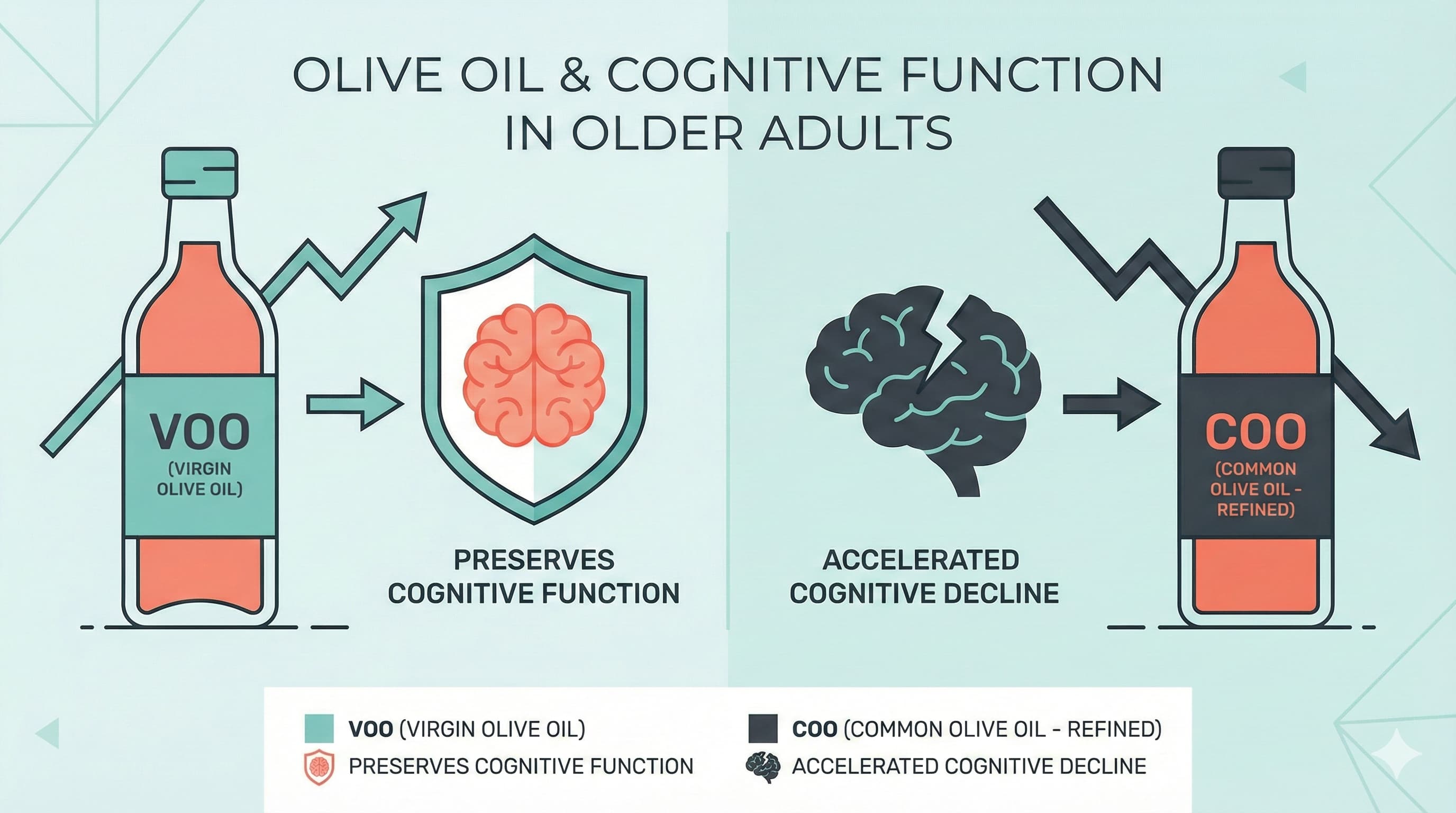
In an interesting new finding for longevity nutrition, a new study from the Universitat Rovira i Virgili in Spain has drawn a hard line between “healthy” fats and “empty” lipids. While olive oil is a cornerstone of the Mediterranean longevity blueprint, this research reveals that not all olive oils are created equal. For the first time, scientists have demonstrated that Virgin Olive Oil (VOO) preserves cognitive function in older adults, whereas Common Olive Oil (COO)—the refined, processed variety often labeled as “Pure” or “Light”—is associated with accelerated cognitive decline.
The mechanism appears to be rooted in a specific gut-brain axis pathway. High-phenolic VOO was found to suppress a specific gut bacterium, Adlercreutzia, which the study identified as a potential driver of cognitive deterioration in this population. Conversely, the consumption of refined olive oil, which lacks the potent polyphenols found in VOO, allowed this bacterium to thrive, correlating with poorer executive function and memory. This suggests that the “health halo” of olive oil depends entirely on its processing grade: the presence of bioactive compounds like hydroxytyrosol and oleuropein is not just a bonus, but the primary engine of neuroprotection.
Source:
- Open Access Paper: Total and different types of olive oilconsumption, gut microbiota, and cognitivefunction changes in older adults
- Context & Impact Institution: Universitat Rovira i Virgili, Spain
- Journal: Microbiome (2026)
- Impact Evaluation: The impact score of this journal is ~12.7–15.0 (JCR/CiteScore), evaluated against a typical high-end range of 0–60+ for top general science. Therefore, this is a High/Elite impact journal, particularly in the specialized field of microbiology.
Part 2: The Biohacker Analysis
Study Design Specifications
- Type: Prospective Cohort Study (Human).
- Subjects: 656 older adults (Age 55–75, mean ~65y) with overweight/obesity and metabolic syndrome.
- Timeline: 2-year follow-up.
-
Intervention:
- Group 1: High Virgin Olive Oil (VOO) consumption.
- Group 2: High Common Olive Oil (COO) consumption (Refined/Pomace oil).
- Controls: Low consumers of respective oils.
Mechanistic Deep Dive
The study isolates the Gut-Brain Axis as the critical mediator of olive oil’s cognitive effects.
- Polyphenol-Mediated Suppression: VOO contains high levels of hydroxytyrosol and oleuropein. The data suggests these compounds actively modulate the gut microbiome, specifically reducing the abundance of Adlercreutzia.
- The Adlercreutzia Paradox: While some previous literature suggests Adlercreutzia is beneficial (as an equol producer), this study found a robust negative correlation: higher Adlercreutzia abundance predicted sharper cognitive decline. VOO consumption suppressed this taxon, while refined COO consumption promoted it.
- Neuroprotection vs. Neurodegeneration:
- VOO: Preserved global cognition, executive function, and attention.
- COO: Associated with significant decline in executive function and language domains. The lack of polyphenols likely leaves the brain vulnerable to oxidative stress and BBB (Blood-Brain Barrier) permeability issues, which VOO strengthens.
Novelty
This is one of the first human studies to explicitly decouple the effects of the lipid profile (monounsaturated fats, present in both oils) from the minor polar compounds (polyphenols, present only in VOO). It effectively kills the argument that “olive oil is healthy because of oleic acid” alone—polyphenols are the requisite driver for cognitive preservation.
Critical Limitations
- Observational Nature: This is a cohort study, not an RCT. While it controls for many variables, it cannot definitively prove causation.
- Population Specificity: Participants had metabolic syndrome. The microbiome dynamics (e.g., the harmful role of Adlercreutzia) might differ in metabolically healthy individuals.
- Measurement Error: Dietary intake was assessed via Food Frequency Questionnaires (FFQ), which are prone to recall bias.
- Short Duration: A 2-year follow-up is relatively short for measuring the progression of neurodegeneration.
Part 3: Claims & Verification
Claim 1: Virgin Olive Oil (VOO) improves cognitive function, while Refined Olive Oil (COO) accelerates decline.
- Evidence Level: B (Supported by external RCTs).
-
Verification: External randomized trials support the superiority of high-phenolic olive oil over refined oil for cognition.
- Reference: The MICOIL study found that high-phenolic EVOO significantly improved cognitive measures (ADAS-cog) in MCI patients compared to low-phenolic diets MICOIL Pilot Study (2020).
- Reference: Another trial demonstrated that EVOO improved blood-brain barrier function and functional connectivity, whereas refined oil did not EVOO Enhances BBB Function (2022).
Claim 2: Adlercreutzia abundance is negatively associated with cognitive function.
- Evidence Level: D/C (Translational Gap/Contradictory).
-
Verification: This finding contradicts some prior research which identifies Adlercreutzia as a beneficial equol-producing genus. However, other studies link its depletion to specific disease states, making its role context-dependent.
- Contradiction: Adlercreutzia is often cited as an equol producer, a metabolite usually linked to health Adlercreutzia and Equol (2019).
- Support for Dysbiosis: Some studies do link specific “beneficial” microbes to negative outcomes in compromised hosts (e.g., metabolic syndrome), suggesting a complex interaction Gut Microbiota in Alzheimer’s (2023). Safety Note: The “harmful” role of Adlercreutzia may be specific to this study’s metabolically unhealthy population.
Claim 3: Polyphenols (Hydroxytyrosol/Oleuropein) are the active neuroprotective agents, not just the fat.
- Evidence Level: D (Strong Mechanistic Support, Pre-clinical).
-
Verification: Widely supported by mechanistic data showing these compounds cross the Blood-Brain Barrier (BBB) and inhibit amyloid aggregation.
- Reference: Hydroxytyrosol exerts neuroprotection and improves mitochondrial function in Alzheimer’s models Hydroxytyrosol Neuroprotection (2023).
Part 4: Actionable Intelligence
The Translational Protocol
- The Switch: Immediately cease consumption of “Pure,” “Light,” or “Refined” Olive Oil. These are calorically identical to EVOO but biologically “dead” regarding neuroprotection.
-
Dosage: The study and supporting RCTs suggest a target of 30–50 mL (approx. 2–4 tablespoons) of High-Phenolic Extra Virgin Olive Oil daily.
-
- Sourcing Criteria: Look for “High Phenolic” certification or a harvest date within the last 12-18 months. The oil should have a peppery “burn” at the back of the throat—this indicates the presence of oleocanthal and oleuropein.
-
Biomarker Verification Panel
-
Efficacy Markers:
- hs-CRP: Expect reduction as systemic inflammation drops.
- Oxidized LDL: High-phenolic EVOO specifically prevents lipid peroxidation.
- Cognitive Testing: Track scores on standardized tests (e.g., CNS Vital Signs or similar digital cognitive batteries) every 6 months.
-
Safety Monitoring:
- Caloric Load: 4 tbsp oil = ~480 kcal. Ensure this replaces other fat sources (seed oils, saturated fats) rather than being added atop a surplus diet to avoid metabolic syndrome exacerbation.
Feasibility & ROI
- Cost: High-phenolic EVOO is expensive ($30–$60 per liter).
- Cost vs. Effect: Compared to novel peptides or monoclonal antibodies for Alzheimer’s (costing thousands), EVOO is a highly cost-effective preventative intervention with a strong safety profile.
- Contraindications: None for the oil itself, but those with gallbladder issues should titrate fat intake carefully.
Part 5: The Strategic FAQ
Q1: Is Adlercreutzia actually bad? I thought it produced equol, which is good for longevity? A: This is the study’s most controversial finding. While Adlercreutzia is indeed an equol producer (usually beneficial for vascular health), this study found a strong negative correlation with cognition in metabolically compromised older adults. It is possible that in a state of dysbiosis (metabolic syndrome), this bacterium behaves differently or serves as a marker for a broader pathogenic environment. [Confidence: Low/Debated].
Q2: Can I just take a hydroxytyrosol supplement instead of drinking oil? A: Likely yes, but you miss the matrix effect. The oil improves bioavailability of the phenols and provides oleic acid, which helps maintain myelin. However, for caloric restriction, a supplement is a viable partial alternative.
Q3: Does cooking destroy the polyphenols in VOO? A: Partially. Heating VOO above 180°C (350°F) degrades some polyphenols, but it remains more stable than seed oils. For maximum neuroprotection, consume it raw (on salads, veggies, or straight).
Q4: How does this compare to MCT oil for brain health? A: Different mechanisms. MCT oil provides ketones (fuel) for the brain. VOO provides polyphenols (repair/protection) for the BBB and neurons. They can be synergistic.
Q5: Is “Pomace” oil ever okay? A: No. Pomace oil is extracted using solvents (hexane) from the waste pulp. It is chemically refined and stripped of beneficial compounds. This study confirms it is associated with worse cognitive outcomes.
Q6: I am on Rapamycin. Will VOO interfere? A: No negative interaction is known. In fact, the anti-inflammatory effects may be synergistic.
Q7: Why did the study focus on people with metabolic syndrome? A: This group is at high risk for dementia (“Type 3 Diabetes”). If VOO works here, it suggests potent efficacy. Results in healthy young biohackers might be more subtle but likely directionally similar.
Q8: What if I have the APOE4 gene? A: The MICOIL study (cited above) showed that high-phenolic EVOO improved cognition regardless of APOE4 status, making it a critical intervention for this high-risk group.
Q9: How do I know if my oil is “high phenolic”? A: Look for brands that list polyphenol count (e.g., >250 mg/kg, ideally >500 mg/kg). If it tastes mild or buttery, it’s low phenolic. It must taste bitter and pungent.
Q10: Can I rely on this single study? A: No, but you can rely on the triangulation of this study with the MICOIL and Auburn RCTs. The signal is consistent: Refined oil = Neutral/Negative; EVOO = Positive.