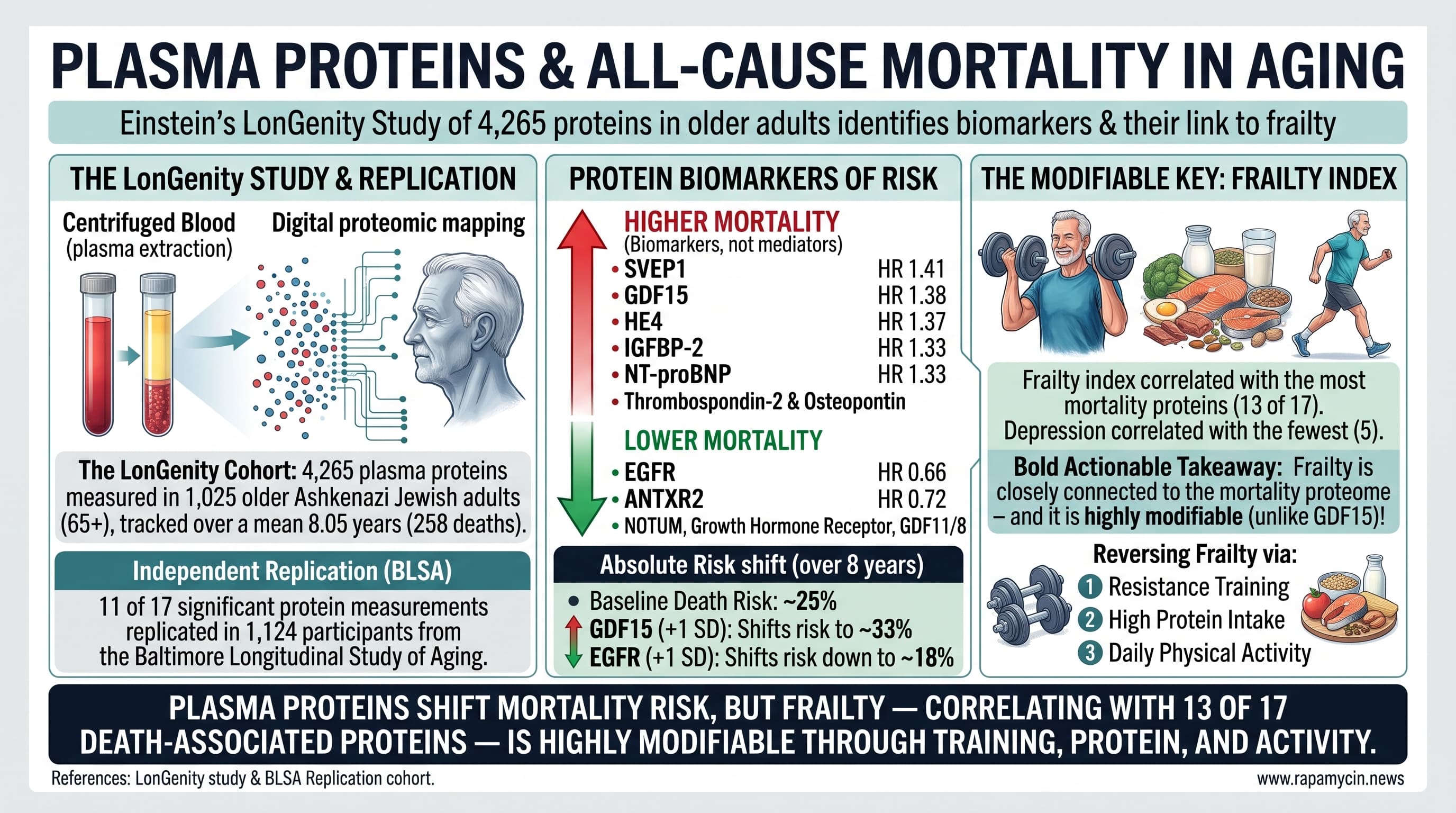
This prospective cohort study from Barzilai’s group at Albert Einstein measured 4,265 plasma proteins in 1,025 community-dwelling Ashkenazi Jewish adults aged 65 and over from the LonGenity study, then tested each against all-cause mortality over a mean 8.05 years of follow-up during which 258 participants died. Seventeen protein measurements reached significance after false-discovery-rate correction, of which eleven replicated in 1,124 participants from the Baltimore Longitudinal Study of Aging. GDF15, HE4, NT-proBNP, IGFBP-2, SVEP1, thrombospondin-2, and osteopontin predicted higher mortality; EGFR, ANTXR2, NOTUM, growth hormone receptor, GDF11/8, and others predicted lower mortality. The authors then correlated these proteins with proteomic organ-specific aging clocks. They state plainly that the proteins are biomarkers rather than demonstrated mediators.
The protein that came out on top of this analysis was not the one that predicted death. It was the one that predicted survival, and it is a protein most people associate with cancer.
Epidermal growth factor receptor, usually written EGFR and here labeled ERBB1, is the target of a whole class of oncology drugs built to shut it down. In this cohort of adults aged 65 and older, higher circulating levels of it were associated with a 34 percent lower rate of death per standard deviation, the single strongest association among 4,265 proteins tested. It also tracked with younger biological age in every organ system the authors examined, most strongly the liver and brain. It replicated in an independent cohort.
That is either a real and important finding about what keeps older bodies functioning, or it is an artifact of measuring a membrane receptor’s soluble fragment with an aptamer. The honest answer is that nobody yet knows, and the paper says this.
The structure of the study is straightforward. Take a cohort, measure everything in plasma, wait, count deaths, run a Cox model per protein, correct for multiple testing. Seventeen measurements survived. Then check them against an independent cohort, and against a third published study of 22,913 Icelanders in which GDF15 had also been the top mortality protein out of 4,684.
What emerges is less a list than a set of three biological themes. Several of the proteins are extracellular matrix molecules: thrombospondin-2, osteopontin, angiostatin, hyaluronidase-1, SVEP1, ANTXR2. Several are growth factor signaling components: EGFR, growth hormone receptor, GDF11/8, IGFBP-2. And three are stress signals: GDF15, HE4, NT-proBNP. So dying, on this reading, is not a single failing pathway. It is matrix turnover, signaling capacity, and systemic stress moving together.
The growth hormone result deserves attention because it points the opposite way from a well-known story. In mice, worms, and flies, dialing down growth hormone and IGF-1 signaling extends lifespan, and that trade-off between growth and longevity is close to canonical. Here, in humans past 65, higher growth hormone receptor was associated with lower mortality. The authors’ interpretation is that what protects a young organism from growing too fast is not what protects an old one from frailty and sarcopenia.
Which brings up the thing the study did not do. LonGenity exists specifically to study longevity: roughly half its participants have a parent who lived past 95. That parental longevity was entered into every model as a covariate, meaning it was statistically removed. The paper’s title promises implications for longevity, and the one longevity contrast the cohort uniquely offers was treated as noise.
Insights
These are biomarkers with no intervention attached, and the authors say outright that the proteins are “best interpreted as reflecting the cumulative physiological consequences of biological aging” rather than as causes.
What the numbers mean in absolute terms. Hazard ratios here are per one standard deviation of protein level, which is a statistician’s unit, so here is the translation. Over the mean 8-year follow-up, 258 of 1,014 participants died, an absolute risk of about 25 percent. Being one standard deviation above average on GDF15, hazard ratio 1.38, shifts that 8-year risk from roughly 25 percent to roughly 33 percent. Being one standard deviation above average on EGFR, hazard ratio 0.66, shifts it from roughly 25 percent down to roughly 18 percent. Real, but not destiny, and these are the two largest effects in the paper.
The strongest associations, all per standard deviation: EGFR 0.66 (0.57 to 0.77), ANTXR2 0.72 (0.63 to 0.83), SVEP1 1.41 (1.23 to 1.63), GDF15 1.38 (1.18 to 1.62), HE4 1.37 (1.17 to 1.59), IGFBP-2 1.33 (1.15 to 1.54), NT-proBNP 1.33 (1.15 to 1.53).
The one finding with a practical edge. Of all the clinical phenotypes tested, the frailty index correlated with the most mortality proteins, 13 of 17. Depression correlated with the fewest, 5. Frailty is also the phenotype on that list most responsive to resistance training, protein intake, and activity. If you want one thing from this paper, it is that frailty appears to sit closest to whatever the mortality proteome is measuring, and frailty is modifiable in a way that GDF15 is not.
A caution on buying tests. The paper reports no C-statistic, no area under the curve, and no reclassification metric, so there is no evidence here that measuring any of these proteins adds anything to knowing someone’s age and sex.
Context and Source
- Open Access Paper: Exploring mortality-linked proteins: Understanding their association with biological aging, disease phenotypes, signaling pathways, and their implications for longevity.
- Authors: Nicholas Garvey, Sanish Sathyan (corresponding), Toshiko Tanaka, Cassandra Joynes, Hamilton Se-Hwee Oh, Tina Gao, Keenan A. Walker, Tony Wyss-Coray, Joe Verghese, Luigi Ferrucci, Sofiya Milman, Nir Barzilai (corresponding).
- Institutions: Institute for Aging Research and Department of Genetics, Albert Einstein College of Medicine, Bronx; Renaissance School of Medicine, Stony Brook University; Kannur University, Kerala; Translational Gerontology Branch and Laboratory of Behavioral Neuroscience, National Institute on Aging, Baltimore; Stanford University School of Medicine and the Phil and Penny Knight Initiative for Brain Resilience.
- Countries: United States, with one Indian affiliation.
- Journal: Geromedicine, volume 3, published October 9, 2026.
- Impact evaluation: this journal has no impact factor. Geromedicine launched in May 2025 under Science Exploration Press, a Singapore-headquartered publisher that is a regular member of the STM Association and lists 14 journals. Two mitigating facts should be weighed against that. The editor-in-chief is Guido Kroemer, with Andrea Maier and Hans Meij as deputy editors, which is a serious geroscience board, and the author list here includes the leadership of LonGenity, BLSA, and the Stanford organ-clock group. This is credible work placed in a venue with no track record.