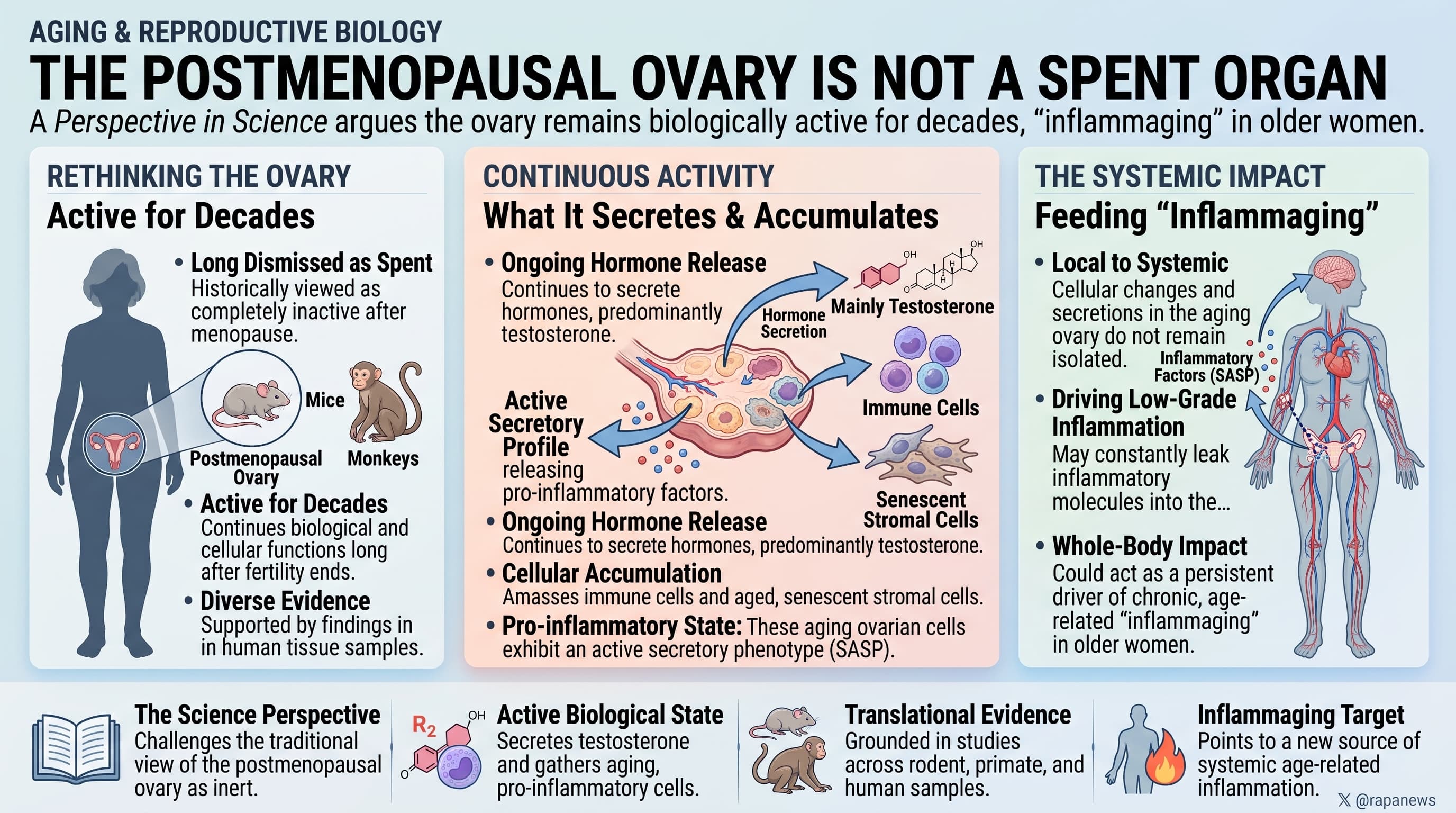
A Perspective in Science argues that the postmenopausal ovary, long dismissed as a spent organ, stays biologically active for decades. It continues to secrete hormones, mainly testosterone, and in mice, monkeys, and some human samples it accumulates immune cells and senescent stromal cells with a secretory profile. The authors propose that the aged ovary could feed whole-body “inflammaging” in older women.
For most of medical history, the ovary after menopause has been treated as leftover tissue. Textbooks have called it senile, a shriveled husk. Michael Stout of the Oklahoma Medical Research Foundation and Francesca Duncan of Northwestern University and the Buck Institute argue that this picture is wrong, and that the error matters because women now spend roughly a third of their lives after menopause.
The ovary does change at menopause. It loses its follicles, shrinks by about 30 percent, and becomes dominated by stroma, the connective tissue scaffold, along with fibrosis and thickened blood vessels. But it does not go silent. Blood sampled directly from the ovarian vein shows the postmenopausal ovary still releases testosterone, plus smaller amounts of androstenedione, estradiol, estrone, and progesterone. Its stromal cells still carry receptors for the pituitary hormones LH and FSH, and still respond to them.
The newer and more provocative claim concerns inflammation. In mice past reproductive age, the ovary fills progressively with T cells, macrophages, and multinucleated giant cells, and its gene activity shifts from reproductive programs toward immune activation. In aging monkeys, spatial mapping finds inflammatory pockets in the stroma that look like sources of senescence signals. In women aged 50 to 75, a proteomic study still at the preprint stage reports that older ovaries express more proteins tied to complement activation, senescence, and tissue remodeling. When postmenopausal human ovarian tissue is exposed in culture to doxorubicin, a drug that induces senescence, its secretions resemble those of naturally aged ovaries.
Put together, the authors suggest the old ovary may behave something like fat tissue, which was once considered inert storage and is now recognized as an endocrine organ that shapes disease risk. If the ovary leaks inflammatory factors into the circulation, it could contribute to cardiovascular disease, neurodegeneration, muscle loss, and metabolic dysfunction.
The authors do not oversell this. They state that the idea is “only inferential.” One human cell atlas found few immune cells and few senescence markers in the postmenopausal ovary, contradicting the other datasets. Nobody has shown that ovary-derived inflammatory molecules reach meaningful concentrations in blood.
The obvious follow-up question is whether removing the ovaries after menopause would help. Here the evidence is thin and indirect. Removing ovaries before menopause clearly harms health, raising cardiovascular and all-cause mortality, but that reflects sudden hormone loss in younger women. A 2005 modeling study concluded that keeping the ovaries improved survival up to about age 65. A 2022 update found no survival penalty from removing them at hysterectomy at age 50 or later. No penalty is not the same as a benefit, and the authors caution that ovarian androgens still support bone, libido, and metabolism.
The piece is a research agenda, not a result. Its value lies in the question it puts on the table.
Actionable Insights
The practical messages are about decisions women already face.
First, timing dominates. In the Nurses’ Health Study, 16.8 percent of women whose ovaries were removed at hysterectomy died over 28 years, against 13.3 percent who kept them. That is a 3.5 percentage point gap, and after adjusting for other risk factors, a 13 percent higher death rate. Among women under 50 who never took estrogen, the death rate was 41 percent higher, roughly one extra death for every eight surgeries over 35 years.
Second, estrogen therapy appears to offset most of that harm in younger women. In the 2022 model, 52.8 percent of women who lost their ovaries before 50 without estrogen survived to 80, against 63.5 percent who kept them, an 11-point gap that disappeared with estrogen use.
Third, at 50 or older the modeled difference is negligible: 66.9 percent versus 66.4 percent surviving to 80. That is half a percentage point, well inside the margin of error.
Fourth, nothing here supports removing healthy ovaries to reduce inflammation.
Context and Source
- Paywalled Paper: “Does the postmenopausal ovary still matter?”
- Institutions: Oklahoma Medical Research Foundation and Oklahoma City VA Medical Center; Feinberg School of Medicine, Northwestern University; Buck Institute for Research on Aging
- Country: USA
- Journal: Science, 1 October 2026.
- Impact evaluation: The impact score of this journal is 45.8, evaluated against a typical high-end range of 0 to 60+ for top general science, therefore this is an Elite impact journal.