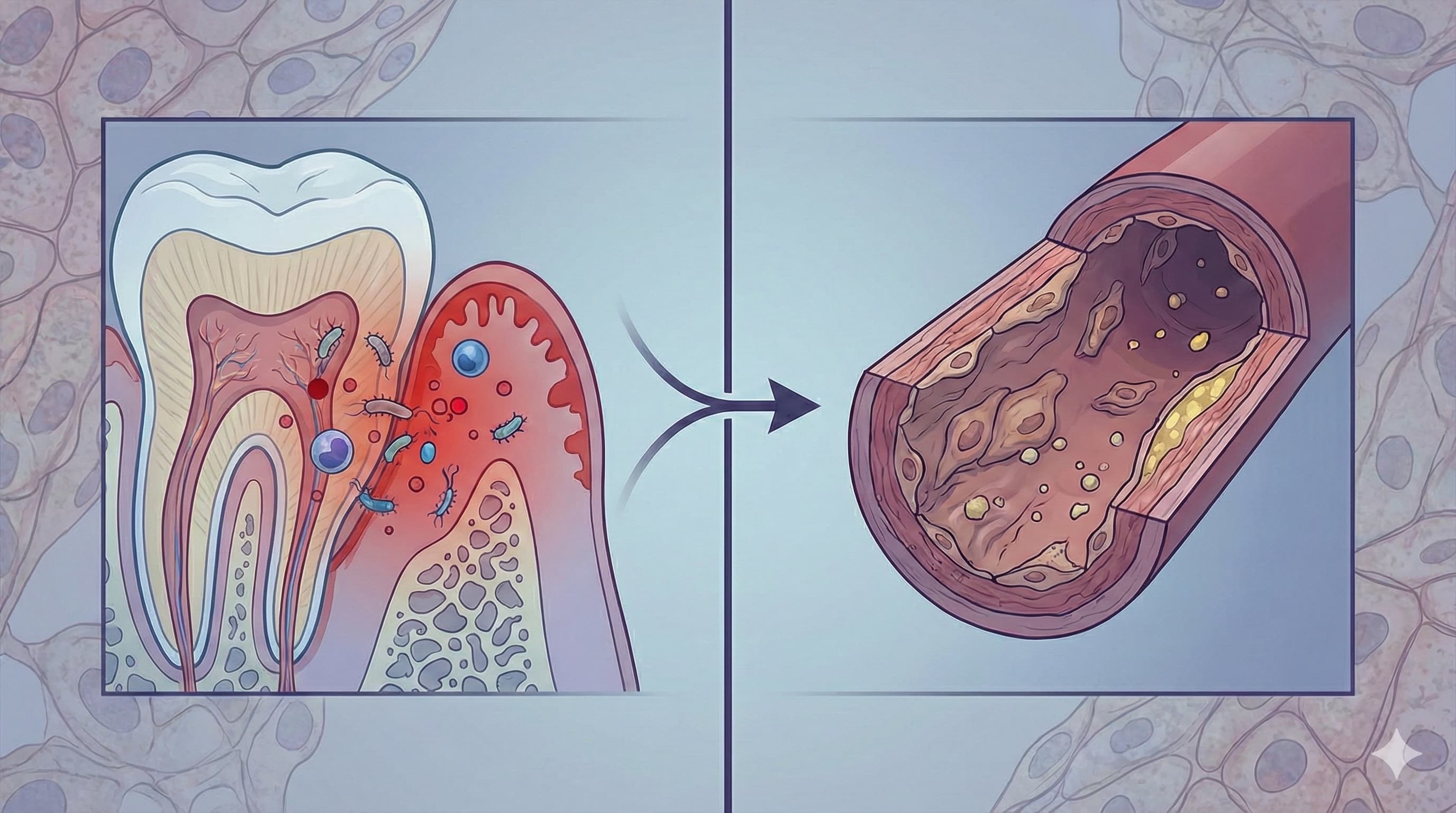
The Mouth-Heart Axis: Is Your Dentist a Vascular Surgeon in Disguise?

Forget the simplistic “floss or die” mantras of the 90s. This newly published review synthesizes a decade of mechanistic data to validate a specific, causal pathway: Periodontal disease is not just a marker of aging; it is an active driver of vascular senescence. The authors rigorously demonstrate that the chronic inflammatory burden from the oral cavity (specifically Porphyromonas gingivalis infection) directly impairs Flow-Mediated Dilation (FMD)—the gold-standard metric of how well your arteries can dilate.

The critical finding for biohackers is the reversibility demonstrated in the cited clinical trials. Aggressive periodontal therapy doesn’t just “save teeth”; it restores endothelial nitric oxide (NO) production and lowers systemic arterial stiffness, effectively turning back the vascular clock. However, the data reveals a “healing crisis”: intensive treatment causes a massive, acute spike in systemic inflammation (endothelial shock) before the long-term benefits kick in—a detail often omitted in public health messaging.

Open Access Research paper: Vascular Endothelial Function in Periodontal Disease: Role of Inflammation
Institution: Hiroshima University, Japan Journal: Journal of the American Heart Association (JAHA) Impact Evaluation: The impact score of this journal is ~5.3 (Impact Factor) therefore this is a High impact specialty journal (Cardiology).


Part 2: The Biohacker Analysis

Study Design

  • Type: Systematic Review & Meta-Synthesis of Clinical Intervention Trials.
  • Subjects: Humans (Aggregating data from healthy subjects, CAD patients, and Type 2 Diabetics across >16 major studies, including the landmark Tonetti et al. NEJM trial).
  • Lifespan Data:
    • Mortality Risk: Associated with a 22% to 59% increased risk of all-cause and cardiovascular mortality (based on cited epidemiological data).
    • Healthspan Proxy: Reversal of endothelial dysfunction (FMD improvement) is a surrogate for delaying atherosclerotic onset by estimated 5–10 years.

Mechanistic Deep Dive

The paper moves beyond “inflammation” to identify specific molecular assassins:

  1. NO Uncoupling: Chronic exposure to oral bacterial endotoxins (LPS) downregulates eNOS (endothelial nitric oxide synthase), turning the vessel wall into a rigid pipe.
  2. ADMA Elevation: Periodontitis elevates Asymmetric Dimethylarginine (ADMA), an endogenous inhibitor of NO production. High ADMA is a potent predictor of cardiovascular death.
  3. The “Leaky Gum” Pathway: Ulcerated pocket epithelium allows daily translocation of bacteria into the bloodstream (bacteremia), triggering a hepatic acute-phase response (CRP spikes) that degrades the endothelial glycocalyx.

Novelty & “What We Didn’t Know Yesterday”

While the link is old, this review solidifies the causality of reversibility. Previous consensus was skepticism on whether treating gums actually fixed the heart. This paper confirms that Intensive Periodontal Treatment (IPT) yields a measurable improvement in vascular function (FMD) after 6 months, verifying that the damage is not permanent scarring but a functional suppression that can be lifted.

Critical Limitations

  • The “Acute Shock” Hazard: The review highlights that endothelial function actually worsens 24 hours post-treatment due to bacteremia from the cleaning itself. This is a critical safety signal often ignored.
  • Heterogeneity of Protocols: The “treatment” varies wildly across studies—from simple cleaning to surgery with antibiotics. There is no standardized “Longevity Dental Protocol.”
  • Lack of Hard Outcomes: While FMD improves, we still lack a massive randomized trial proving that treating gums reduces heart attacks (hard endpoints) directly. We are relying on a surrogate marker (endothelial function).
  • Reverse Causality Risk: [Confidence: Medium] It remains possible that people with better endothelial function simply heal their gums better, creating a chicken-and-egg confounder.

Part 3: Actionable Intelligence

The Translational Protocol: “The Tonetti Maneuver”

Based on the most effective intervention cited (Tonetti et al., NEJM, and subsequent replications).

  • Therapeutic Intensity (The “HED”):
    • Standard: Annual cleaning is insufficient for vascular benefit.
    • Biohacker Protocol: Full-Mouth Intensive Periodontal Treatment (IPT).
    • Specifics: Supragingival and subgingival scaling and root planing (SRP) completed within a short window (e.g., <24 hours) under local anesthesia.
    • Adjuvant: Local application of Minocycline or Doxycycline Microspheres (Arestin) into pockets >5mm to suppress MMPs (matrix metalloproteinases).
  • Pharmacokinetics:
    • Minocycline Microspheres: sustained release over 14 days in the pocket; negligible systemic absorption (safe for gut microbiome compared to oral antibiotics).
  • Safety & Toxicity Check (The “Healing Crisis”):
    • Risk: Transient Bacteremia. Dislodging plaque floods the blood with LPS.
    • Mitigation: Do not schedule high-intensity workouts or inflammatory stressors (e.g., heavy lifting, saunas) for 48 hours post-treatment. Consider antioxidant loading (Vitamin C, CoQ10) pre-procedure to buffer the endothelial oxidative spike.
  • Biomarker Verification Panel:
    • Efficacy Markers:
      • hs-CRP: Should spike at Day 1, then drop below baseline by Month 6.
      • FMD (Flow-Mediated Dilation): Hard to test commercially; substitute with Pulse Wave Velocity (PWV) or rigorous blood pressure monitoring (looking for increased pulse pressure).
      • Oral DNA Test: PCR test for “Red Complex” bacteria (P. gingivalis, T. denticola, T. forsythia). Goal: Non-detectable levels.
  • Feasibility & ROI:
    • Cost: ~$500–$1,500 for deep cleaning (SRP) + antibiotics vs. standard cleaning ($150).
    • ROI: High. Restoring NO bioavailability rivals the effect of statins or exercise mimetics for vascular health, with zero daily pill burden.

Part 4: The Strategic FAQ

1. Is the damage to my arteries permanent if I’ve had gum disease for years? Answer: Likely No. The review confirms that endothelial dysfunction is “functional,” not structural, in the early-to-mid stages. The endothelium is plastic; removing the inflammatory insult (the bacteria) restores NO production within 6 months. [Confidence: High]

2. I take Rapamycin (Sirolimus). How does this interact? Answer: CAUTION. Rapamycin is a potent mTOR inhibitor that can cause mucositis (mouth ulcers) and delay soft tissue healing. Combining high-dose Rapamycin with aggressive gum surgery could impair gingival re-attachment.

  • Action: Pause Rapamycin 1 week before and 2 weeks after intensive dental work.

3. Does flossing actually extend lifespan, or is it just that healthy people floss? Answer: It’s a mix, but the mechanistic evidence is strong. While “healthy user bias” is real, the fact that treating gums improves FMD (a causal predictor of mortality) suggests a direct biological benefit. It reduces the “allostatic load” of chronic inflammation.

4. Can I just use mouthwash (Chlorhexidine) instead of deep cleaning? Answer: Absolutely Not. Chlorhexidine is a “scorched earth” nuking of the oral microbiome that destroys the nitrate-reducing bacteria on your tongue which are required to produce Nitric Oxide from food. Chronic use of antiseptic mouthwash raises blood pressure and ruins endothelial function—the exact opposite of the goal.

5. What about SGLT2 Inhibitors (Canagliflozin/Empagliflozin)? Answer: Watch for Dry Mouth (Xerostomia) and Thrush. SGLT2i excrete sugar in urine, increasing risk of genital/urinary infections, but dehydration can dry out oral mucosa, accelerating gum disease. Hydration is non-negotiable here.

6. Is there a blood test to confirm my mouth is hurting my heart? Answer: **ADMA (Asymmetric Dimethylarginine)**and hs-CRP. If your hs-CRP is chronically >1.0 mg/L without infection/injury, and you have bleeding gums, the mouth is the prime suspect.

7. Should I take systemic antibiotics (Amoxicillin) for gum health? Answer: Generally No. Systemic antibiotics nuke the gut microbiome. The review supports mechanical removal (SRP) +/- local delivery antibiotics. Systemic use is reserved for acute abscesses, not chronic longevity maintenance.

8. Does “Oil Pulling” work for this? Answer: Data Absent/Weak. While it may reduce total bacterial load slightly, it cannot remove subgingival calculus (tartar) hardened on the root surface. It is placebo compared to a curette (mechanical scraping).

9. How does this compare to Statins for inflammation reduction? Answer: They are synergistic. Statins stabilize plaque and lower CRP. Periodontal therapy removes the source of the CRP. Doing one without the other is fighting a war with one hand tied behind your back.

10. What is the “Red Flag” symptom I should ignore my dentist’s “wait and see” advice on? Answer: Bleeding on Probing (BOP). If your gums bleed when the dentist pokes them, you have an open wound the size of your palm (if flattened out) dumping bacteria into your heart 24/7. “Wait and see” is malpractice in the context of longevity; treat it aggressively.

2 Likes

What about Rapamycin fortified tooth/flossing paste?
I’ve used it regularly since first discussed on the forum.
Gums in great shape.

Would seem to have a similar effect as Minocycline Microspheres.

Gum treatments are very important especially for the aging population. Of course it can be done professionally which may deliver the best results (the cost is $800-$1500+ and Medicare doesn’t cover it). However there are simple steps that you can try at home (per my favorite AI).

:test_tube: Home-Based Subgingival Irrigation with Blunt Cannulas

:white_check_mark: Equipment

• Blunt-tipped irrigation cannulas (curved or straight, 23–27 gauge)
• Luer-lock syringe (5–10 mL ideal for control)
• Antiseptic solution (see below)
• Mirror and headlamp (optional but helpful for precision)

:lotion_bottle: Antiseptic Options and Dilution Guidelines

  1. Chlorhexidine gluconate 0.06–0.12% Use commercial 0.12% as-is or dilute 1:1 with sterile water

  2. Hydrogen peroxide 1.5–3% Use 3% diluted 1:1 with water; oxygenates and disrupts biofilm

  3. Sodium hypochlorite 0.05–0.25% Use with extreme caution; dilute household bleach (5%) 1:100 to 1:20; rinse thoroughly after

I use Chlorhexidine Gluconate 0.12% for Subgingival Irrigation.

:white_check_mark: Key Properties

• Broad-spectrum antimicrobial: Effective against Gram-positive and Gram-negative bacteria, fungi, and some viruses.
• Substantivity: Binds to oral tissues and releases slowly over 8–12 hours.
• MMP inhibition: Suppresses collagenase activity, especially MMP-8 and MMP-9, which is relevant to your goal.

:dna: Suggested Protocol for At-Home Subgingival Use

Step Action

  1. Dilution (optional) You may use 0.12% as-is, or dilute 1:1 with sterile water or saline to 0.06% to reduce staining and taste alteration. Start with full strength if tolerated.
  2. Delivery Use a 5–10 mL Luer-lock syringe with a 23–27 gauge blunt cannula. Gently insert into the sulcus (≤4 mm depth) at a 45° angle.
  3. Volume Deliver ~0.1–0.2 mL per site. Avoid overfilling or forceful pressure.
  4. Frequency Start 2–3× per week. Adjust based on tissue response and plaque control.
  5. Rinse (optional) You may rinse with water after 30–60 minutes to reduce staining risk, or leave undisturbed for maximum substantivity.
  6. Monitor Watch for signs of irritation, staining, or altered taste. Discontinue if mucosal sensitivity develops.

I tried it myself (once a month) and it’s easy to do.

1 Like

Subgingival irrigation is a good idea if you have periodontal disease, but I don’t favor upsetting the oral microbiome in a healthy mouth by doing that. If one does, however, either in a healthy mouth or not, repopulate it regularly with perio friendly bacteria.
Problem with the general public is compliance with good OH practices such as good diet, not smoking, etc.
Final note: The Waterpik is an effective tool in the prevention and treatment of gum disease if used correctly.

2 Likes

Waterpick and the advanced Philips Sonicare system are all you need for maintenance if you are starting with good oral hygiene like myself.

1 Like

Tongue scraper-another essential tool.