

The "live to 100" checklist

Some benchmarks from an Endurance athlete trainer Alan Couzens. They seem like reasonable targets.

The “live to 100” checklist (at the halfway point)

  1. Over 6hrs movement per day (PAL 2.0+)
  2. 7-9 hrs high-quality sleep
  3. VO2max >50 ml/kg/min
  4. ApoB <70mg/dL
  5. BP <115/75 mmHg
  6. HbA1c = 5.0
  7. FFMI >20 kg/m2
  8. Visceral Fat <1kg
  9. Omega-3 Index >= 8%
  10. Resting HR <50 bpm

No polyps.

Source: https://x.com/Alan_Couzens/status/2025662290000011493?s=20

Biomedical Analysis of the “Live to 100” Clinical Checklist

The provided parameters define an aggressive, highly optimized physiological phenotype. This checklist targets the primary drivers of all-cause mortality—atherosclerotic cardiovascular disease (ASCVD), metabolic dysfunction, neurodegeneration, and malignancy—rather than merely avoiding population-average disease states.

Below is a detailed analysis of the clinical rationale, targeted biological pathways, actionable interventions, and existing knowledge gaps for each metric.


1. >6hrs Movement per Day (PAL 2.0+)

  • Clinical Rationale: A Physical Activity Level (PAL) of ≥2.0 means Total Energy Expenditure is at least double the Basal Metabolic Rate. This requires significant non-exercise activity thermogenesis (NEAT) combined with structured exercise. Sustained movement prevents the downregulation of lipoprotein lipase associated with sedentary behavior and maintains peripheral insulin sensitivity.
  • Actionable Pathways: Activates AMP-activated protein kinase (AMPK), prompting mitochondrial biogenesis via PGC-1alpha.
  • Scholarly Debate & Gaps: It remains debated whether 6 hours of low-intensity movement confers greater longevity benefits than shorter, higher-intensity bouts. The exact point of diminishing returns for physical activity volume regarding all-cause mortality remains poorly defined.

2. 7-9 hrs High-Quality Sleep

  • Clinical Rationale: Critical for neurodegenerative disease prevention, autonomic nervous system recovery, and endocrine homeostasis (cortisol/testosterone regulation).
  • Actionable Pathways: Facilitates the glymphatic system clearance of metabolic waste products, specifically beta-amyloid and tau proteins, from the brain interstitium during slow-wave sleep.
  • Scholarly Debate & Gaps: “High-quality” is subjectively defined. Objective polysomnography metrics (specific percentages of REM vs. Deep sleep) required for optimal longevity are still actively researched.

3. VO2max >50 ml/kg/min

  • Clinical Rationale: Maximum rate of oxygen consumption is arguably the single most powerful independent predictor of all-cause mortality. A VO2max >50 ml/kg/min places an individual in the elite category for middle age and provides a massive functional reserve against age-related cardiopulmonary decline.
  • Actionable Interventions: Zone 2 training (mitochondrial efficiency) paired with Zone 5 high-intensity interval training (stroke volume and cardiac output maximization).
  • Scholarly Debate & Gaps: Scaling VO2max solely to body weight (ml/kg/min) can penalize individuals with high muscle mass. Scaling to fat-free mass (ml/kg FFM/min) may offer a more precise longevity metric.

4. ApoB <70 mg/dL

  • Clinical Rationale: Apolipoprotein B is the structural protein for all atherogenic lipoproteins (LDL, VLDL, IDL, Lp(a)). The concentration of ApoB particles is a superior predictor of ASCVD risk compared to LDL-C, as it dictates the probability of particle retention in the arterial intima.
  • Actionable Interventions: Pharmacotherapy is often required to reach this threshold. Primary clinical levers include statins, ezetimibe, bempedoic acid, and PCSK9 inhibitors.
  • Scholarly Debate & Gaps: Some aggressive longevity protocols argue for ApoB levels below 50 mg/dL or even 30 mg/dL (approximating neonatal levels), though longitudinal data on the absolute safety and marginal mortality benefit of lifelong sub-40 mg/dL ApoB is pending.

5. Blood Pressure <115/75 mmHg

  • Clinical Rationale: Minimizes mechanical shear stress on the vascular endothelium, preventing microvascular damage in the brain and kidneys, and reducing the risk of left ventricular hypertrophy.
  • Actionable Interventions: Sodium restriction, optimized potassium intake, Zone 2 exercise. Pharmacological interventions often utilize Angiotensin II Receptor Blockers (ARBs) like telmisartan, which may have secondary PPAR-gamma activation benefits.
  • Scholarly Debate & Gaps: The SPRINT Trial demonstrated the superiority of a target systolic BP <120 mmHg. Pushing below 115 mmHg must be weighed against the risk of orthostatic hypotension, particularly in older adults.

6. HbA1c = 5.0%

  • Clinical Rationale: An HbA1c of 5.0% translates to an estimated average glucose of ~97 mg/dL. This aggressively limits the formation of Advanced Glycation End-products (AGEs), which cross-link collagen and accelerate tissue aging.
  • Actionable Interventions: Carbohydrate restriction, exercise timing, and potential use of insulin-sensitizing compounds (e.g., Metformin, Acarbose, or SGLT2 inhibitors).
  • Scholarly Debate & Gaps: HbA1c is confounded by red blood cell turnover. Individuals with rapid RBC turnover (e.g., athletes) may show artificially low HbA1c. Continuous Glucose Monitor (CGM) metrics, specifically Time-In-Range (70-100 mg/dL) and glycemic variability, are emerging as superior metrics.

7. FFMI >20 kg/m2

  • Clinical Rationale: Fat-Free Mass Index (FFMI) is a measure of lean mass relative to height (FFMI=LeanMass/Height2). Muscle acts as a critical metabolic sink for glucose disposal (via GLUT4 translocation) and defends against age-related sarcopenia and frailty.
  • Actionable Interventions: Progressive resistance training, adequate dietary protein (typically >1.6 g/kg/day), and optimization of anabolic signaling pathways (mTOR).
  • Scholarly Debate & Gaps: An FFMI >20 is easily attainable for adult males but borders on the physiological limit for adult females without exogenous androgens. The target must be sex-stratified to be clinically valid.

8. Visceral Fat <1kg

  • Clinical Rationale: Visceral adipose tissue (VAT) is highly metabolically active and pathological. It secretes inflammatory adipokines (IL-6, TNF-alpha) and directly deposits free fatty acids into the portal vein, driving hepatic insulin resistance and non-alcoholic fatty liver disease (NAFLD).
  • Actionable Interventions: Caloric deficit, elimination of fructose, and potentially GLP-1/GIP receptor agonists(e.g., tirzepatide) which show profound efficacy in depleting VAT.
  • Scholarly Debate & Gaps: Precise quantification requires Dual-Energy X-ray Absorptiometry (DEXA) or MRI.

9. Omega-3 Index ≥ 8%

  • Clinical Rationale: Represents the percentage of EPA and DHA in red blood cell membranes. An index ≥8% is associated with optimal erythrocyte deformability, reduced platelet aggregation, and maximal production of specialized pro-resolving mediators (resolvins) that actively terminate inflammation.
  • Actionable Interventions: High-dose dietary supplementation of EPA/DHA (often requiring 2-4 grams daily) and reduction of competitive Omega-6 fatty acids (linoleic acid) in the diet.
  • Scholarly Debate & Gaps: The isolated cardiovascular benefit of Omega-3 supplementation is contested in modern clinical trials (e.g., REDUCE-IT vs. STRENGTH trials), often dependent on the exact formulation (icosapent ethyl vs. mixed formulations) and placebo design.

10. Resting HR <50 bpm

  • Clinical Rationale: A proxy for high parasympathetic (vagal) tone and excellent cardiac stroke volume. It indicates a highly efficient myocardium.
  • Actionable Interventions: High volumes of aerobic conditioning.
  • Scholarly Debate & Gaps: While low resting heart rate correlates with longevity, extreme bradycardia (<40 bpm) in athletes can sometimes induce arrhythmias or atrial fibrillation over decades of exposure.

11. No Polyps

  • Clinical Rationale: Colorectal cancer typically follows a predictable adenoma-carcinoma sequence spanning 10-15 years. The complete absence of polyps during screening directly halts this mechanical pathway to malignancy.
  • Actionable Interventions: Regular screening colonoscopy. Dietary fiber optimization, limiting processed meats, and maintaining adequate Vitamin D levels.
  • Scholarly Debate & Gaps: The exact etiology of isolated benign polyps versus those destined for malignant transformation remains a subject of genomic research; therefore, blanket excision remains the current gold standard.

1 Like

In that last posting of Alan’s (A day in the life of perfect health) he references this study, which I found interesting:

Associations of 24 h time-use compositions of sitting, standing, physical activity and sleeping with optimal cardiometabolic risk and glycaemic control: The Maastricht Study

The Optimal Movement Composition for Cardiometabolic Longevity

The Maastricht Study, conducted by researchers at Maastricht University in the Netherlands and published in Diabetologia, tackles a fundamental challenge in metabolic health: determining the ideal 24-hour balance of physical movement, posture, and rest. Rather than isolating individual behaviors such as exercise or sleep, researchers utilized compositional data analysis (CoDA) to map how sitting, standing, physical activity, and sleep interact as interconnected variables within a finite 24-hour window.

Using 24-hour continuous thigh-worn accelerometry on 2,388 adults (aged 40–75), the team cross-referenced daily time-use patterns against rigorous cardiometabolic markers, including fasting plasma glucose, HbA1c, 2-hour post-load glucose, and the Matsuda index for insulin sensitivity.

The data revealed a highly specific daily target for systemic metabolic optimization. The consensus optimal 24-hour composition across all measured health markers is approximately 6 hours of sitting, 5.1 hours of standing, 2.1 hours of light-intensity physical activity (LPA), 2.1 hours of moderate-to-vigorous physical activity (MVPA), and 8.3 hours of sleep.

Notably, substituting sitting time with either standing or active movement yielded substantially stronger improvements in glycemic control for individuals with type 2 diabetes compared to those with normoglycemia. This indicates that compromised metabolic pathways are disproportionately responsive to the mechanical and contractile stimuli of non-sedentary postures [Confidence: High]. The evidence strongly suggests that longevity-focused interventions must move beyond weekly exercise targets to aggressively limit total seated time to roughly six hours per day, replacing the balance with low-level physical cadence and standing [Confidence: Medium].

Context & Impact


The Biohacker Analysis

Study Design Specifications

  • Type: Clinical/Observational (Cross-sectional).
  • Subjects: 2,388 human adults (predominantly European descent).
  • Sex: 1,224 male (51.3%), 1,164 female (48.7%).
  • Groups: 1,341 normoglycemic, 363 impaired glucose metabolism, 684 type 2 diabetes.

Mechanistic Deep Dive While this is a macro-level observational study lacking tissue biopsies, shifting behavior from sedentary to LPA and standing directly manipulates skeletal muscle energy demand. Frequent, low-intensity muscle contractions reliably upregulate AMPK pathways, bypassing insulin-resistant bottlenecks to force GLUT4 translocation to the sarcolemma for immediate glucose disposal [Confidence: High].

The Matsuda index improvements noted in the optimal movement compositions reflect an easing of the secretory burden on pancreatic beta-cells by enhancing peripheral insulin sensitivity. Furthermore, prolonged sitting triggers the downregulation of skeletal muscle lipoprotein lipase; interrupting this sedentariness likely prevents lipid stagnation and preserves mitochondrial beta-oxidation [Confidence: Medium]. Skeletal muscle acts as the primary organ-specific priority here, serving as a vital metabolic sink for circulating glucose and triglycerides.

Novelty The primary utility of this paper lies in its methodology. By using rigorous CoDA, the researchers treat the 24-hour day as a zero-sum game—proving that you cannot simply “add exercise” without evaluating what behavior is being displaced. Furthermore, it elevates the status of standing (targeting an optimal 5.1 hours daily) from a passive posture to an active, necessary component of a longevity-focused daily routine, distinct from actual physical activity.

Critical Limitations

  • Causality: The cross-sectional design makes reverse causation a highly probable confounder; metabolically unhealthy, fatigued individuals naturally default to higher sitting times.
  • Measurement: Physical activity intensity was parsed purely by stepping cadence cut-points (<100 steps/min for LPA vs. >100 steps/min for MVPA) rather than physiological load metrics like heart rate variability or zone 2 output.
  • Accumulation Patterns: The data treats a total of 6 hours of sitting identically whether it occurs in one continuous block or is broken up in 15-minute intervals. The absence of data on bout frequency is a significant blind spot.
  • Demographics: The cohort consists almost entirely of European-descent participants, restricting genetic and global translational certainty.

This is nice, but I am biased and I think my thread (Quantifying the low-hanging fruit of longevity) was better! (Sadly it didn’t take off with as much discussion as I’d hoped)

This seems biased by the fact this guy is an endurance athlete trainer. I don’t think a normal person needs such elite-level targets. RHR of <50, FFMI > 20 etc are very tough. In my thread I calculated that if we all followed the standard health advice (150 mins exercise per week, not smoking, BMI 20-25, basic ApoB targets etc) average male life expectancy (UK numbers) should rise from 78 to 87. And if we performed very simple optimisations (ApoB <70mg/dl BP 110/70 etc), that could increase to 92. If the average reaches 92, plenty of people would be making it to >100, especially women.

By focusing too much on fitness, there are some huge gaps in the checklist:

Vaccines - particularly those which prevent dangerous cancers. So that means HBV, HCV, HPV. There are also plenty of pathogens which can damage your body and leave you physically much worse off - polio, TB, mumps etc.

Screening tests. Yes it says “no polyps”, but cervical smear tests, PSA, mammograms, self-checks (skin, testicles etc) are also essential. In a modern country, 5y survival for stage 1 breast cancer with a lumpectomy is almost 100%. A year later, when it’s progressed to stage 3 it’s below 50% and you’re doing the full chemo/radiation. Something like melanoma is even more dramatic where early diagnosis is a 10 minute outpatient excision, and late diagnosis is literally a death sentence.

Mental health is a leading cause of death, either directly (suicide) or indirectly (depression, leading to lack of self-care, poor habits etc). There’s also good evidence that relationships themselves are pro-longevity.

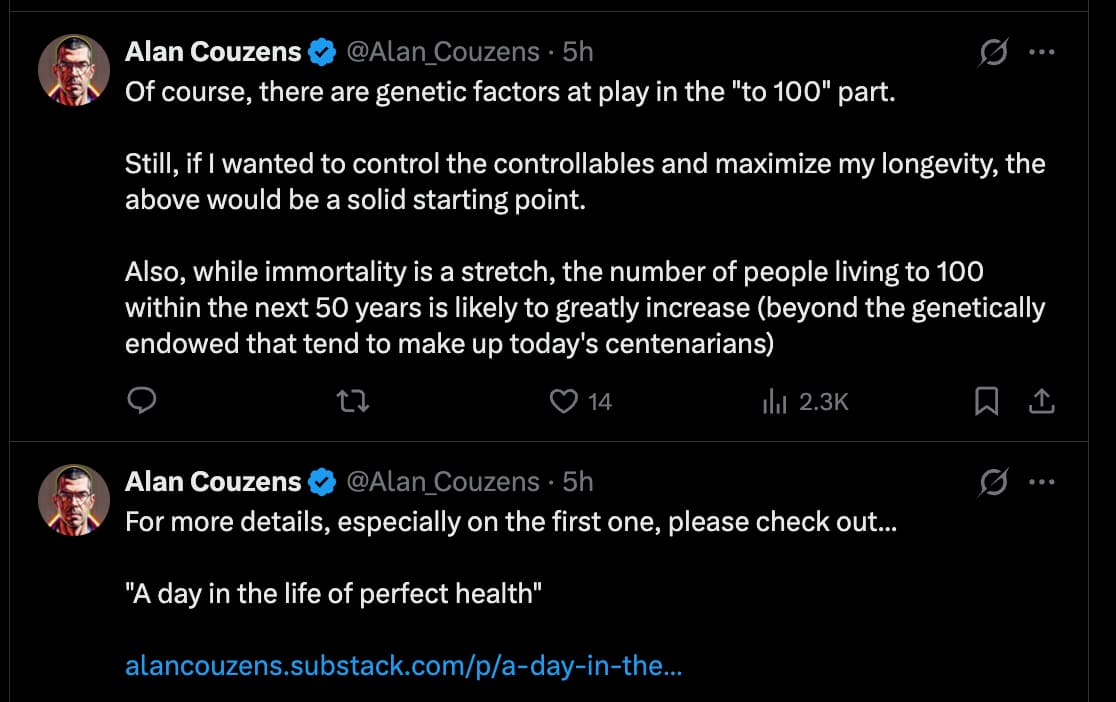
And lastly, I think this downplays the huge role of genetics and luck. He has one sentence of “of course there are genetic factors”. But IMO, number 1 probably should be a family history of longevity, and if you have strong family histories of cancers, heart disease then you want to be intervening early and aggressively.

4 Likes

Don’t overthink this. It’s largely rubbish. A bunch of biomarker levels which correlate with “health”, but completely disconnected from extreme longevity. The title is the giveaway that you’re dealing with bunk - because past about the age of 90-95, you really are down to genes. Pegging 100 as the goal almost by definition says: you won’t get to that point by anything you do or don’t do (within reason), it’s down to the genes.

Get a database of centenarian biomarkers and health related behaviors. You will likely not find ONE centenarian who hits all of them, and many, if not most, will not hit any of them.

If you tell me “here’s what to do to hit 90 years” (while you only focus on non-drug interventions) I might listen to you. The moment you tell me “here’s what to do to hit 100 and beyond” (and you don’t involve any drugs) I know you’re full of :poop:

And so it is here. Vast majorities of people will never hit 100, no matter what they do. The only - possible - way out with average run of the mill genes to get to 100 is maaaaybe with a good combo of medications. Maybe. At that point you might eke out another 5-8 years past to where your genes took you if you have decent genes of a 95, now add 5-8 years thanks to DRUGS (not lifestyle and the rubbish list by this coach) and hit the 100-105 mark - you might not, but maybe the drugs at least will make your healthspan better than it otherwise would’ve been. And I’m being optimistic, if you get your med stack just right plus a good pinch of luck. YMMV.

I agree. Of course any study of centenarians is, by definition, looking at outliers who have survived against the odds. So they are certainly blessed with good genetics, and have been lucky. A 100 year old today was born in 1926 and has survived through a major world war, very few vaccinations, rubbish antibiotics, no statins etc. I had one great aunt of mine live to 101, and another to 96, and I don’t think either of them did anything “right” in terms of their health (aside from both of them never having children!). Both died of fairly non-specific causes: one was gradual kidney failure, and the other died in her sleep.

Looking at causes of death is pretty interesting. Nowadays the largest cause of death globally is ASCVD, even in very poor countries. That’s good really, because it means we have already mostly addressed the majority of basic things like sanitation, vaccines, antibiotics. And in a wealthy country ASCVD is pretty much preventable if you intervene with the right medications. As we go forwards, we will chip away at ASCVD deaths with better and earlier treatments, and then cancer will become the top cause of death. The good news is we also have better early detection and cures for a good number of cancers now. Vaccines are chipping away at many virus-related cancer deaths in younger people, and colon cancer and cervical cancer are highly preventable too. Plus of course smarter drugs, immunotherapies and maybe more exotic things that I can’t imagine right now. If/when we get xenotransplantation solved, many organ failures may not be terminal either if we can do heart, lung, liver, kidney etc transplants.

However, the real question (and I think you’re alluding to this) is whether there’s some hard cap to lifespan. i.e. if you took care of all the “preventable early” causes (heart disease, cancers, infections etc) would there still be a general degradation of our bodies which is incompatible with living far beyond 100, and most people simply don’t have the genetics for it?