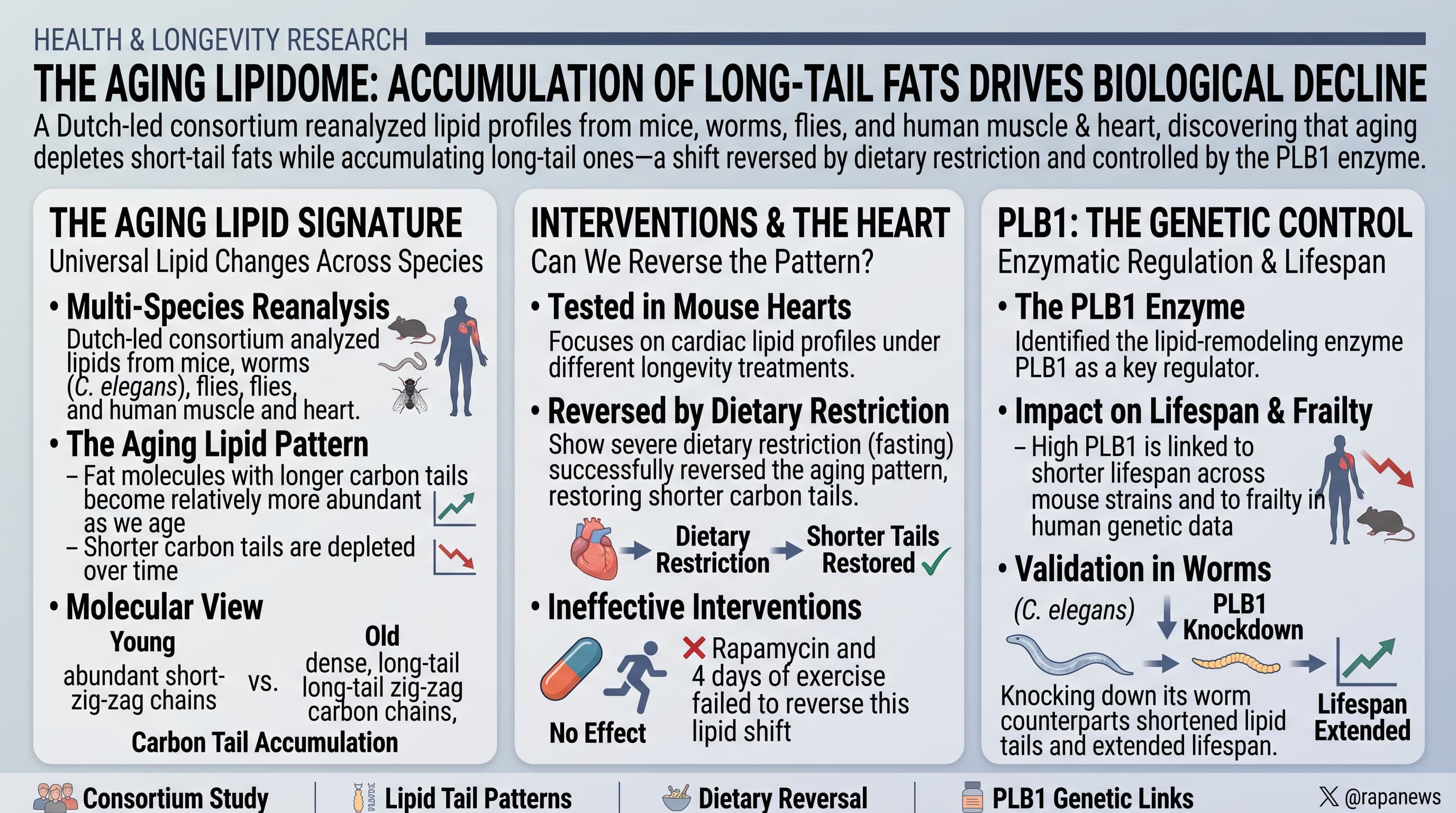
A Dutch-led consortium reanalyzed lipid profiles from mice, worms, flies, and human muscle and heart and found one recurring pattern: with age, fat molecules with longer carbon tails become relatively more abundant while shorter ones are depleted. Severe dietary restriction reversed the pattern in mouse hearts, while rapamycin and four days of exercise did not. The team then linked a lipid-remodeling enzyme, PLB1, to shorter lifespan across mouse strains and to frailty in human genetic data. Knocking down its worm counterparts shortened lipids and extended lifespan. The descriptive finding is broad and fairly convincing.
Every cell membrane is built from lipids, and each lipid carries fatty tails of varying length. A study in Nature Aging reports that those tails drift longer as animals age, and that the drift appears in species separated by hundreds of millions of years of evolution.
The work began with a second look at old data. Georges Janssens and colleagues at Amsterdam UMC had already profiled lipids across ten tissues in young and old mice. In heart tissue, they noticed that one lipid family rose with age mainly in its long-tailed forms. Versions with 44 carbons climbed roughly five-fold, while versions with 34 carbons rose only about 1.5-fold. Six of ten mouse tissues showed the same lean toward longer lipids. Brain and testis did not.
The pattern held in aging worms, in two fly cohorts, and in human skeletal muscle and heart tissue from both sexes. It also tracked with worsening heart function in patients with hypertrophic cardiomyopathy. A closer look showed the shift is not simply the body building longer fats. In more than half of the datasets, loss of shorter-chain lipids was a defining feature, with the tipping point near 18 carbons.
Could known longevity interventions reverse it? A 40 percent food restriction did so clearly in mouse hearts. Rapamycin shortened lipids in cultured heart cells at a very high dose but failed in live mice. Four days of vigorous exercise in postmenopausal women changed some lipid classes without moving the overall picture.
The team then looked for a gene behind the shift. Across 38 mouse strains, higher muscle activity of Plb1, an enzyme that clips fatty tails off membrane lipids, went with shorter lifespan. Human genetic data tied higher predicted PLB1 activity to greater frailty. In worms, silencing any of seven related genes extended lifespan. Silencing one of them shortened lipids across the board, and feeding the worms longer fatty acids erased the lifespan gain.
Finally, human cancer cells exposed to 20- and 22-carbon fatty acids died at higher rates than cells given 16- or 18-carbon fats, and computer simulations suggested small changes in membrane structure.
The authors propose lipid lengthening as a new hallmark of aging and a drug target. The human evidence is cross-sectional and drawn from small groups. The mouse gene link is a weak correlation. The causal experiments were done in worms, where a second lipid-shortening manipulation actually cut lifespan. And rapamycin, which reliably extends mouse lifespan, left heart lipid length untouched, so shorter lipids are evidently not required for a longevity benefit.
What the paper does provide is a simple, measurable feature of aging tissue that replicates across species, along with a testable hypothesis about why it occurs.
Actionable Insights
There is very little here to act on yet.
- The only intervention that reversed lipid lengthening in a living mammal was a 40 percent cut in food intake started in early adulthood. Typical lipid classes moved modestly, with class-level correlations around minus 0.25 in old mice (figure estimate). That degree of restriction is not practical or clearly safe for most people.
- Four days of daily vigorous exercise produced no overall shift (P = 0.90). This says nothing about long-term training, which was not tested.
- Rapamycin produced no overall shift in mouse hearts (P = 0.16 in females, 0.77 in males).
- In cultured cells, 22-carbon saturated fat raised the share of dead cells from about 1.5 percent to about 8 percent. More than 90 percent of cells survived, and the cells were bathed directly in the fat, which eating does not replicate.
- Worm lifespan gains were roughly 15 to 25 percent by eye from the survival curves. Worm results often fail to carry over to mammals.
Nothing in this paper supports avoiding long-chain dietary fats such as fish oil, or taking medium-chain fats to compensate. Dietary fat chain length was never tested in animals or people. No consumer test for tissue lipid length exists, and no PLB1-blocking drug or supplement is available.
Context and Source
- Paywalled Paper: Longer lipids mark aging and constrain lifespan
- Lead institution: Laboratory Genetic Metabolic Diseases, Amsterdam UMC, University of Amsterdam. Collaborators include the University of Sheffield, EPFL, Lawrence Livermore National Laboratory, the Max Planck Institute for Biology of Ageing, and University College London.
- Country: The Netherlands (lead), with the UK, Switzerland, USA, Germany, and Luxembourg.
- Journal: Nature Aging, published online 6 October 2026.
- Impact evaluation: The impact score of this journal is 25.0, evaluated against a typical high-end range of 0 to 60+ for top general science, therefore this is a High impact journal.