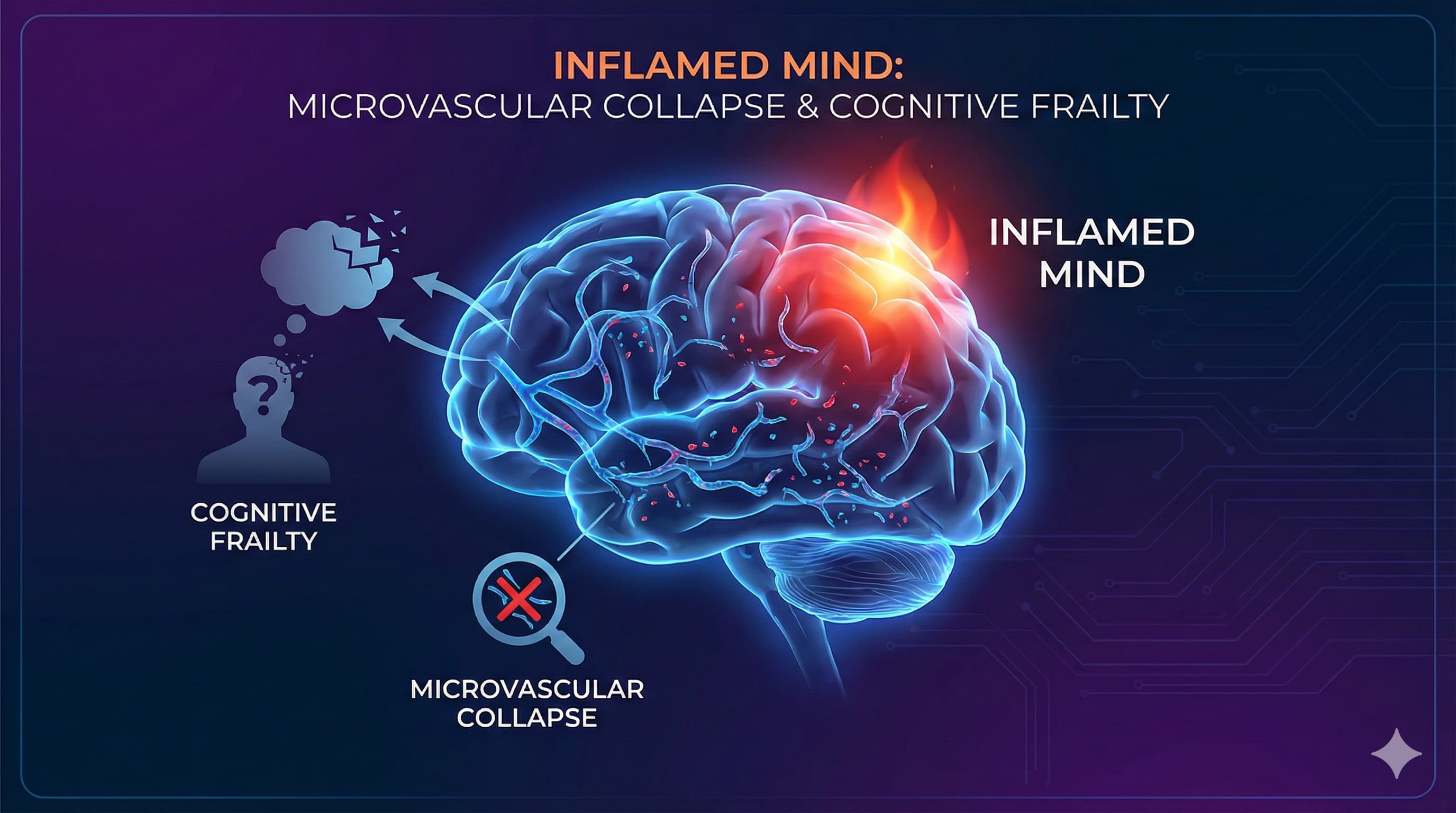
The Inflamed Mind: Microvascular Collapse as the Architect of Cognitive Frailty

The Silent Burn: How Systemic Inflammation Dismantles the Brain’s Hydraulic Infrastructure

In a paradigm-shifting review published in Experimental Gerontology , researchers from China Medical University have re-framed the etiology of “Cognitive Frailty”—the dangerous intersection of physical weakness and cognitive decline. Moving beyond the neuron-centric models that have dominated Alzheimer’s research for decades, the authors propose a “vascular-inflammatory axis” as the primary driver of this condition. The central thesis is stark: the aging brain does not simply wither; it starves, choked off by a collapsing microvascular network that has been degraded by chronic, systemic inflammation.

The paper, titled “Chronic inflammation and cognitive frailty in older adults: A narrative review” (Jiang et al., 2025), synthesizes emerging evidence that pro-inflammatory cytokines—specifically IL-6, TNF-α, and CRP—are not merely passive markers of aging but active agents of structural destruction. These molecules, originating from senescent cells and visceral fat, launch a relentless assault on the body’s microcirculation, the delicate web of capillaries responsible for nourishing tissues. In the brain, this results in the breakdown of the Blood-Brain Barrier (BBB), neurovascular uncoupling, and eventually, the simultaneous manifestation of sarcopenia (muscle loss) and cognitive impairment.

For the longevity community and biohackers, this report serves as a critical biological signal: preserving cognitive function is isomorphic with preserving endothelial integrity. The authors detail mechanistic pathways, including the cGAS-STING axis—a cellular alarm system triggered by leaking mitochondrial DNA—that drives this sterile inflammation. Crucially, the review posits that this state is reversible. Interventions ranging from the Dietary Inflammatory Index (DII) optimization to specific mind-body exercises like Baduanjin are highlighted as potent levers to dampen this inflammatory fire and restore microvascular perfusion. The implication is profound: to save the neuron, one must first save the vessel.

The Sources of Sterile Inflammation

Jiang et al. identify several upstream sources of the cytokines driving CF. These sources are critical targets for biohacker interventions because they represent the “root causes” of the downstream damage.

  • Cellular Senescence (The SASP): As cells accumulate DNA damage or reach their replicative limit (Hayflick limit), they enter a zombie-like state called senescence. They do not die, but they stop dividing. Crucially, they become metabolically hyperactive, secreting a toxic cocktail of pro-inflammatory cytokines (IL-6, IL-1β, IL-8), chemokines, and proteases. This is the Senescence-Associated Secretory Phenotype (SASP). In CF, endothelial cells lining the blood vessels become senescent, turning the vasculature itself into a source of inflammation.
  • Visceral Adipose Tissue: Fat is not merely energy storage; it is an endocrine organ. In aging and metabolic syndrome, visceral fat becomes infiltrated with macrophages (M1 phenotype) that secrete high levels of TNF-α and IL-6. This “adipose inflammation” spills over into the systemic circulation, reaching the brain and muscle tissues.
  • Gut Dysbiosis (“Leaky Gut”): The review and supporting literature point to the gut-brain axis. With age, the intestinal barrier permeability increases, allowing bacterial endotoxins (Lipopolysaccharides, LPS) to enter the bloodstream. This condition, metabolic endotoxemia, triggers a systemic immune response, chronically elevating CRP levels and driving neuroinflammation.
  • Immunosenescence: The aging immune system loses its ability to distinguish “self” from “non-self” and to clear pathogens effectively. This results in a dual failure: a weakened response to new infections (like flu) but a heightened, non-specific autoimmune-like activity against the body’s own tissues.

The Neural Consequences

When these cytokines cross the Blood-Brain Barrier (or damage it sufficiently to enter), they activate the brain’s resident immune cells: the microglia. In a healthy brain, microglia are housekeepers, pruning synapses and clearing debris. In an inflamed brain, they adopt a “primed” or aggressive phenotype. They stop cleaning and start attacking, releasing reactive oxygen species (ROS) and excitotoxins (like glutamate) that kill neurons. This “neuroinflammation” is the biological bridge linking systemic inflammation to the cognitive deficits seen in CF.

Continue reading the full story in the next post, here: Interventions and Protocols: Actionable Insights

Source Paper (Open Access): Chronic inflammation and cognitive frailty in older adults: A narrative review

Gemini Analysis of the paper: https://gemini.google.com/share/11560ad80357

5. Interventions and Protocols: Actionable Insights

Based on the mechanisms identified in the Jiang et al. review, we can construct a comprehensive protocol for the prevention and reversal of Cognitive Frailty. These interventions focus on suppressing inflammation, restoring microcirculation, and re-balancing the mTOR/AMPK axis.

5.1 Nutritional Modulation

The paper explicitly highlights the Dietary Inflammatory Index (DII) as a modifiable risk factor.4

Intervention Mechanism Biohacker Protocol
Dietary Nitrates Provides substrate for NO synthesis via the nitrate-nitrite-NO pathway, bypassing dysfunctional eNOS. Beetroot Juice: 70-140ml concentrated shot pre-workout. Greens: Arugula/Rocket (2-3 cups/day).
Polyphenols (Sirtuin Activators) Xenohormetic compounds that activate SIRT1/AMPK and inhibit NF-κB. Resveratrol/Pterostilbene: 250-500mg (trans-form) with fat. EGCG: 400-800mg (Green Tea Extract). Cocoa Flavanols: 900mg/day (for vascular cognition).
Omega-3 Fatty Acids Precursors to Resolvins and Protectins, which actively terminatethe inflammatory response. EPA/DHA: 2-4g daily combined. Target an Omega-3 index > 8%.
Ketogenic Cycling Ketone bodies (BHB) inhibit the NLRP3 inflammasome and provide alternative fuel for hypoperfused neurons. Cyclical Keto: 3-4 days/week or exogenous Ketone Esters (10-25g) prior to cognitive tasks.
Elimination Reducing the DII score. Strict reduction of seed oils (Linoleic acid), refined sugars, and ultra-processed foods.

5.2 Physical Modulation

Exercise is the only intervention with Grade A evidence for both sarcopenia and cognitive decline.

  • Mind-Body Exercise (Baduanjin): The review highlights Baduanjin, a traditional Chinese Qigong exercise.5
    • Mechanism: Reduces oxidative stress markers (MDA) and cortisol; enhances parasympathetic tone (HRV).
    • Protocol: 30-60 minutes, 3-5 times/week. Best for stress reduction and vascular compliance.
  • Zone 2 Cardio:
    • Mechanism: Low-intensity steady-state (LISS) training maximizes mitochondrial fat oxidation and stimulates endothelial shear stress without excessive ROS production. It increases capillary density (angiogenesis).
    • Protocol: 45-90 minutes at 60-70% Max HR, 3-4x/week.
  • Resistance Training:
    • Mechanism: Mechanical tension on muscle releases myokines (Irisin, IL-6 in acute pulses) that cross the BBB and stimulate BDNF.
    • Protocol: Heavy compound movements (Squat, Deadlift, Press) 2-3x/week. Essential for reversing the “physical” component of frailty.

5.3 Pharmacological and Supplemental Stacking

Compound Target Pathway Dosage (Theoretical n=1) Notes
Rapamycin mTOR Inhibition: Clears senescent cells, induces autophagy. 2-6mg weekly (pulsed). Rx only. Gold standard in longevity. Requires medical supervision.
Metformin / Berberine AMPK Activation: Improves insulin sensitivity, mimics caloric restriction. Berberine: 500mg 2-3x/day (with meals). Metformin: 500-1000mg (evening). Berberine is a potent non-Rx alternative. Cycle to avoid blunting muscle gains.
Urolithin A Mitophagy: Induces clearance of damaged mitochondria, preventing cGAS-STING activation. 500-1000mg daily. Derived from pomegranates but requires specific gut bacteria; supplementation is more reliable.
NAD+ Precursors (NR/NMN) Sirtuins/PARPs: Fuels DNA repair and enzymatic anti-inflammatory pathways. 500-1000mg daily (morning). Critical for restoring vascular endothelial energetic capacity.18
Fisetin / Quercetin Senolysis: Clears SASP-secreting senescent cells. Fisetin: High-dose pulse (20mg/kg) for 2 days/month. “Hit and run” strategy to reduce systemic inflammatory burden.19
Magnesium L-Threonate Synaptic Density: The only form that effectively crosses the BBB. 1500-2000mg daily (evening). Improves synaptic plasticity and sleep quality.

5.4 Dose-Timing and Circadian Alignment

  • Morning: NAD+ boosters (circadian inputs), AMPK activators (fasted state), Cortisol modulation (sunlight exposure).
  • Afternoon: Physical training (peak body temp), Nitrate loading (pre-workout).
  • Evening: mTOR activation (protein-rich meal for muscle repair), Anti-inflammatories (Curcumin/Magnesium), Glymphatic optimization (sleep hygiene).

6. The Quantified Self: Biomarkers of the Vascular-Inflammatory Axis

To manage Cognitive Frailty, one must measure it. The standard lipid panel is insufficient. Biohackers require a dashboard that reflects endothelial health and systemic inflammation.

6.1 Blood Biomarkers

  • hs-CRP (High-Sensitivity C-Reactive Protein): The gold standard for systemic inflammation. Target: < 0.5 mg/L. Values > 1.0 mg/L indicate elevated risk; > 3.0 mg/L indicates active inflammaging.
  • Homocysteine: A vascular toxin that degrades endothelium and inhibits NO production. Target: 6-8 µmol/L. High levels indicate methylation deficits (B12/Folate need).
  • HbA1c & Fasting Insulin: Metrics of metabolic health. Insulin resistance is a primary driver of endothelial dysfunction. Target: HbA1c < 5.0%, Insulin < 5 uIU/mL.
  • NLR (Neutrophil-to-Lymphocyte Ratio): A cheap, accessible marker from a standard CBC. It reflects the balance between innate (neutrophil) and adaptive (lymphocyte) immunity. Target: < 1.5. Higher values correlate with frailty and mortality.8
  • Cystatin C: A superior marker of kidney function than creatinine. Since the kidney is a microvascular organ, it serves as a proxy for systemic microvascular health. Target: < 0.8 mg/L.
  • IL-6: If available (specialty testing), this is the most direct measure of the SASP burden. Target: < 1.5 pg/mL.

6.2 Functional and Digital Biomarkers

  • Grip Strength: A surprisingly potent biomarker. Use a dynamometer. Weak grip correlates strongly with brain atrophy. Target: Top quartile for age/sex.
  • Pulse Wave Velocity (PWV): Measures arterial stiffness. Can be estimated with some smart scales or specialized cuffs (e.g., Withings). Stiff arteries transmit damaging pulsatile energy to the delicate brain capillaries.
  • Digital Cognition: Regular testing of reaction time and working memory (e.g., CNS Vital Signs, Cambridge Brain Sciences). Intra-individual variability (inconsistency) is an early sign of neural network instability.
  • Gait Speed: Measure the time to walk 4 meters at a normal pace. < 0.8 m/s is the clinical cutoff for frailty; biohackers should aim for > 1.2 m/s.

7. Cost-Effectiveness and ROI Analysis

Biohacking can be expensive, but the most effective interventions for CF are often the cheapest.

7.1 High ROI (Foundational)

  • Exercise (Zone 2 & Resistance): Cost: $0. ROI: Infinite. It is the only intervention that simultaneously addresses sarcopenia (muscle), angiogenesis (vascular), and neurotrophy (brain).
  • Dietary Restriction (Fasting/DII): Cost: Neutral or negative (saving money on food). ROI: Very High. Reducing the intake of inflammatory foods and practicing time-restricted feeding profoundly impacts insulin sensitivity and mTOR signaling.
  • Sleep: Cost: $0. ROI: Critical. The glymphatic system, which clears neurotoxins, only works during deep sleep. Poor sleep actively degrades the BBB.

7.2 Medium ROI (Optimization)

  • Basic Supplements (Vitamin D, Omega-3, Magnesium, Creatine): Cost: $30-50/month. ROI: High. These correct widespread deficiencies that accelerate aging. Creatine is particularly valuable for both muscle and cognitive energy reserves.
  • Wearables (Sleep/HRV trackers): Cost: $100-300 (one-time). ROI: Moderate. Useful for behavioral feedback loops.

7.3 Speculative/High Cost (Advanced)

  • Senolytics & NAD+ Boosters: Cost: $100-300/month. ROI: Variable. While mechanistically sound, human clinical data is still maturing. Best reserved for those who have already optimized diet, sleep, and exercise.
  • Peptide Therapy (BPC-157, etc.): Cost: High ($200+/month). ROI: Niche. Potentially useful for injury repair, but systemic effects on CF are not well-validated in humans.

8. Critical Limitations and Translational Uncertainty

While the vascular-inflammatory hypothesis is compelling, the Jiang et al. review and the field at large face several limitations.

  • Correlation vs. Causation: Most data linking inflammatory markers (IL-6, CRP) to CF is cross-sectional. It remains debated whether inflammation causes frailty or is simply a biomarker of the tissue damage associated with frailty. The “chicken or egg” problem persists.2
  • Methodological Heterogeneity: The definition of Cognitive Frailty varies between studies. Some use the Fried phenotype; others use the Frailty Index. Some measure cognition with the MMSE (which has a ceiling effect); others use the MoCA. This makes meta-analysis and definitive conclusions difficult.
  • The “One-Target” Fallacy: Geroscience often seeks a “silver bullet.” However, CF is multifactorial. Targeting only inflammation (e.g., with NSAIDs) has historically failed to prevent Alzheimer’s. The authors advocate for multimodal interventions, but these are harder to standardize and study.
  • Translational Gap: Much of the mechanistic data (cGAS-STING, specific mitochondrial pathways) comes from murine (mouse) models. Humans have different inflammatory set-points and much longer lifespans, meaning mechanisms like telomere attrition and stem cell exhaustion play different roles.
  • Publication Bias: The review heavily cites positive studies regarding herbal interventions (like Baduanjin) and specific biomarkers, potentially underrepresenting null results.