The Identity Crisis Theory of Aging: Why Your Cells Forget What They Are

For more than a decade, aging biology has been organized around a tidy checklist: the “hallmarks of aging,” a roster that has swollen from nine to twelve to fourteen separate molecular faults, from DNA damage to worn-out telomeres to exhausted stem cells. The list is useful as a filing system, but it has a nagging problem — it describes symptoms without explaining why they all show up together, or how to treat more than one at a time.

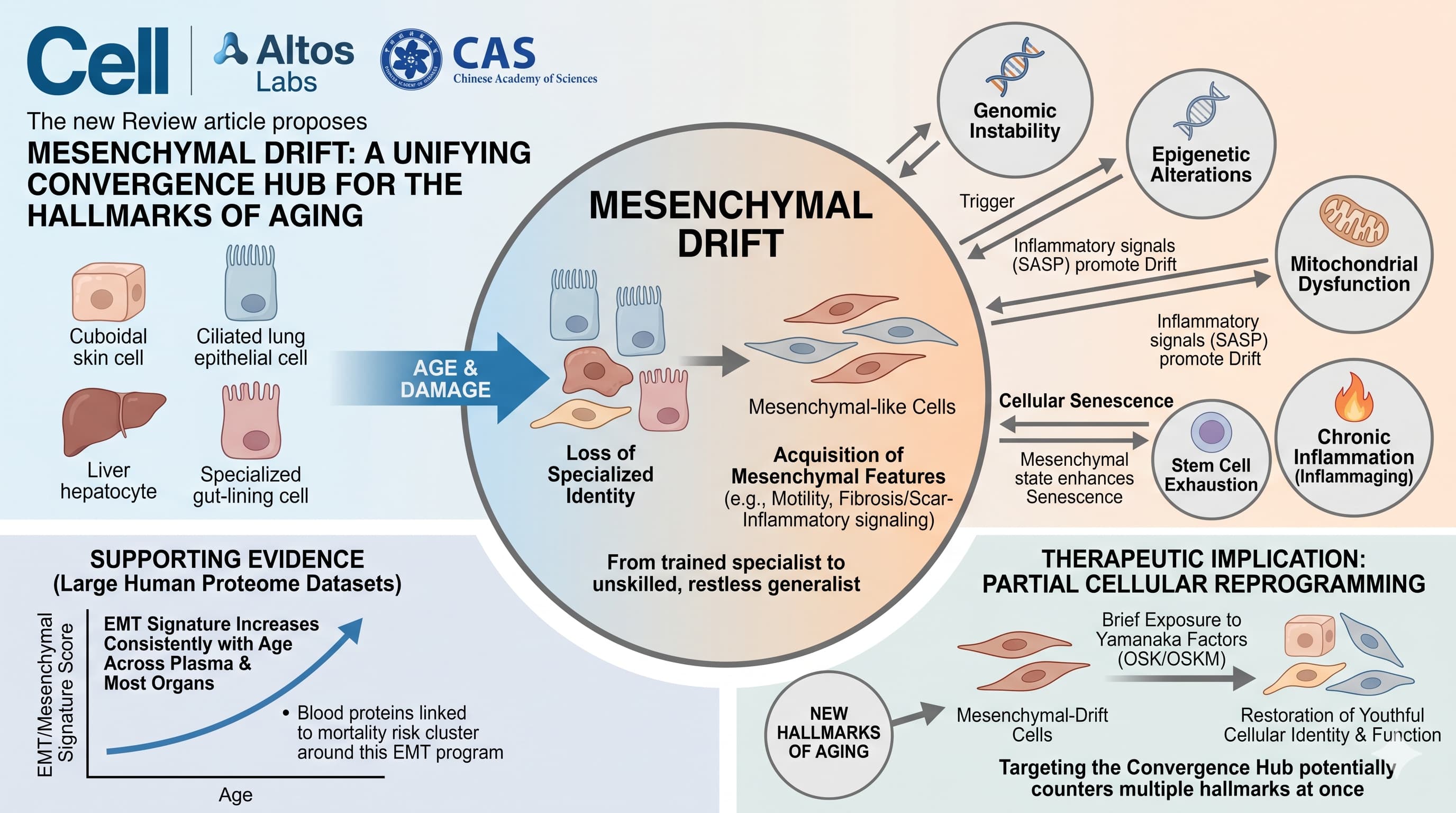
A new Leading Edge Review in Cell, from a team spanning Altos Labs in California and the Chinese Academy of Sciences in Beijing, proposes a single thread that may run through the entire checklist. They call it mesenchymal drift. The claim is that as tissues age, specialized cells — the skin, lung, liver, blood-vessel and gut-lining cells that do the actual work of an organ — slowly forget their identity and slide toward a generic, mobile, scar-producing “mesenchymal” state. Think of a trained specialist gradually reverting to an unskilled, restless generalist who lays down fibrous tissue and inflammatory signals instead of doing its original job.

The provocative part is the direction of causation. The authors argue mesenchymal drift is not just another item on the list but a convergence hub: nearly every classic hallmark — genomic instability, epigenetic change, failed protein recycling, broken mitochondria, deranged nutrient sensing, senescence, stem-cell exhaustion, chronic inflammation — can both trigger drift and be worsened by it, forming self-reinforcing loops. As supporting evidence they point to large human proteome datasets in which an “epithelial-to-mesenchymal transition” signature is among the most consistently age-upregulated features across plasma and most organs, and to the observation that blood proteins most strongly tied to mortality risk cluster around this same drift program.

If the framework holds, it reframes aging from a dozen leaks needing a dozen plugs into one underlying instability of cellular identity. That has a clear therapeutic implication the authors clearly favor: partial cellular reprogramming — briefly exposing cells to the Yamanaka factors (OSK/OSKM) to nudge them back toward their youthful identity without erasing it. Because drift sits where the hallmarks meet, hitting it could, in principle, counter several at once.

The honest caveat: this is a unifying hypothesis, elegant and well-referenced but not yet proven causal. “Mesenchymal drift” is a reinterpretation of existing data, not a discovery of a new molecule. Whether it is a true driver of aging or a particularly vivid description of it is the open question the paper itself cannot settle.

Actionable Insights

Because this is a conceptual review, take-homes are indirect — there is no protocol to copy. Still, several practical signals emerge, all consistent with mainstream geroscience rather than novel to this paper:

The strongest recurring lever is restraining the pro-fibrotic, mesenchymal program, and the interventions the authors repeatedly invoke are already familiar to this audience: mTOR inhibition (rapamycin) and AMPK activation (caloric restriction, exercise, and agents like metformin) both suppress drift in the cited models, which the authors suggest may partly explain rapamycin’s longevity effect. Autophagy support (fasting, exercise, mTOR suppression) counteracts the proteostasis collapse that feeds drift. NAD+ restoration is cited as easing mitochondrial dysfunction and one form of drift in preclinical work.

The broader theme worth internalizing: anti-fibrotic and anti-inflammatory living is anti-aging. Anything that lowers chronic low-grade inflammation, preserves mitochondrial fitness, and limits tissue fibrosis is acting on this proposed convergence node.

What you should NOT do is treat partial reprogramming as a near-term consumer intervention — it remains a research-stage, delivery-and-safety-unsolved technology with documented tumor risk in continuous-exposure animal studies.

Source:

  • Open Access Paper: Mesenchymal drift: A convergent framework for the hallmarks of aging
  • Institutions: Altos Labs, San Diego, California, USA; and the State Key Laboratory of Organ Regeneration and Reconstruction, Institute of Zoology, Chinese Academy of Sciences, Beijing, China.
  • Country: United States / China (collaborative).
  • Journal: Cell (Cell Press / Elsevier), Volume 189, May 28, 2026
  • Corresponding authors: Guang-Hui Liu (IOZ, CAS) and Juan Carlos Izpisua Belmonte (Altos Labs).
  • Disclosure flag: All authors are employees of Altos Labs or the Chinese Academy of Sciences. Altos Labs is a commercial longevity company whose flagship scientific bet is cellular reprogramming – the exact therapy this framework elevates. This is a legitimate conflict-of-interest consideration when weighing how strongly the review steers toward reprogramming as the answer.
  • Impact: The impact score of this journal is 45.5 (JIF) / 74.8 (CiteScore) , therefore this is an Elite impact journal.
https://www.cell.com/cell/fulltext/S0092-8674(26)00455-1

chatGPT:

Summary

This is a Cell review article, not a primary experimental paper. Its central proposal is that “mesenchymal drift” (MD) can act as a unifying framework for understanding aging.

The authors define mesenchymal drift as a gradual process in which cells lose their original lineage identity and acquire or intensify mesenchymal-like features. At tissue level, this means loss of functional parenchymal cells, expansion or activation of mesenchymal/stromal programs, extracellular matrix remodeling, fibrosis, inflammation, and organ dysfunction. They present this not as a binary switch, but as a spectrum of hybrid states, similar to partial EMT rather than full conversion.

The article argues that MD may connect the traditional hallmarks of aging. Instead of viewing genomic instability, epigenetic alterations, mitochondrial dysfunction, senescence, inflammation, stem-cell exhaustion, dysbiosis, and altered communication as separate processes, the authors suggest that many of them converge on — and are reinforced by — cellular identity erosion toward mesenchymal/fibrotic states.

The paper’s core model is a feedback-loop model:

aging damage and stress induce mesenchymal drift; mesenchymal drift then worsens genomic instability, inflammation, senescence, mitochondrial dysfunction, ECM stiffening, stem-cell exhaustion, and barrier breakdown.

For example, the authors describe genomic instability as both a driver and consequence of MD: DNA damage can promote EMT/EndoMT/FMT, while mesenchymal programs can increase replication stress, chromosomal instability, and defective DNA repair.

They also emphasize that MD spans multiple cell types and transitions: EMT, endothelial-to-mesenchymal transition, fibroblast-to-myofibroblast transition, pericyte-to-myofibroblast transition, macrophage-to-myofibroblast transition, hepatic stellate cell activation, vascular smooth muscle cell plasticity, and related stromal or inflammatory conversions. The figure on page 3 illustrates this as diverse cell origins converging on a mesenchymal spectrum under cues such as TGF-β, WNT, NOTCH, hypoxia, and inflammatory cytokines.

A major therapeutic implication is that partial reprogramming might counteract MD. The authors argue that OSKM/Yamanaka-factor or chemical reprogramming can initiate mesenchymal-to-epithelial transition-like reversal, repress mesenchymal transcription factors such as SNAIL, TWIST, and ZEB, restore youthful epigenetic patterns, and potentially reset multiple aging hallmarks at once.

They cite evidence that partial reprogramming can improve DNA repair, restore H3K9me3, reduce DNA methylation age, improve mitochondrial function, activate autophagy, reduce senescence/SASP markers, remodel ECM, and improve regeneration in several tissues.

What is novel?

The novelty is conceptual rather than experimental.

The main new idea is to elevate mesenchymal drift from a disease-associated phenomenon — familiar from EMT, fibrosis, cancer invasion, endothelial dysfunction, and wound healing — into a proposed central integrator of aging biology.

The paper’s novelty can be broken down into four points:

  1. A unifying framework: It reframes aging as not just accumulation of molecular damage, but as progressive destabilization of cell identity toward mesenchymal/fibrotic states.

  2. A bridge between hallmarks: It tries to explain how many hallmarks interact rather than simply listing them. MD becomes a “hub” linking genomic instability, epigenetic drift, mitochondrial dysfunction, senescence, inflammation, ECM remodeling, and stem-cell exhaustion.

  3. A directional model of tissue aging: The authors suggest aging has a biased trajectory: tissues drift toward fibrosis, ECM stiffening, inflammatory signaling, and loss of differentiated function.

  4. A therapeutic axis: The paper positions partial reprogramming as a possible inverse process to MD — not merely “making cells younger,” but specifically restoring lineage identity and reversing mesenchymal-state erosion.

Critique

The paper is strong as a synthesis, but weaker as a proof of causality.

Its biggest strength is that it brings together a large body of evidence from EMT, fibrosis, inflammation, senescence, epigenetics, mitochondrial dysfunction, and partial reprogramming into a coherent biological story. This is useful because aging tissues often do show fibrosis, stromal activation, ECM stiffening, inflammatory signaling, and loss of specialised cell function.

However, the central claim risks becoming too broad. If mesenchymal drift includes EMT, EndoMT, FMT, PMT, macrophage transitions, stellate-cell activation, fibroblast activation, vascular smooth-muscle plasticity, and general ECM remodeling, then MD may become a label for many different processes rather than a sharply defined mechanism. The paper acknowledges MD as a spectrum, but that makes it harder to know exactly what counts as MD and what does not.

A second weakness is causal hierarchy. The authors argue that MD can both arise from and reinforce hallmarks, but this does not prove that MD is upstream of aging rather than downstream of damage. In many cases, inflammation, DNA damage, mitochondrial dysfunction, senescence, and tissue injury could be the primary drivers, with MD being a common repair/fibrosis response. The authors themselves state that more longitudinal and experimental work is needed to decide whether MD is a primary driver or an amplifying node.

A third issue is measurement. For MD to become a true aging hallmark or therapeutic target, it needs robust biomarkers: single-cell signatures, spatial markers, lineage-tracing evidence, ECM-state measures, or blood-based correlates. The review discusses this need, but does not yet provide a standardized MD score that can be used across tissues and species.

A fourth concern is therapeutic ambiguity. Mesenchymal plasticity is not always bad. EMT-like and fibroblast activation programs are needed for wound healing, development, repair, and regeneration. Blocking MD too broadly could impair repair or immune containment. The authors recognize this problem, noting that therapies must distinguish adaptive transient plasticity from chronic pathological drift.

Finally, the partial reprogramming section is plausible but somewhat optimistic. Partial reprogramming may indeed reverse some aging-associated features, but it also raises unresolved issues: tumor risk, loss of cell identity if overdosed, delivery, tissue specificity, dosing cycles, and whether observed rejuvenation reflects true aging reversal rather than stress adaptation or selective survival of healthier cells.

Bottom line

This is a useful and ambitious review. Its main contribution is to propose mesenchymal drift as a systems-level aging mechanism linking cell identity loss, fibrosis, inflammation, ECM remodeling, and multiple hallmarks of aging. The idea is compelling because fibrosis and stromal activation are widespread in aging. But the framework still needs sharper definitions, better biomarkers, longitudinal validation, and experiments showing that reducing MD extends healthspan independently of merely suppressing injury, inflammation, or fibrosis.

1 Like