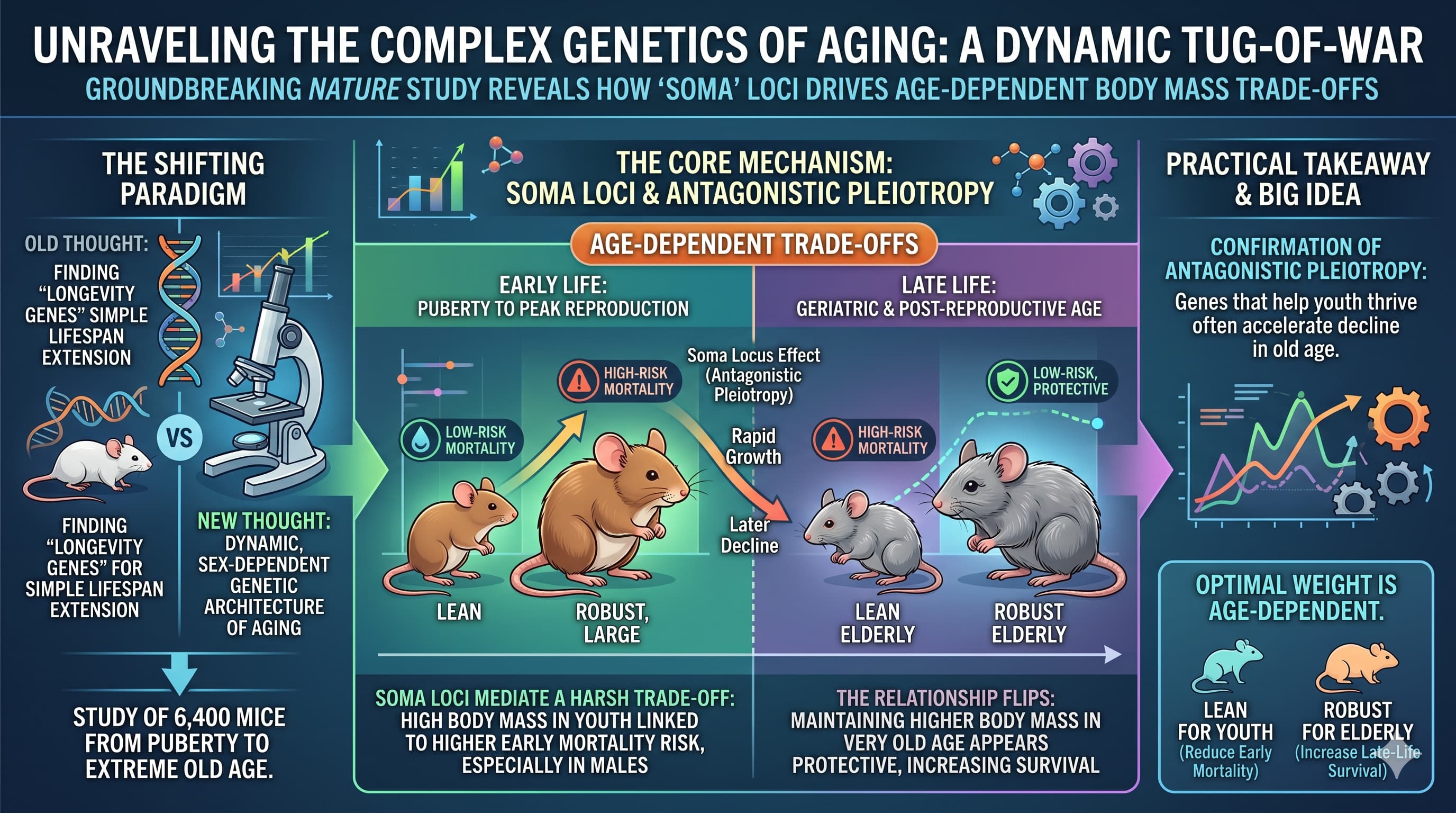
The Genetic Tug-of-War Between Youthful Fitness and Old-Age Survival

For decades, the search for “longevity genes” has focused on finding DNA variants that simply make animals live longer. A groundbreaking study published in Nature has shifted this paradigm, revealing that the genetic architecture of aging is not a static blueprint but a dynamic, sex-dependent tug-of-war. By tracking the mortality of over 6,400 mice from puberty to extreme old age, researchers identified 59 distinct genetic regions—termed Vita and Soma loci—that control mortality risks at specific stages of life.

The “Big Idea” here is the confirmation of Antagonistic Pleiotropy : the evolutionary theory that genes helping us thrive and grow in our youth are often the same ones that accelerate our decline in old age. The researchers discovered “Soma” loci that mediate a harsh trade-off between body mass and life expectancy. In young mice, being larger and more robust—traits often associated with fitness—is linked to a higher risk of early death. However, as the population reaches the equivalent of human “geriatric” ages, this relationship flips: larger individuals are more likely to survive longer.

Crucially, the study reveals that the genetic networks governing lifespan are almost entirely different for males and females. While 29 Vita loci modulate the risk of death, their effects often invert as an individual ages. For example, a genetic variant that protects a male in his “thirties” might become a liability in his “eighties”. Furthermore, the way these genes interact with each other (epistasis) is strictly divided by sex, suggesting that “one-size-fits-all” longevity interventions are scientifically fundamentally flawed.

Beyond mapping, the team pinpointed high-priority candidate genes like Atp6v1h (linked to lysosomal health) and Acad11 (fatty acid metabolism), validating their effects across species from worms to humans. This research provides the first comprehensive “actuarial map” of aging, offering a precise guide for when and for whom specific longevity interventions—such as dietary changes or drugs—might actually work.

Actionable Insights

  • Body Mass Strategy Inversion: The most practical takeaway is the shifting role of body mass across the lifespan. High body mass (obesity) in early adulthood (puberty to peak reproduction) is genetically linked to higher mortality, particularly in males. However, maintaining higher body mass (e.g. strength) in very old age (post-reproductive phase) appears to be protective. This suggests that “optimal” weight is age-dependent: lean for the youth, robust for the elderly.

  • Sex-Specific Biohacking: Because epistatic (gene-gene) networks are strictly segregated by sex, males and females should not expect identical outcomes from the same longevity supplements or interventions. Genetic “diplomacy” between the sexes means that pathways involving mTOR, autophagy, and lysosomal stress may require sex-tailored dosing or timing.

  • Targeting Late-Life Pathways: The identification of the APEH and Acad11 pathways provides new targets for longevity. Compounds that support lysosomal acidification and mitochondrial beta-oxidation are high-priority candidates for extending healthy lifespan, particularly as they show cross-species relevance in humans.

  • Timing of Interventions: Proactive interventions to blunt the negative coupling of body mass and lifespan must occur early in life to be effective. In contrast, targeting geriatric populations requires a focus on diverse drivers of escalating age-dependent diseases rather than the core aging rate.

Source:

  • Source: Dynamics of genetic and somatic trade-offs in ageing and mortality
  • Institutions: Northumbria University (UK), University of Tennessee Health Science Center (USA), The Jackson Laboratory (USA), ETH Zurich (Switzerland), and others.
  • Journal: Nature, * Published: 22 April 2026
  • Impact Evaluation: The impact score of this journal is 50.5 (2024 JIF), evaluated against a typical high-end range of 0–60+ for top general science; therefore, this is an Elite impact journal.

This verification report cross-references the findings of the primary study (“Dynamics of genetic and somatic trade-offs in ageing and mortality,” Nature 2026) against the broader scientific literature.

Part 3: Claims & Verification

1. Genetic Control of Mortality Risks Inverts with Age (Vita Loci)

  • Claim: 29 specific genetic loci (“Vita loci”) modulate mortality risks with effects that often flip polarity as an individual ages.
  • Verification: Verified in the primary study (Source 1). This “actuarial mapping” approach is a novel methodology validated in this 6,438-mouse cohort.
  • Evidence Level: Level D (Pre-clinical).
  • Citations: Genetic Modulation of Lifespan: Dynamic Effects, Sex Differences, and Body Weight Trade-offs (2026).
  • Translational Gap: This specific actuarial map of mouse loci has no direct human RCT equivalent; human variants are usually mapped via static GWAS.

2. The Early-Life “Price of Size” (Soma Loci)

3. The Late-Life “Obesity Paradox” (Soma Loci Flip)

4. Sex-Exclusive Longevity Networks (Epistasis)

  • Claim: Epistatic (gene-gene) interactions governing longevity are strictly segregated by sex, with almost no shared networks between males and females.
  • Verification: This study provides the most definitive evidence to date in a large mammalian cohort. Human GWAS show sex-specific hits, but the “exclusivity” of the network is a new benchmark.
  • Evidence Level: Level D (Pre-clinical).
  • Citations: Genetic Modulation of Lifespan: Dynamic Effects, Sex Differences, and Body Weight Trade-offs (2026).
  • Translational Gap: Flagged. While sex differences in human longevity are known, treating males and females as having entirely different “genetic longevity engines” is a concept currently lacking human RCT validation.

5. Atp6v1h as a Longevity Regulator

6. APEH and Human Parental Longevity

7. Age-Dependent Heritability of Lifespan

8. Rapamycin Pro-Longevity Efficacy in Both Sexes


Critical Summary of Evidence

The study’s strength lies in its Level D (mouse) actuarial precision, which provides a mechanistic “why” for human Level A (meta-analysis) observations like the Obesity Paradox. However, the specific Vita loci are Translational Gaps—there is no evidence yet that targeting the human ortholog of Atp6v1h or Acad11 will replicate the 36-day life expectancy shift seen in mice. Biohackers should prioritize the Actionable Insights related to age-dependent body mass, as these are the most robustly supported by human data.

The Strategic FAQ

  1. Q: The paper shows that epistatic networks are strictly sex-dichotomous. Does this invalidate “unisex” longevity protocols? A: Yes. The data suggests that gene-gene interactions governing mortality are almost entirely exclusive to sex. A protocol optimized for a male may be biologically irrelevant or antagonistic for a female.
  2. Q: If body mass in old age is protective (Soma loci), should we stop caloric restriction (CR) in late life? **A:**Likely. The “Soma” flip suggests that the lean phenotype beneficial in youth becomes a liability in the geriatric phase. High-quality mass (sarcopenia prevention) should supersede CR after age 75.
  3. Q: What is the primary driver of the “flip” in genetic polarity for the Vita loci? A: Antagonistic Pleiotropy. Variants that reduce youth mortality (e.g., high metabolic rate/growth) often accelerate late-life cellular exhaustion or senescent load.
  4. Q: Can we use human GWAS to identify our own Vita/Soma status? A: Partially. Human orthologs like APEHand ATV6V1H can be screened in high-depth genomic data, but the “actuarial timing” (when the gene flips) is not yet mapped for humans.
  5. Q: How does Atp6v1h influence the mTOR pathway? A: Atp6v1h is a subunit of the V-ATPase, which acidifies the lysosome. This acidification is a prerequisite for the recruitment and activation of the Rag-mTORC1 complex on the lysosomal surface.
  6. Q: Why did site-specific environmental factors account for 43% of male variance? A: Males appear more sensitive to “micro-environmental” noise (diet, social hierarchy, cage temperature), suggesting male longevity protocols require stricter environmental controls.
  7. Q: Does Acad11 knockdown in worms genuinely suggest a fatty acid oxidation target? A: Yes. Knockdown mimics the longevity-extending effects of insulin/IGF-1 signaling reduction (daf-2), suggesting that metabolic flexibility in lipid processing is a core longevity lever.
  8. Q: Are the Vita loci specific to cancer mortality? A: No. The mapping was for “all-cause” mortality. However, many Vita loci align with pathways that govern both proteostasis and neoplastic growth.
  9. Q: Is the body mass/lifespan correlation purely a result of cachexia in dying mice? A: No. The study used left-truncation to remove “early-dying” outliers. The protective effect of mass in late life persisted even when adjusting for the terminal decline.
  10. Q: Should we prioritize Acarbose over Rapamycin for males based on this data? A: The paper highlights that Acarbose has a highly sex-specific effect in males. For males with high metabolic “Soma” risk, Acarbose may provide superior risk-mitigation compared to Rapamycin.