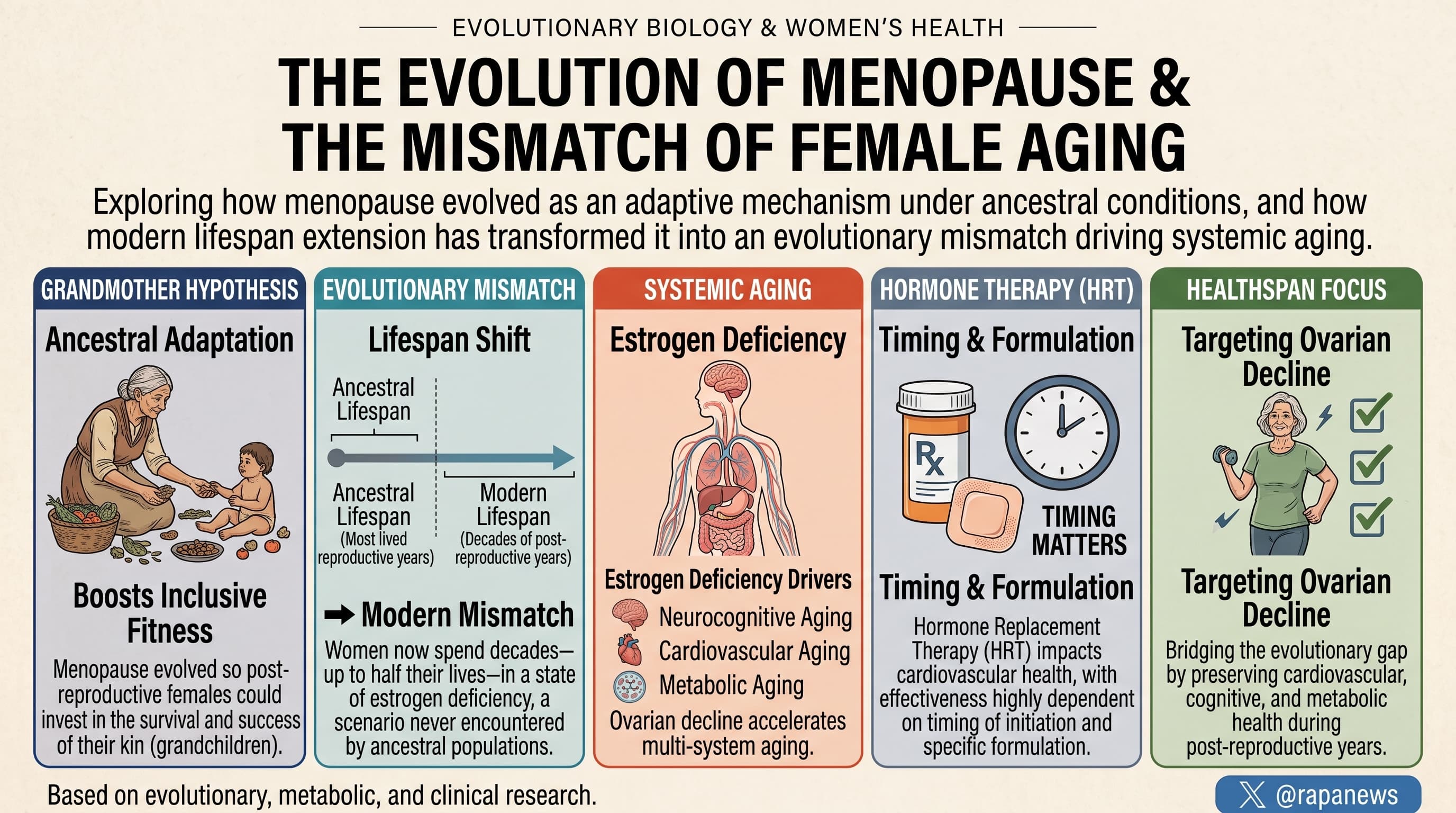
This review article explores the prolonged post-reproductive lifespan of human females through an evolutionary lens, focusing on the Grandmother Hypothesis. The author posits that menopause evolved as an adaptive mechanism under ancestral conditions to enhance inclusive fitness via childcare investment. However, the modern extension of human lifespan has transformed this historical adaptation into an evolutionary mismatch. Consequently, women now spend decades in a state of estrogen deficiency, driving accelerated cardiovascular, metabolic, and neurocognitive aging. The paper outlines the pathways linking ovarian decline to systemic aging and evaluates the nuanced cardiovascular impacts of hormone replacement therapy based on timing and formulation.
Human females occupy a unique position in the mammalian world because they routinely live for decades beyond their reproductive capacity. In stark contrast, the vast majority of mammals succumb to mortality shortly after their fertility ceases. The Grandmother Hypothesis provides a compelling evolutionary framework for understanding this extended post-reproductive lifespan. Under brutal ancestral conditions characterized by extreme infant mortality, scarce resources, and prolonged juvenile dependency, older females achieved greater genetic success by ceasing personal reproduction. Instead, they invested their remaining energy into the survival of their grandchildren. This strategic shift reduced the escalating physiological risks of late-life pregnancy and provided essential alloparental care and ecological knowledge transfer. Because overall life expectancy in these ancient environments was drastically shorter, ancestral women rarely survived long enough to experience the chronic, cumulative consequences of prolonged estrogen withdrawal.
In contemporary society, dramatic advancements in public health, nutrition, and medicine have radically extended human longevity. Women now regularly spend up to a third of their lives in a postmenopausal state. This demographic shift creates a profound evolutionary mismatch. A physiological trait shaped by the rigorous physical demands of ancient foraging environments now intersects with modern sedentary lifestyles, hypercaloric diets, and extended lifespans. The direct result is an unprecedented, prolonged period of estrogen deficiency that systematically dismantles cardiovascular, skeletal, and metabolic resilience over decades.
Estrogen acts as a fundamental guardian of female vascular health throughout the reproductive years. It actively regulates nitric oxide production, maintains structural endothelial flexibility, and suppresses local tissue inflammation. As endogenous estrogen levels collapse during the menopausal transition, this protective architectural network fails. Arteries begin to stiffen, lipid profiles become aggressively atherogenic, and autonomic nervous system regulation tilts heavily toward damaging sympathetic dominance. This sequential cascade accelerates the clinical onset of hypertension, atherosclerosis, and heart failure. The cardiovascular deterioration is frequently compounded by interconnected shifts in skeletal integrity and metabolic function, manifesting as increased visceral adiposity, disrupted glucose homeostasis, and insulin resistance.
Historically, the broader medical community viewed hormone replacement therapy as a universal, straightforward shield against this age-related decline. Landmark clinical trials eventually dismantled that assumption, revealing that initiating exogenous hormones in older women with already established vascular damage actively increases the risk of stroke and thromboembolism. The current scientific consensus points instead to a narrow window of therapeutic opportunity. Hormone therapy appears to offer tangible cardiovascular protection only when initiated near the immediate onset of menopause, before the vascular endothelium sustains irreversible structural damage. This transition highlights a critical pivot in longevity science and preventative medicine. Menopause is not merely the end of fertility but a systemic, life-course inflection point requiring proactive, highly individualized management of cardiovascular and metabolic health to align female healthspan with our newly achieved modern lifespan.
Actionable Insights
For individuals seeking to optimize health and longevity, this research clarifies that the menopausal transition is a critical period of accelerated biological aging requiring aggressive preventative action. The data indicates that the initial year following menopause drives an increase in arterial stiffness of up to 7.5%. Concurrently, lipid profiles shift unfavorably, yielding absolute increases in circulating low-density lipoprotein cholesterol of 0.45 mmol/L and total cholesterol of 0.58 mmol/L. These metabolic alterations represent a substantial, measurable escalation in baseline cardiovascular disease risk.
The practical application of these findings centers on the precise timing and physical formulation of hormone replacement therapy. Initiating hormone therapy within ten years of the final menstrual period leverages relatively intact endothelial function, which strongly suggests a stabilization of cardiovascular risk. Conversely, initiating therapy later in life exacerbates thromboembolic events. For those utilizing hormone therapy, the research supports opting for transdermal estradiol over oral conjugated equine estrogens. Transdermal administration completely bypasses hepatic first-pass metabolism, directly neutralizing the prothrombotic risks associated with oral estrogen processing. Furthermore, selecting micronized progesterone instead of synthetic progestins mitigates adverse vascular and metabolic effects. Beyond hormone management, individuals entering the menopausal transition must aggressively manage blood pressure, maintain insulin sensitivity, and track autonomic balance to actively counter the sudden systemic absence of estrogen-mediated cardioprotection.
Context/Source
- Paywalled Paper: The Grandmother Hypothesis: A perspective from cardiovascular aging
- Institution: Las Colinas Institutes, Irving, TX
- Country: USA
- Journal Name: Ageing Research Reviews
- Impact Evaluation: The impact score of this journal is 13.1, evaluated against a typical high-end range of 0-60+ for top general science, therefore this is a High impact journal.