For decades, the scientific consensus regarding the human brain was one of inevitable, “benign” erosion. Data showed that by age 80, the average person’s ability to recall words drops by nearly 50% compared to those in their 50s and 60s. This decline was seen as an inescapable consequence of net negative entropy—the biological wear and tear of a brain that processes massive information loads and manages trillions of synapses. However, the Northwestern University SuperAging Program, summarized in this 25-year retrospective, has identified a group of “cognitive time travelers” who defy this trajectory.
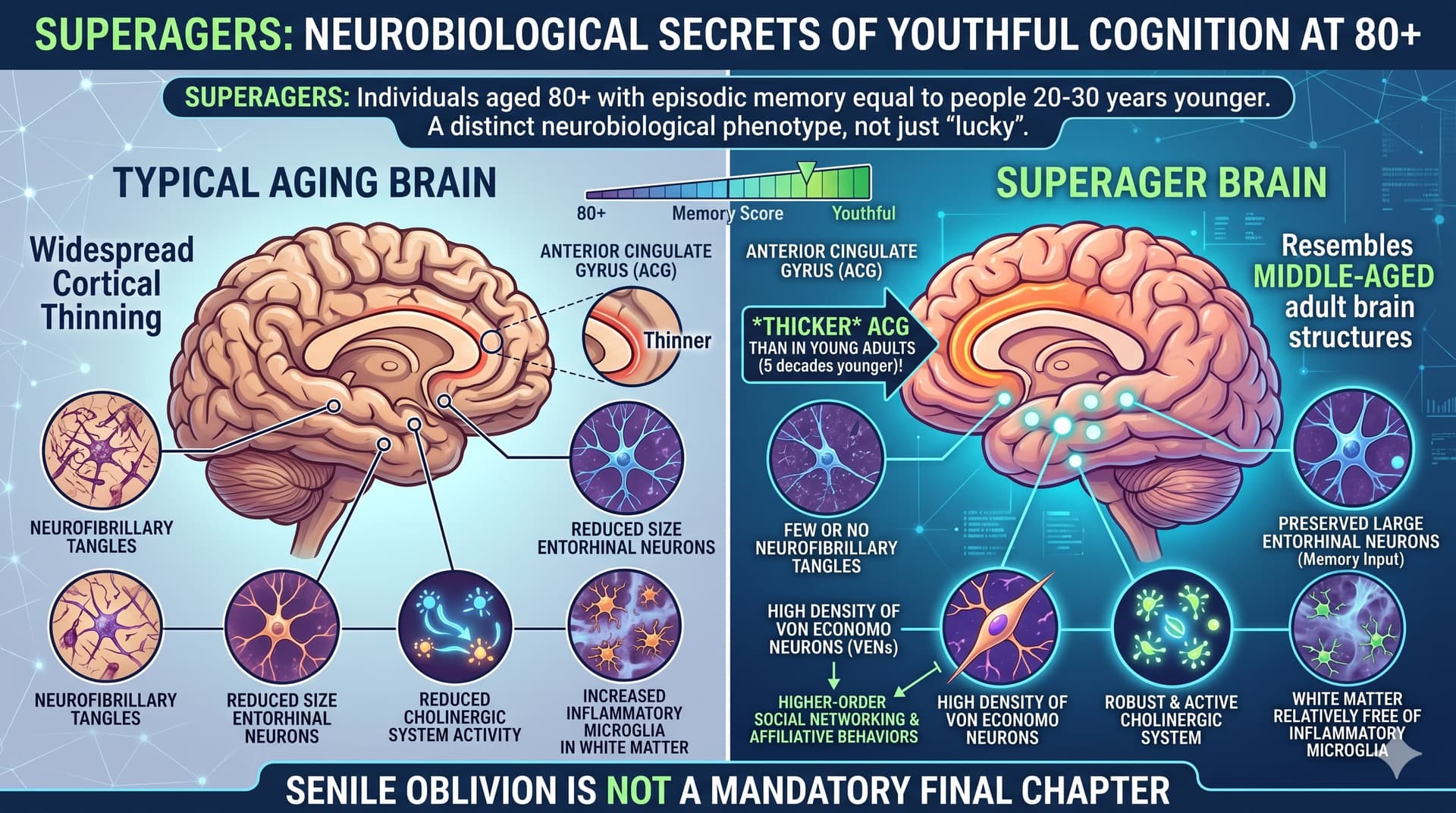
Superagers are individuals aged 80 and older who possess episodic memory scores at least equal to those of people 20 to 30 years younger. They are not merely “lucky” average agers; they represent a distinct neurobiological phenotype. While neurotypical seniors show widespread cortical thinning, Superagers exhibit brain structures that mirror those of middle-aged adults. Most remarkably, a specific region—the anterior cingulate gyrus—is actually thicker in Superagers than in individuals five decades younger.
Under the microscope, the differences are even more profound. Superagers possess a significantly higher density of von Economo neurons—large, spindle-shaped cells associated with higher-order social networking and affiliative behaviors. Their brains also show a robust resistance to the hallmarks of Alzheimer’s disease. They have fewer neurofibrillary tangles, larger entorhinal neurons (vital for memory input), and a notably more active cholinergic system than their peers. Perhaps most tellingly, their white matter is relatively free of the inflammatory microglia that typically signal age-related decline. This research suggests that senile oblivion is not a mandatory final chapter for the human brain.
Actionable Insights The Northwestern data shatters the “perfect lifestyle” myth of longevity. While some Superagers adhered to rigorous health regimens, others smoked, drank, and ignored traditional exercise guidelines. The one universal trait identified was extreme gregariousness and the maintenance of positive, high-quality social relationships.
-
Prioritize Social Complexity: The high density of von Economo neurons in the anterior cingulate—a region governing social behavior—suggests that intense social engagement may be a primary driver of cognitive resilience.
-
Target Neuro-Inflammation: The observation of fewer activated microglia in Superager white matter indicates that managing systemic and brain-specific inflammation is a critical priority for maintaining “youthful” brain structure.
-
Cholinergic Support: Superagers naturally have better-preserved cholinergic innervation and lower levels of the enzyme that breaks down acetylcholine. This points toward the importance of supporting the basal forebrain cholinergic system through lifestyle or potential future compounds.
Context
- Open Access Paper: The first 25 years of the Northwestern University SuperAging Program
- Institution: Northwestern University Feinberg School of Medicine, Mesulam Institute for Cognitive Neurology and Alzheimer’s Disease.
- Country: USA.
- Journal Name: Alzheimer’s & Dementia: The Journal of the Alzheimer’s Association.
- Impact Evaluation The impact score of this journal is 13.0, evaluated against a typical high-end range of 0–60+ for top general science, therefore this is a High impact journal.