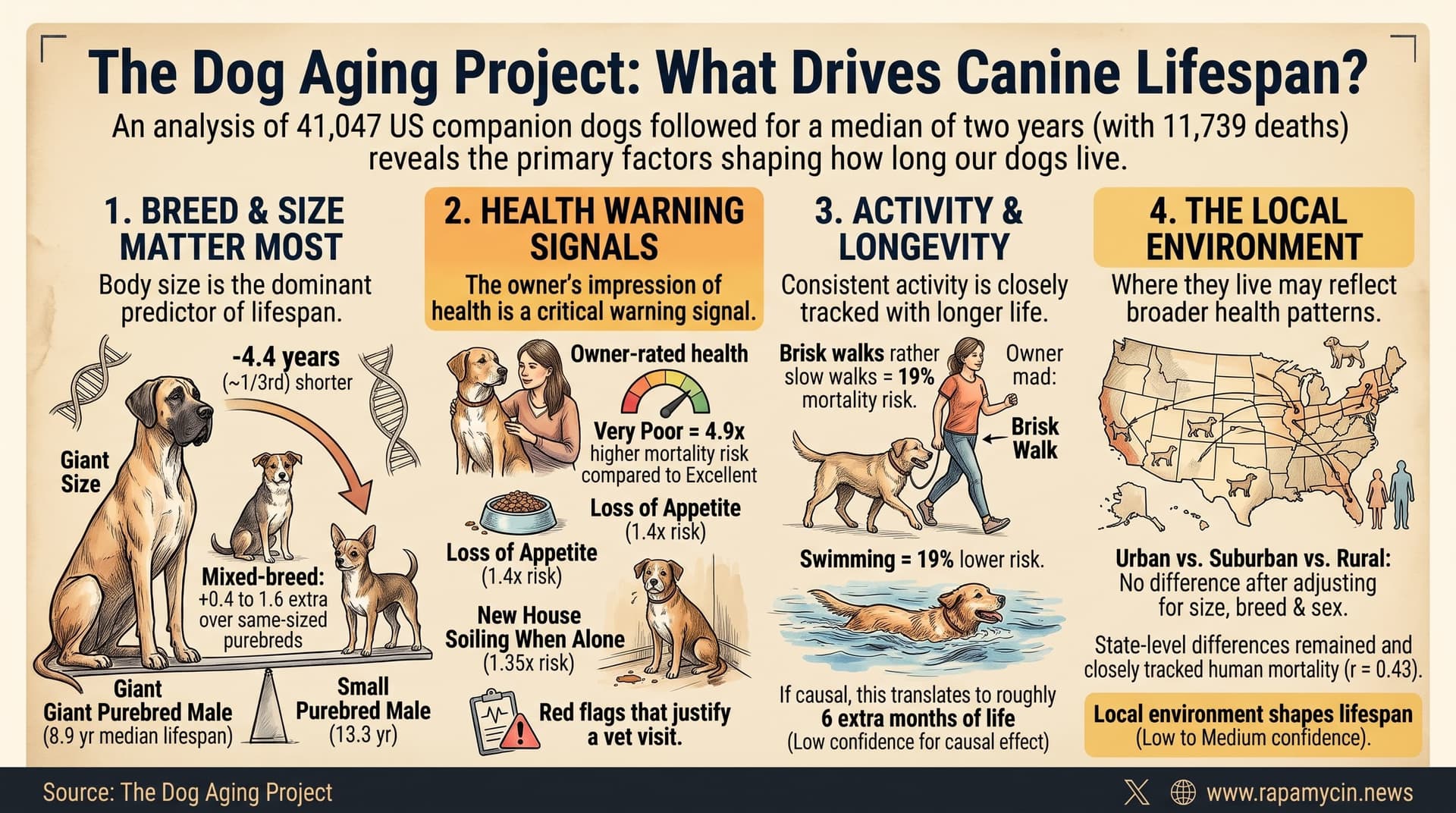
The Dog Aging Project analyzed 41,047 US companion dogs followed for a median of about two years, with 11,739 deaths. Body size was the dominant predictor of lifespan: median survival fell from about 14 years in small mixed-breed dogs to under 9 years in giant purebred males. Within each size class, mixed-breed dogs outlived AKC-registered purebreds, and females had a small advantage, mostly in larger purebreds. After adjusting for size, breed status and sex, rural, suburban and urban differences vanished, but state-level differences remained and tracked human mortality across states (r = 0.43). A screen of 804 owner-survey variables flagged 72 associated with mortality, mostly owner-rated health, chronic disease, physical activity and energetic behavior. All findings are observational.
Dogs make useful stand-ins for people in aging research. They share our homes, our air and often our habits, they get many of the same chronic diseases, and they age about five to seven times faster. The Dog Aging Project was built to use that, and this paper is its first big look at who dies when.
The researchers followed more than 41,000 pet dogs whose owners filled in a detailed baseline survey covering health, diet, exercise, behavior and environment. Over about two years of follow-up, nearly 11,800 dogs died, most of them by euthanasia.
The headline result confirms what vets have long seen. Size dominates. Small mixed-breed dogs had a median lifespan of about 14 years. Giant purebred males reached about 9. Within every size class, however, the spread was wide. Half of the dogs in each group died within a window of roughly four years, which means size sets the average but leaves plenty of room for other factors.
Breed background mattered too. Mixed-breed dogs outlived purebreds of the same size by up to 1.6 years in males and about half a year in females, consistent with the idea that genetic diversity protects against inherited disease. Breed-level differences were stark. Dachshunds, Havanese and Border Collies reached a median of around 14 years, while Doberman Pinschers and Great Danes lived about 8.5. Cavalier King Charles Spaniels and Boxers fell well short of other dogs their size, consistent with their known heart disease burdens.
The more surprising result was geographic. Once size, breed and sex were accounted for, living in the city or the country made no difference. But some states still stood out. Dogs in Texas, Tennessee and parts of the South died sooner, while dogs in California and Washington lived longer. When the team set these state-level dog risks against human death rates, the two lined up. States where people die younger tended to be states where dogs die younger too. Something about place, whether climate, parasites, veterinary access, income or pollution, appears to affect both species.
The survey screen produced a long list of signals. Owners who rated their dog’s health as very poor were about five times more likely to lose it during follow-up than owners who rated it excellent. Dogs that walked briskly, swam, played games daily, chased squirrels and had access to parks had lower risk. Dogs that slowed down, lost appetite or started soiling the house when left alone had higher risk.
These links are easy to misread. A dog that walks slowly may already be ill, and a dog that eats grass may simply be one healthy enough to roam outdoors. The authors say plainly that their list is a set of leads for future study, not a recipe for longer life.
What the study does provide is a solid baseline. The Dog Aging Project’s data are public, the follow-up is growing every year, and the ongoing genetic, biomarker and drug-trial arms will be able to test which of these signals are causes and which are only symptoms.
Actionable insights
These are associations, so the effect sizes below describe what was observed, not what changing the factor would achieve.
- Breed choice carries the largest effect. A giant purebred male’s median lifespan (8.9 years) is about 4.4 years, or one-third, shorter than a small purebred male’s (13.3). Picking a mixed-breed dog of the same size was associated with 0.4 to 1.6 extra years.
- Treat your own impression of your dog’s health as a warning signal. Dogs rated “very poor” had 4.9 times the risk of dying compared with “excellent”. Loss of appetite (1.4 times the risk) and new house soiling when alone (about 1.35 times) were also red flags that justify a vet visit.
- Activity tracks with longevity. Dogs whose walks were all brisk rather than all slow had about 19 percent lower risk, and dogs that swam showed the same 19 percent reduction. If those links were fully causal, which is unlikely, that would be worth roughly six months of median life.
- For humans, the dog-human state correlation adds modest support to the idea that local environment, beyond personal choices, shapes lifespan.
Context and source
- Open Access Paper: Factors associated with longevity in companion dogs: initial findings from the Dog Aging Project
- Institutions: Texas A&M University (corresponding author), University of Washington, Tufts University (Jean Mayer USDA Human Nutrition Research Center on Aging)
- Country: United States
-
Journal: GeroScience (Springer; official journal of the American Aging Association)
Impact evaluation: The impact score of this journal is 5.4, evaluated against a typical high-end range of 0-60+ for top general science, therefore this is a Medium impact journal.