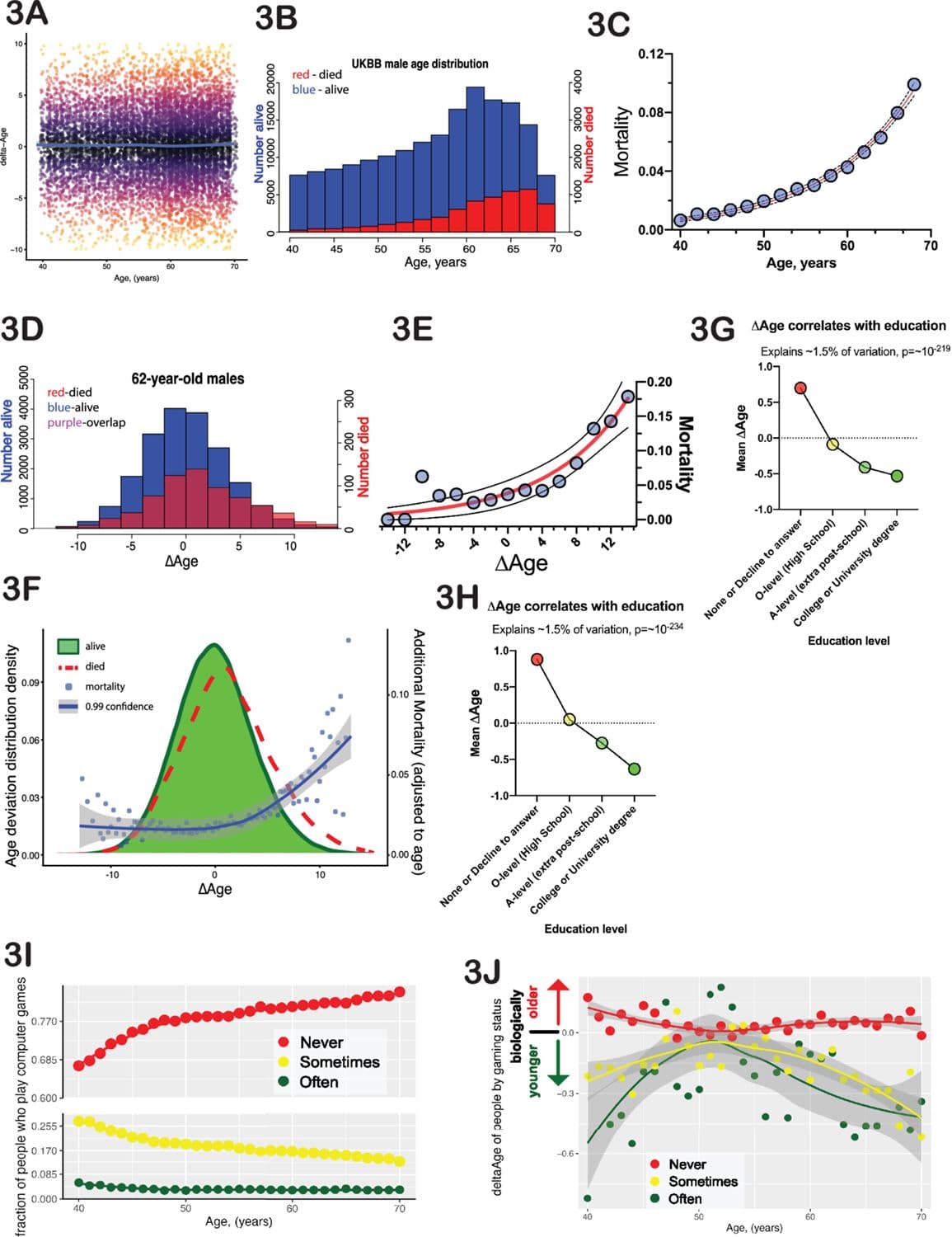
In a significant release (July, 2025) from Calico Life Sciences (the Google-backed longevity moonshot), researchers Sergiy Libert and Cynthia Kenyon have unveiled a new biological age clock that bypasses expensive molecular sequencing in favor of “old school” physiological function. Published in eLife (United Kingdom/USA), the study utilizes the massive UK Biobank dataset to demonstrate that a specific set of physiological traits—ranging from lung function to reaction time—can predict biological age (ΔAge) with striking accuracy.
The Big Idea is a paradigm shift from “molecular” to “functional” aging. While current excitement focuses on DNA methylation clocks (like Horvath or GrimAge), Calico’s model argues that the functional decay of organ systems is the ultimate arbiter of aging. The study shows that this physiological ΔAge is a potent predictor of all-cause mortality and parental age at death, suggesting it captures the true “rate of aging.” Crucially, a Genome-Wide Association Study (GWAS) of this clock revealed that synapse biology and neural function are central drivers of whole-body aging. In a surprising twist for the biohacking community, the data identified a “tendency to play computer games” as a behavioral factor associated with significantly younger biological age, potentially acting as a proxy for preserved cognitive processing speed.
Open Access Research Paper: A mathematical model that predicts human biological age from physiological traits identifies environmental and genetic factors that influence aging
Impact Evaluation: The impact score of this journal is 6.4 (2023 JIF) / 11.6 (CiteScore), evaluated against a typical high-end range of 0–60+ for top general science. Therefore, this is a High impact journal. (Note: eLife has recently paused its official Impact Factor participation due to a new open-science peer review model, but it remains a top-tier venue for rigorous biological research.)
Part 2: The Biohacker Analysis
Study Design Specifications
- Type: In silico / Epidemiological (Data Science).
-
Subjects: Humans (UK Biobank).
- N-number: ~400,000 (215,949 Females, 183,715 Males).
- Age Range: 40–70 years.
-
Lifespan Data: Predicted Mortality Risk (Gompertz). The study did not measure absolute lifespan extension of a treated cohort but validated the “clock” against participant mortality records and parental age at death.
- Effect Size: Each year of increased physiological ΔAge (being “older” than your calendar age) carried a mortality risk equivalent to one year of actual chronological aging.
Mechanistic Deep Dive
The study deconstructs aging into 121 physiological traits but finds that a core subset drives the signal.
- Neural-Centric Aging: The GWAS identified genes involved in synapse biology (specifically modulation of excitatory postsynaptic potential) as top hits. This suggests that the maintenance of cognitive processing speed and neural integrity is not just a result of youth but a driver or central biomarker of systemic biological age.
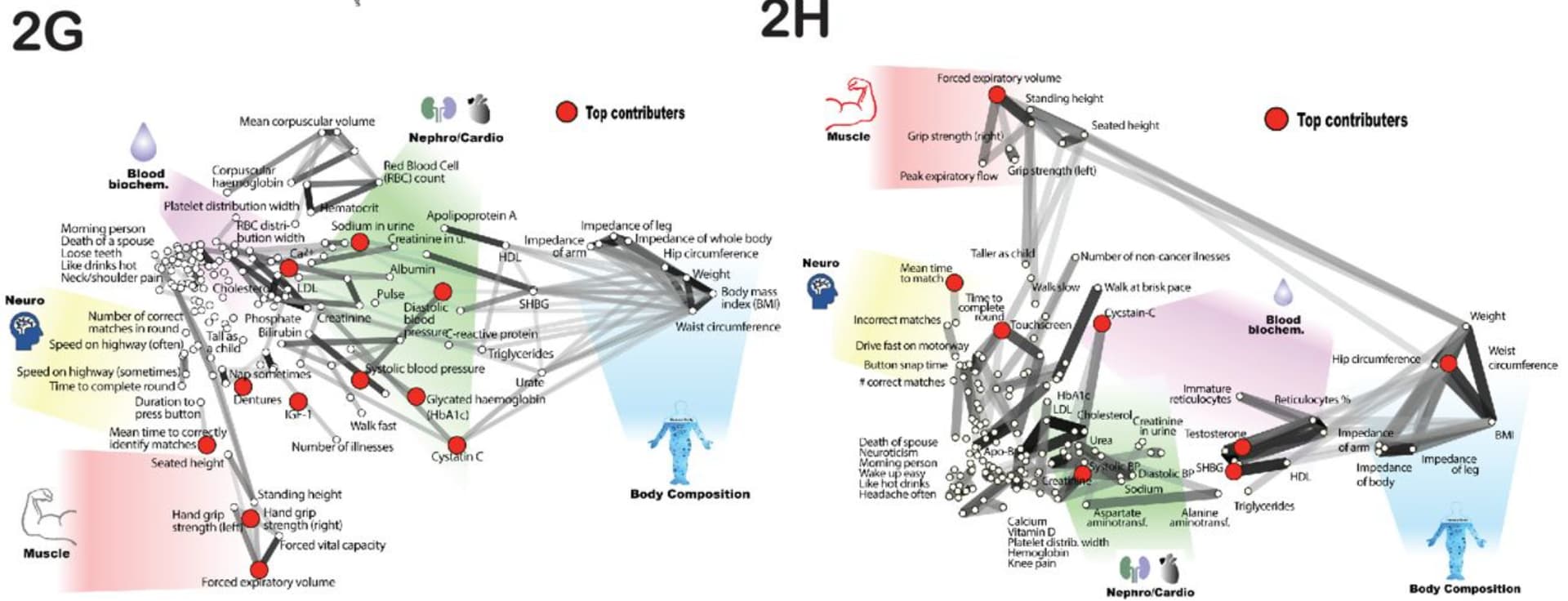
- Organ Integration: The model performed best when it forced integration across multiple organ systems (lung, heart, kidney, muscle), implying that “aging” is the loss of cross-system homeostasis rather than the failure of a single organ.
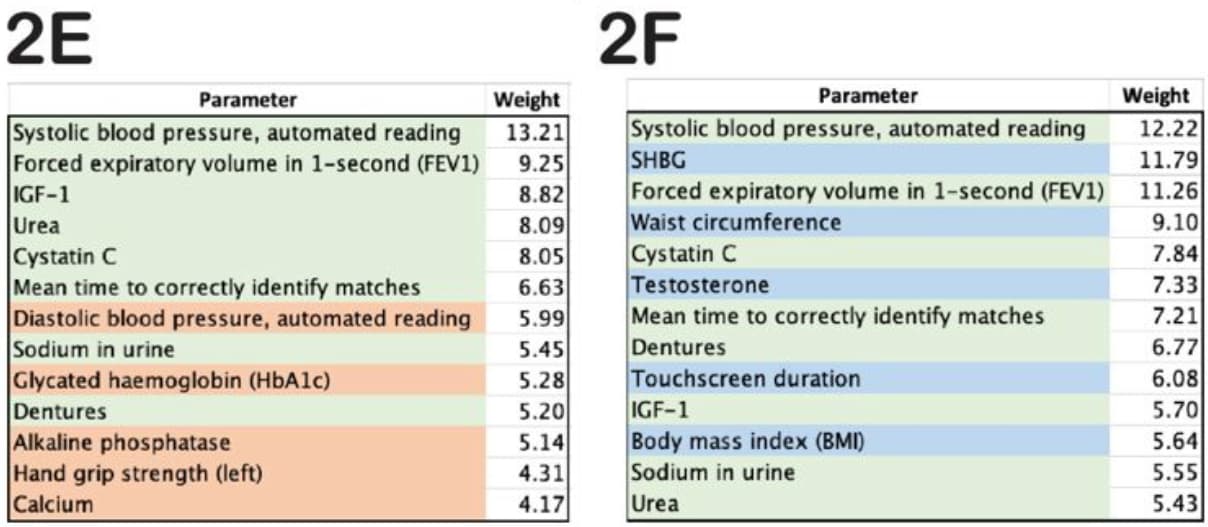
- Sex Dimorphism: The clock had to be separated by sex. For males, Sex Hormone Binding Globulin (SHBG) was a top predictor (increasing levels = aging). For females, this marker was less predictive, highlighting distinct endocrine aging trajectories.
Novelty
- The “Physiological” Checkmate: It challenges the dominance of methylation clocks. It asserts that you don’t need to measure DNA methylation to know if you are aging; you can measure FEV1 (lung volume), Systolic Blood Pressure, and Reaction Time. These functional metrics may be more actionable than abstract molecular patterns.
- The “Gamer” Correlation: The identification of “playing computer games” as a factor associated with younger biological age (especially in men) provides a novel behavioral target, likely linking to the “use it or lose it” principle of neural plasticity.
Critical Limitations
- Correlation vs. Causation: The “Computer Game” finding is classic epidemiology. Do games keep you young, or do you stop playing games when you start cognitively declining? The directionality is unproven.
- Cohort Bias: The UK Biobank is predominantly white and “healthier” than the general population (the “healthy volunteer” bias). The clock may not calibrate perfectly to other ethnicities or high-morbidity populations.
- No Intervention Tested: This is a biomarker definition study, not a drug trial. No compound was administered. The “validation” is statistical, not experimental (i.e., they didn’t treat people to see if the clock reversed).
Part 3: Actionable Intelligence
Actionable Intelligence (Deep Retrieval & Validation Mode) Since this paper is a biomarker study, the “Intervention” analyzed below is the optimization of the specific physiological drivers identified by the Calico Clock.
The Translational Protocol (Lifestyle & Metric Hacking)
- Intervention: Cognitive-Motor Training (“Gaming”) & The 12-Marker Protocol.
-
Human Equivalent Dose (HED):
- Cognitive Load: Based on the “Computer Games” finding, the protocol implies a “High” frequency. Extrapolation: 3–5 sessions/week of high-demand cognitive-motor tasks (e.g., fast-paced FPS or RTS games, or reaction-training sports like Table Tennis).
-
Pharmacokinetics (PK/PD) - Adaptation Rates:
- Reaction Time: Improvements are neuroplasticity-dependent; measurable gains typically require 4–6 weeks of consistent training.
- FEV1/Lung Function: Slow adaptation. Requires consistent Zone 2/Zone 5 cardiovascular training over 3–6 months to show significant shifts.
-
Safety & Toxicity Check:
- Sedentary Risk: The “Gamer” intervention carries a massive confounder: sedentary behavior.
- Mitigation: This protocol is contraindicated unless paired with standing desks or active movement. Data Absent on specific “safe upper limit” of gaming hours in this cohort.
Biomarker Verification Panel (The “Calico Panel”)
To replicate this clock yourself, you do not need a sequencer. You need to track these specific physiological outputs identified as the strongest predictors:
- Systolic Blood Pressure (Target: <120 mmHg)
- Forced Expiratory Volume (FEV1) (Target: High for age/height)
- Hand-Grip Strength (Target: Top quartile for sex)
- Reaction Time (Target: Minimize latency; <250ms is elite)
- Forced Vital Capacity (FVC) (Lung elasticity)
- Waist Circumference (Visceral fat proxy)
- Sex Hormone Binding Globulin (SHBG) (Males: Lower rise indicates youthfulness; Note: High SHBG in older men correlates with lower free T)
- Cystatin C (Kidney function; superior to Creatinine)
- Urea (Kidney/Metabolic health)
- Albumin (Liver/Nutritional status; Higher is generally younger)
- HbA1c (Glycemic control)
- C-Reactive Protein (CRP) (Systemic inflammation)
Feasibility & ROI
-
Sourcing: All metrics are available via standard annual physicals or consumer devices.
- Reaction Time: Free online tests (e.g., Human Benchmark).
- Grip Strength: Dynamometer (~$30 USD).
- Spirometry: Handheld spirometer (~$150 USD).
- Cost vs. Effect: High ROI. Unlike Rapamycin or TAME ($$$), optimizing lung function and grip strength requires effort (exercise) rather than capital. The predictive power for mortality is equivalent to or better than expensive molecular clocks.
Population Applicability
-
Contraindications:
- Hypertension/Vascular Disease: High-intensity “gaming” or reaction training can spike blood pressure transiently; monitor if SBP is uncontrolled.
- Respiratory Conditions: FEV1/FVC goals must be adjusted for asthmatics/COPD.
Part 4: The Strategic FAQ
- Q: Is the “Computer Games” finding a proxy for “Cognitive Reserve” or just a sign that these people aren’t frail yet?
- A: [Confidence: High] It is likely bidirectional. While “healthy users” play games, the GWAS link to synapse biology genes suggests that maintaining high-speed neural processing (required for gaming) is a mechanistic marker of youth.
- Q: Can I use this “Calico Clock” if I am on Rapamycin?
- A: Yes. In fact, it may be more relevant. Rapamycin targets mTOR and inflammation. If Rapamycin is working, you should see delay in reductions (or improvements) in Grip Strength (muscle preservation) and improvements in CRP, which are key inputs for this model.
- Q: Why is FEV1 (Lung Function) so heavily weighted in a “general” aging clock?
- A: FEV1 is a proxy for overall tissue elasticity and mitochondrial capacity. It correlates with “frailty” long before clinical disease appears. It is the “canary in the coal mine” for physical resilience.
- Q: How does this compare to Horvath’s GrimAge?
- A: GrimAge is a molecular prediction of mortality. The Calico Clock is a functional prediction. GrimAge might tell you your cells are aging; the Calico Clock tells you your organ systems are failing. They are complementary, but the Calico metrics are easier to modify with exercise.
- Q: What is the specific genetic link mentioned (“Synapse Biology”)?
- A: The GWAS identified genes involved in the modulation of excitatory postsynaptic potential. This strongly implies that keeping your brain’s “electrical wiring” fast is essential for systemic longevity.
- Q: Is SHBG (Sex Hormone Binding Globulin) always “bad” as it rises?
- A: In this model, for men, rising SHBG was a strong predictor of aging. Biologically, high SHBG binds more Testosterone, lowering Free T. Thus, high SHBG acts as a biomarker for the age-related decline in bioavailable androgens.
- Q: Can I “hack” the clock by just training for the test (e.g., practicing the reaction time test)?
- A: Yes, you can cheat the test, but you can’t cheat the biology. However, “training for the test” (improving VO2 max for FEV1, lifting for Grip Strength) is the longevity intervention.
- Q: Does the model account for distinct “aging types” (e.g., Kidney Agers vs. Heart Agers)?
- A: Yes. The authors used “cluster-dropout” analysis to show that some people age globally, while others age predominantly in specific systems (e.g., renal aging).
- Q: What is the data source for the safety of “Computer Games” as an intervention?
- A: Data Absent in this paper. Extrapolating from general literature: excessive gaming (>3hrs/day) is linked to sedentary behavior and metabolic risk unless offset by physical activity.
- Q: Is this model available for public use?
- A: The paper provides the methodology. The inputs (the 12 traits) are standard clinical measures. You can effectively “run” a simplified version of this clock on yourself by tracking your quartiles for the 12 biomarkers listed above.