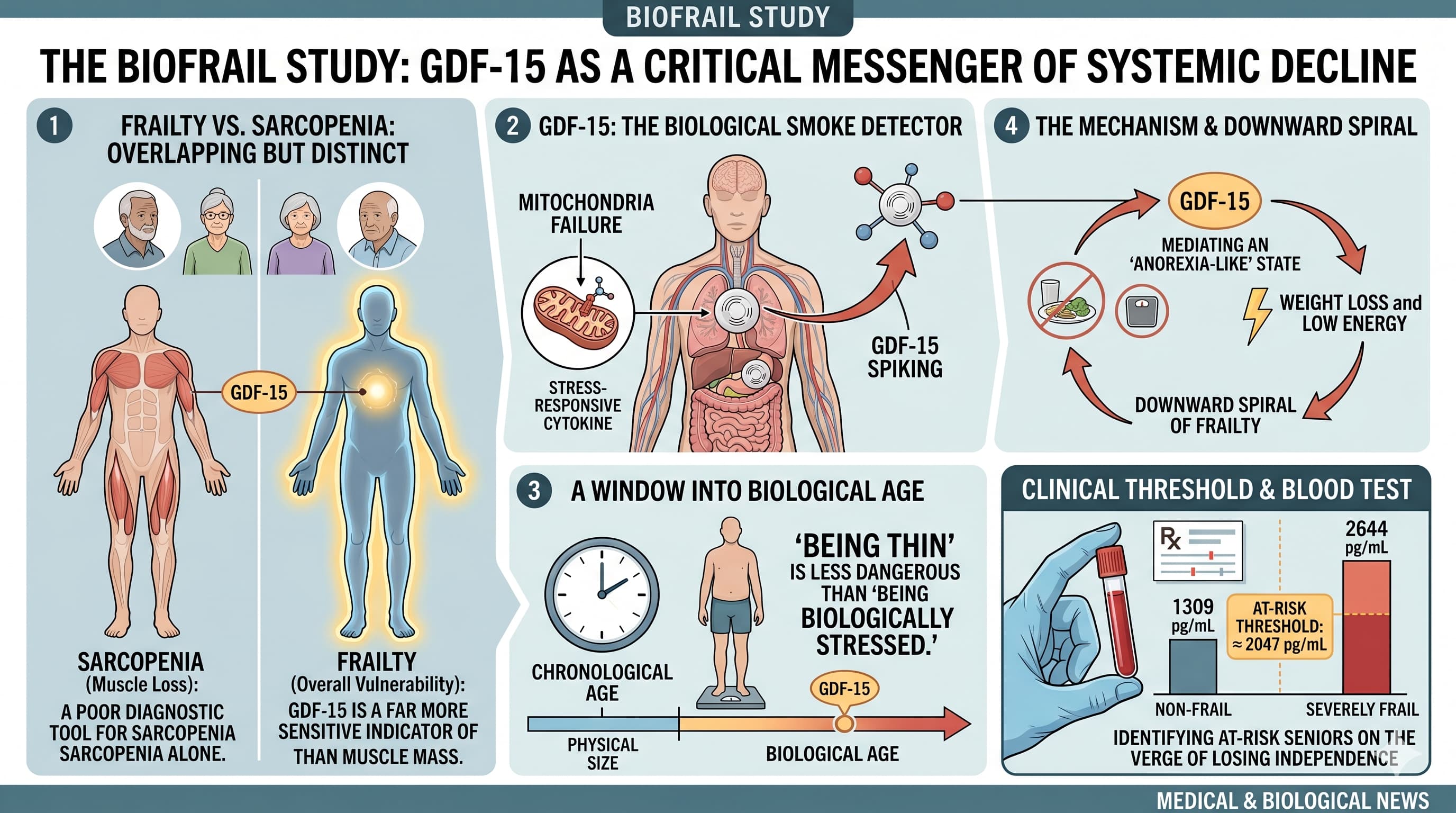
As the global population ages, clinical focus is shifting from simply treating diseases to identifying the biological “stress signatures” that precede physical collapse. New research from the BIOFRAIL study identifies Growth Differentiation Factor 15 (GDF-15) as a critical messenger of systemic decline. While muscle loss (sarcopenia) and frailty often overlap, this study reveals that GDF-15 is a far more sensitive indicator of a person’s overall vulnerability than their actual muscle mass.
The study, which tracked 429 older adults in Denmark, found that GDF-15 acts like a biological smoke detector. It is a “stress-responsive cytokine” that spikes not just when muscle is weak, but when the body’s internal machinery—specifically the mitochondria —begins to fail. In the cohort, patients identified as “severely frail” exhibited median GDF-15 levels nearly double those of their non-frail peers (2644 pg/mL vs. 1309 pg/mL).
The “Big Idea” here is that GDF-15 provides a window into biological age rather than chronological age or simple physical size. Interestingly, the protein was a poor diagnostic tool for sarcopenia alone. This suggests that “being thin” is less dangerous than “being biologically stressed”. GDF-15 appears to mediate an “anorexia-like” state, potentially driving the weight loss and low energy that characterize the downward spiral of frailty. By identifying a clear threshold—approximately 2047 pg/mL—clinicians may soon be able to use a simple blood test to identify which “at-risk” seniors are on the verge of losing their independence.
Actionable Insights
-
Biomarker Tracking: For those focused on longevity, monitoring GDF-15 levels via blood panels could serve as an early warning system for systemic “biological stress” long before physical symptoms like gait-speed reduction manifest. [Note: A GDF-15 blood test is very hard to get in the USA right now. Few places provide it (not Labcorp or Quest)].
-
Mitochondrial Priority: Since GDF-15 is upregulated by myocellular stress and mitochondrial dysfunction, longevity interventions should prioritize mitochondrial quality control (e.g., mitophagy induction, NAD+ precursors, or Zone 2 exercise) to keep this cytokine in check.
-
The Sarcopenia Distinction: Do not rely solely on muscle mass (SMI) as a health metric. High GDF-15 levels in the presence of “normal” muscle mass may indicate “pre-sarcopenia” or hidden physiological decline that requires immediate intervention.
-
Appetite Regulation: If experiencing unexplained late-life weight loss or reduced appetite, GDF-15 may be the endocrine culprit. Addressing the underlying systemic inflammation may be more effective than simply increasing caloric intake.
Source:
- Open Access Paper: GDF-15 plasma levels are elevated in mobility-limited older adults with frailty and sarcopenia—results from the BIOFRAIL study
- Institution: Copenhagen University Hospital (Herlev, Gentofte, Bispebjerg, and Frederiksberg), University of Copenhagen.
- Country: Denmark.
- Journal Name: GeroScience.
- Impact Evaluation: The impact score of this journal is 5.6, evaluated against a typical high-end range of 0–60+ for top general science, therefore this is a High impact journal within the specialized field of geriatrics and aging research.