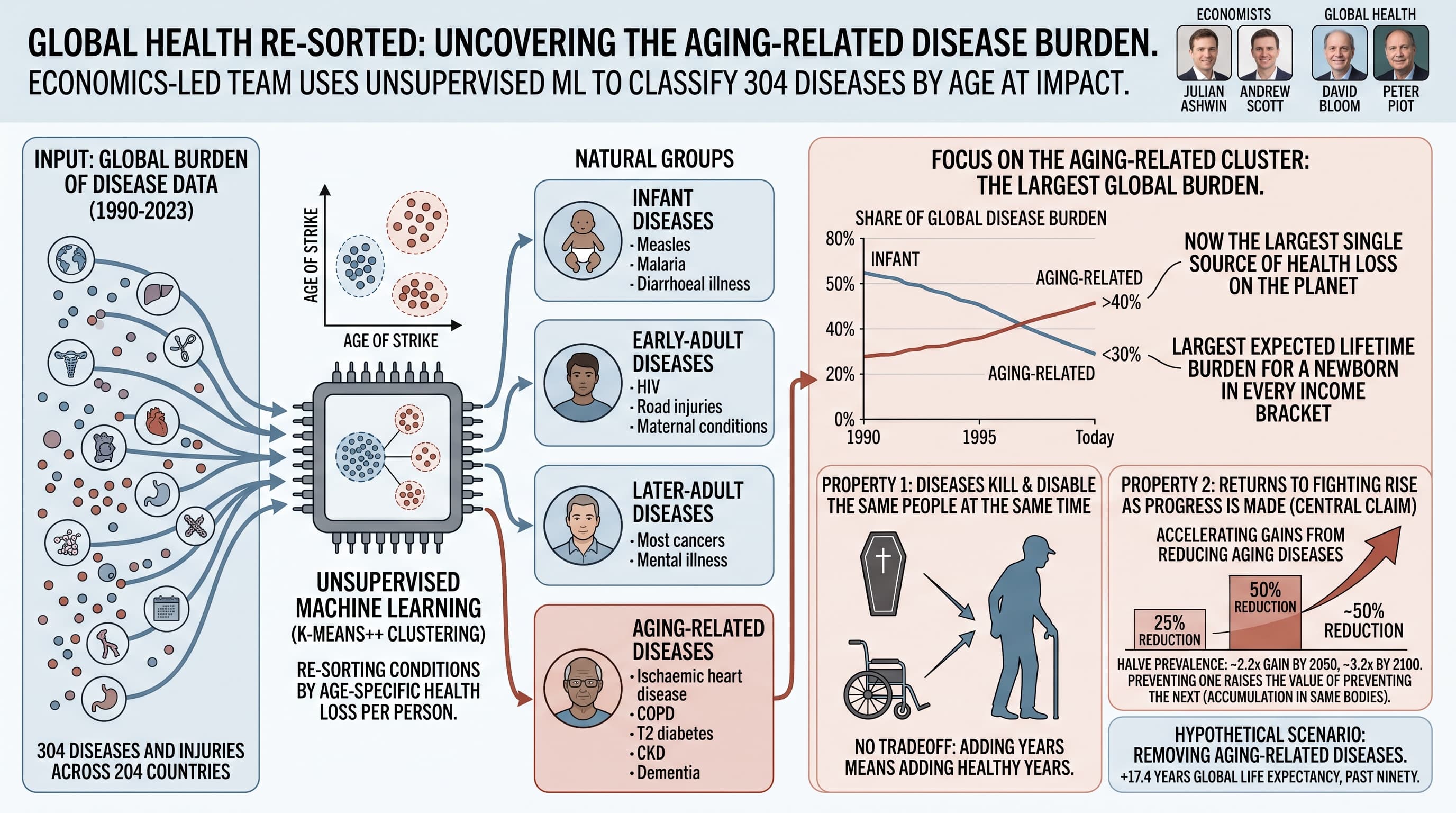
An economics-led team applied unsupervised machine learning to fifty years of Global Burden of Disease data and re-sorted 304 diseases not by their biology but by the age at which they strike. Four natural groups emerged: infant, early-adult, later-adult and aging-related. The aging-related group is now the largest single source of health loss on the planet, it is the largest expected lifetime burden facing a newborn in every income bracket, and it behaves differently from the other three in two measurable ways. Its diseases kill and disable the same people at the same time, and the payoff from reducing them grows as you reduce them.
For half a century global health has run on a simple storyline. Poor countries lose children to infection, rich countries lose adults to heart disease and cancer, and development moves a nation from one state to the other. Abdel Omran named it the epidemiological transition in 1971, and it has shaped where money goes ever since. A new analysis in Nature Aging argues the storyline is wrong in an important way.
The research team, led by economists Julian Ashwin and Andrew Scott alongside global health figures David Bloom and Peter Piot, took Global Burden of Disease data covering 304 diseases and injuries across 204 countries from 1990 to 2023 and did something unusual. Instead of sorting conditions into the standard bins of communicable and non-communicable, they let an algorithm sort them by when in life they strike. The method, K-means++ clustering, was given a single input: how much health loss each disease causes per person at each age.
Four groups fell out. Infant diseases, including measles, malaria and diarrhoeal illness. Early-adult diseases, including HIV, road injuries and maternal conditions. Later-adult diseases, including most cancers and much of mental illness. And a fourth group whose burden climbs with age and then stays high: ischaemic heart disease, chronic obstructive pulmonary disease, type 2 diabetes, chronic kidney disease and dementia.
That fourth cluster is now the largest single category of disease burden in the world. Its share has grown from roughly a quarter in 1990 to a little over two-fifths today, while the infant share has fallen from just above half to below thirty per cent. The classification holds steady across three decades.
Two properties make the aging cluster distinctive. First, the diseases that kill are largely the same ones that disable, so there is no tradeoff between adding years and adding healthy years. Second, and this is the paper’s central claim, the returns to fighting these diseases rise as progress is made. Because aging-related conditions accumulate in the same bodies, preventing one raises the value of preventing the next. Halve their prevalence and the gain is about 2.2 times what a quarter reduction buys by 2050, rising to 3.2 times by 2100. Remove them entirely, a hypothetical the authors use as a ceiling rather than a plan, and global life expectancy would rise by 17.4 years, past ninety.
Insights
First, the ceiling. Removing every aging-related disease worldwide would add 17.4 years to average life expectancy, roughly a 24 per cent gain on a base near 73 years. Removing all infant, early-adult and later-adult disease combined would add 5.3 years. The aging cluster is worth about 3.3 times all other life stages put together. That is the size of the prize, and it is a theoretical maximum, not an achievable target.
Second, the compounding. Halving the prevalence of aging-related disease buys about 2.2 times what a quarter reduction buys, not the 2.0 times a straight line would predict. That 10 per cent premium is the measurable value of stacking prevention across multiple systems rather than one condition at a time. By 2100 the same comparison is 3.2 versus 2.0, a 60 per cent premium.
Third, no tradeoff. For aging-related diseases the correlation between how much a disease kills and how much it disables is 0.59. For early-adult diseases it is 0.26. In plain terms, the strongest lever on lifespan and the strongest lever on healthspan are the same lever.
Context and Source
- Paper: Aging rises, yet the double burden of illness remains. Published 2 September 2026.
- Institutions: Maastricht University, Netherlands; Harvard T.H. Chan School of Public Health and NBER, USA; Ellison Institute of Technology, Oxford, UK; London School of Hygiene and Tropical Medicine, UK; London Business School, UK; Centre for Economic Policy Research, France. Access status:
- Journal: Nature Aging (Springer Nature).
- Impact: The impact score of this journal is 25.0, evaluated against a typical high-end range of 0-60+ for top general science, therefore this is a High impact journal.