This study from Aalto University in Finland asked why behavioral studies find semantic skills stable with age while imaging studies report altered brain activity. Forty-six healthy native Finnish speakers, 25 aged 22 to 32 and 21 aged 62 to 69, judged whether word pairs were semantically related. Both groups exceeded 95% accuracy, and the older group responded faster. Brain responses differed substantially. Younger adults showed the canonical N400 effect in left temporal cortex between 300 and 400 milliseconds, followed by a later reversed effect. Older adults showed a weaker, delayed and spatially diffuse response distributed across frontal and bilateral regions. Despite that, machine-learning decoding separated related from unrelated word pairs from roughly 300 milliseconds in both groups, and more strongly in older adults.
Most cognitive abilities decline with age. Semantic knowledge is the stubborn exception. Vocabulary, general knowledge and word associations hold steady or improve into the seventies, a finding so reliable that psychologists treat it as a benchmark of what aging does not take away.
Brain imaging has told a less tidy story. Studies repeatedly find that older adults produce a weaker version of the N400, an electrical response that appears about 400 milliseconds after a word violates expectation. They also find activity shifting from the left temporal lobe toward frontal regions and spreading into both hemispheres. If semantic ability is intact, why does the brain look so different?
A team at Aalto University led by Pietari Nurmi set out to reconcile the two literatures by measuring them in the same people at the same time. Forty-six Finnish speakers, half in their twenties and half in their sixties, lay in a magnetoencephalography scanner and judged whether pairs of words were related. Banana and orange, related. Banana and police, unrelated. Semantic relatedness was defined objectively using a computational language model trained on a 126-million-word corpus of Finnish.
Behavior came out exactly as the semantic literature predicts. Both groups were above 95% accurate. The older adults were not slower. By the raw averages they were about 107 milliseconds faster, which is unusual enough that the authors flag it themselves.
The brain data came out exactly as the imaging literature predicts. Younger adults produced the textbook N400 in left temporal cortex. Older adults produced something later, weaker and smeared across frontal and bilateral regions, with no clean source-level equivalent at all. By conventional measures, their semantic response looked degraded.
The reconciliation came from a different analytic approach. Instead of asking whether a particular response was bigger or smaller, the team trained a classifier to read out, moment by moment, whether the brain was processing a related or an unrelated pair. If the distinction is encoded anywhere in the pattern of activity, the classifier should find it regardless of where that pattern sits.
It found it in both groups, from about 300 milliseconds onward. In older adults it found it more strongly, with classification accuracy peaking around 0.7 compared with 0.6 in younger adults.
That inverts the usual interpretation. The weaker N400 in older adults does not mean the semantic distinction is weaker. It means the distinction has moved somewhere the N400 does not measure well. A response averaged over a specific region at a specific latency will miss information that has been redistributed.
The team also found that within each group, people whose brains separated the two conditions more cleanly responded faster. The correlation was moderate to strong, around 0.65 in younger adults and 0.54 in older adults in the relevant time windows.
Several cautions apply. The sample is small and unusually healthy, screened for cognitive impairment and scoring above age-adjusted norms. The comparison is between people in their twenties and people in their sixties with nobody in between, so it describes a contrast rather than a trajectory. And the headline claim that older adults responded faster does not survive the paper’s own participant-level analysis, where the difference sits at the threshold of significance rather than below it.
Insights
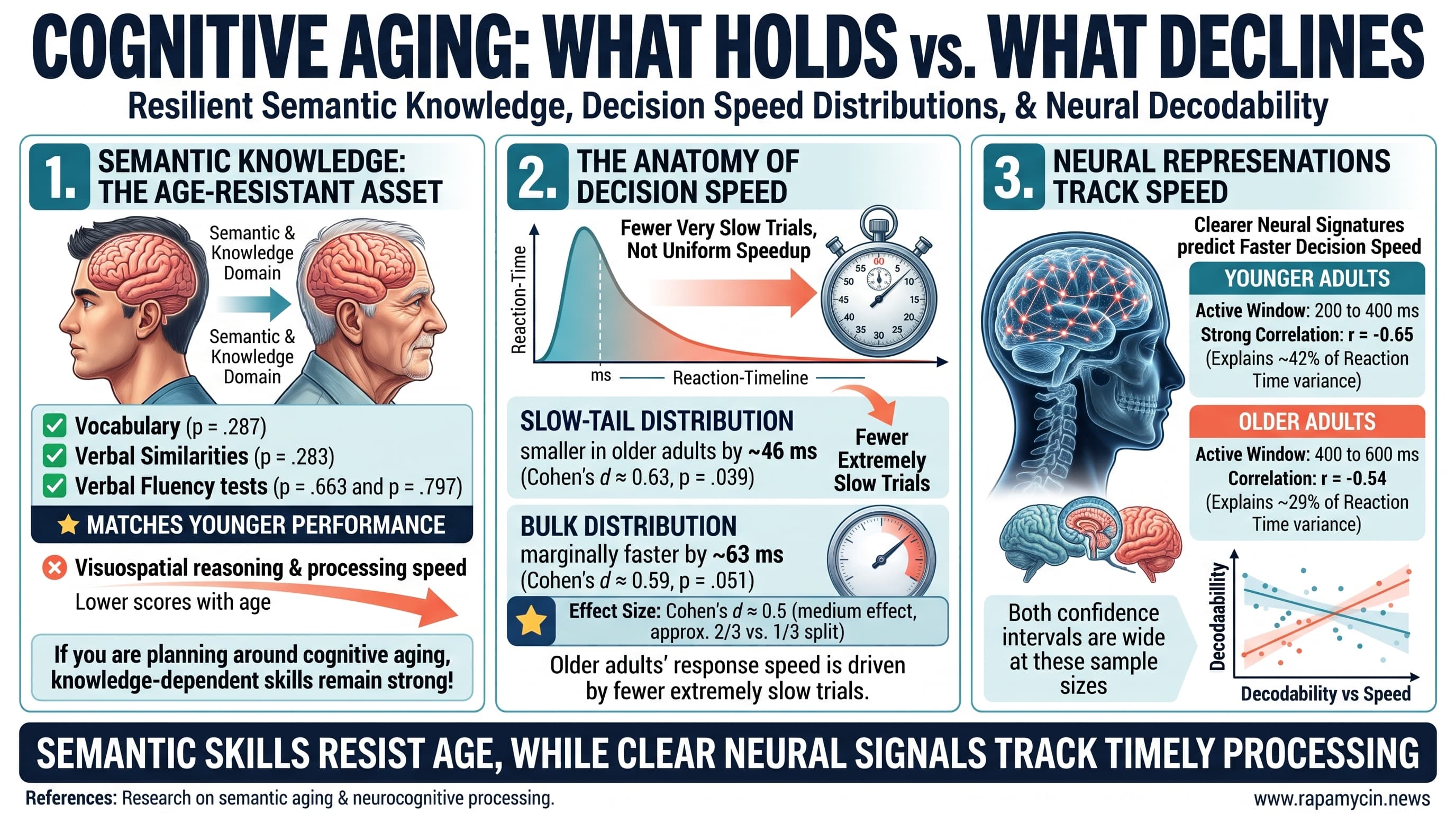
- Semantic knowledge is the most age-resistant cognitive domain measured here. The older group matched the younger on vocabulary (p = .287), verbal similarities (p = .283), and both verbal fluency tests (p = .663 and p = .797), while scoring lower on processing speed and visuospatial reasoning. If you are planning around cognitive aging, knowledge-dependent skills are the asset that holds.
- Faster responding in older adults was driven by fewer very slow trials, not by uniformly quicker processing. The slow-tail parameter was smaller in older adults (difference about 46 ms, Cohen’s d approximately 0.63, p = .039). The bulk of the distribution was faster by about 63 ms but only marginally so (d approximately 0.59, p = .051). A Cohen’s d of 0.5 is a medium effect, meaning roughly a two-thirds versus one-third split in how the groups fall relative to each other.
- Clearer neural representations tracked faster decisions within both groups. In younger adults the correlation between decodability and reaction time was r = -0.65 in the 200 to 400 ms window, accounting for about 42% of the variance in response speed. In older adults the strongest window was 400 to 600 ms at r = -0.54, about 29% of variance. Both confidence intervals are wide at these sample sizes.
- A reduced brain response is not automatically a deficit. The older group’s N400 was attenuated, yet the information was more decodable, with classification accuracy of 0.7 versus 0.6 (corresponding to Cohen’s d of roughly 0.74 versus 0.36). This is a useful caution for anyone interpreting EEG or MEG amplitude metrics from consumer or clinical reports.
Context and Source
- Open Access Paper: Neurophysiological signatures underlying preserved lexical-semantic proficiency in healthy aging
- Institutions: Department of Neuroscience and Biomedical Engineering, Aalto University, Espoo; BioMag Laboratory, HUS Diagnostic Center, Helsinki University and Helsinki University Hospital; Aalto Neuroimaging, Aalto University
- Country: Finland
- Journal: Neurobiology of Aging, volume 170 (2027), pages 1-13
- Impact evaluation: The impact score of this journal is 4.2, evaluated against a typical high-end range of 0 to 60+ for top general science, therefore this is a Low impact journal.