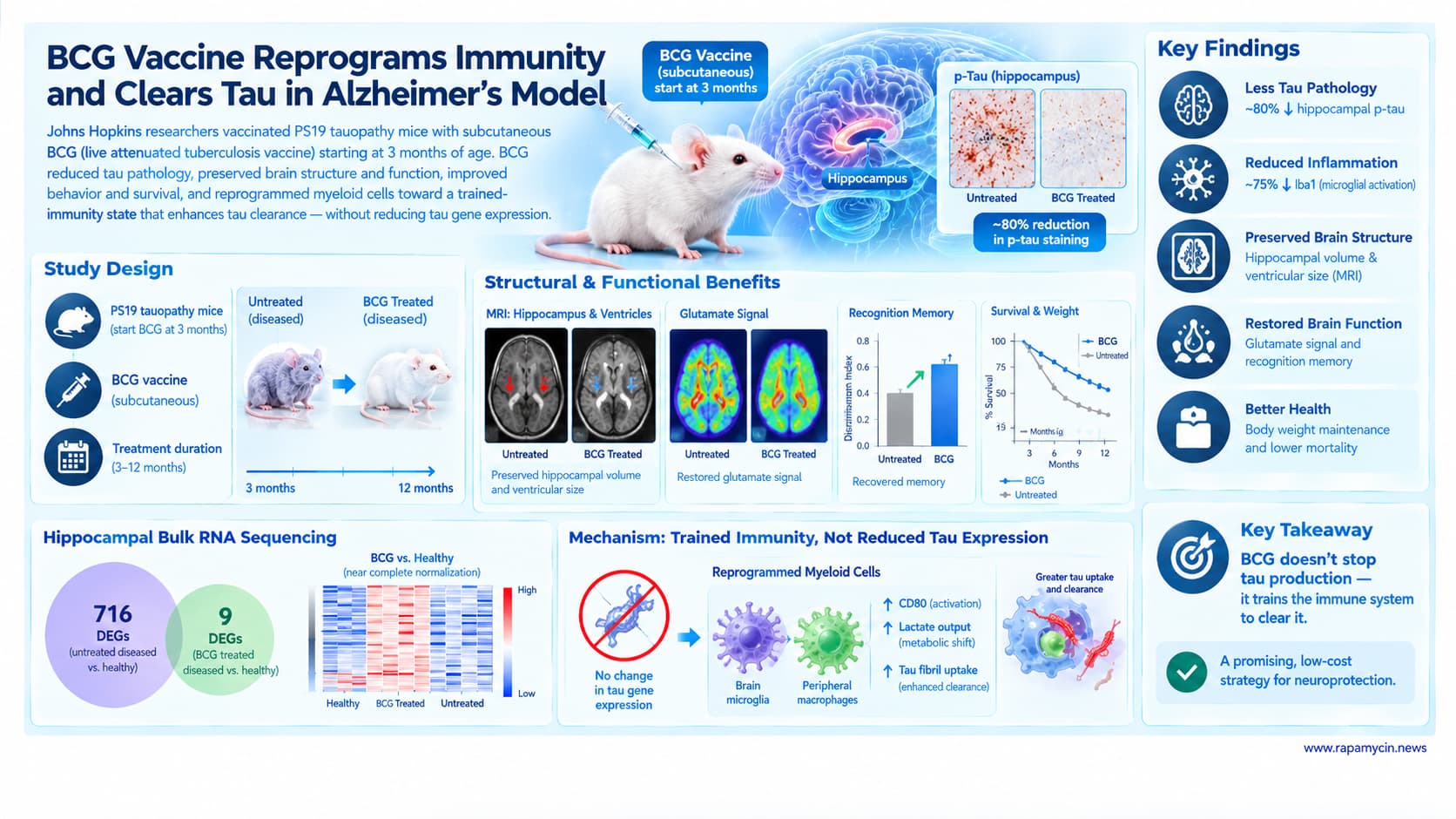
Johns Hopkins researchers vaccinated PS19 tauopathy mice with subcutaneous BCG, the live attenuated tuberculosis vaccine, starting at three months of age. Treated animals showed roughly an 80 percent reduction in hippocampal phospho-tau staining, a 75 percent reduction in microglial activation marker Iba1, preserved hippocampal volume and ventricular size on MRI, restored brain glutamate signal, recovered recognition memory, better body weight maintenance, and lower mortality. Hippocampal bulk RNA sequencing showed near-total normalization of the disease transcriptome, with only nine differentially expressed genes separating BCG-treated diseased mice from healthy controls, versus 716 genes in untreated diseased mice. Mechanistically, BCG did not reduce tau gene expression. Instead it reprogrammed brain and peripheral myeloid cells toward a trained-immunity phenotype with higher CD80, higher lactate output, and markedly increased uptake of fluorescent tau fibrils, implying enhanced clearance rather than reduced production.
The most interesting drug candidates in dementia research right now may not be drugs at all. Over the past two years, large population studies have repeatedly found that people who received shingles vaccines develop dementia at lower rates (though there are also studies showing no effect). A parallel and quieter body of evidence points at BCG, the live tuberculosis vaccine given to roughly 290 million newborns a year and used as standard immunotherapy for early-stage bladder cancer. Six separate retrospective studies covering more than 85,000 bladder cancer patients have each found less dementia among those who received BCG, with reductions ranging from 12 to 78 percent, and three meta-analyses have backed the signal.
Retrospective findings like that are usually where a story stalls. The association could reflect healthier patients, better clinical follow-up, or any number of confounders. What the field lacked was a mechanism.
This paper supplies one. The Hopkins group took PS19 mice, which carry a mutant human tau gene and develop aggressive tangle pathology, brain shrinkage, memory failure, and early death. They injected BCG under the skin of the neck at three months of age, repeated monthly, then stopped and let the animals age. By eight to ten months, treated mice looked substantially different from their untreated littermates. Phospho-tau deposits in the hippocampus were down roughly fivefold. Hippocampal volume, which falls about 21 percent in untreated animals, was preserved. Ventricular enlargement was reversed. Glutamate levels, measured noninvasively in living mice, returned to healthy ranges. Memory, assessed by whether a mouse recognizes a new object, came back from chance level to near normal.
The mechanism is the part worth sitting with. The vaccine did not reduce tau production at all. Human tau messenger RNA was overexpressed roughly threefold in treated and untreated animals alike. What changed was the immune system’s ability to clean up. BCG works through a phenomenon called trained immunity, in which innate immune cells undergo lasting epigenetic and metabolic rewiring after an initial challenge and respond more aggressively to later, unrelated threats. Here the unrelated threat was tau. Myeloid cells from vaccinated mice carried more of the activation marker CD80, produced more lactate, indicating a shift to glycolytic metabolism, and swallowed about 25 percent more labeled tau fibrils than cells from healthy controls.
The brain’s resident immune cells told a related story. Total microglia numbers stayed high in treated animals, but the proportion in an inflamed, disease-associated state fell from 14.4 percent to about 6 percent. The authors describe this as keeping the cleanup crew while turning down the shouting.
The intervention was both physically and temporally remote: an injection in the scruff of the neck, with the brain’s transcriptome normalized four and a half months later. That is a notable finding in itself.
The caveats are substantial, and the next section deals with them. But BCG is cheap, manufactured at enormous scale, has a century of safety data, and is already in human use. The authors argue it deserves prospective trials.
Actionable Insights
What the effect sizes actually show. In mice, tau staining fell about 80 percent and microglial activation about 75 percent relative to untreated animals. These are very large standardized effects, roughly in the range of 2 to 4 standard deviations, meaning almost no overlap between treated and untreated animals. For context, a standardized effect of 0.8 is conventionally “large” in human research. Effects this extreme are typical of tissue-staining measurements in transgenic models and almost never survive translation at that magnitude.
The survival numbers are more modest and more honest. Reading the published survival curves, roughly 22 percent of untreated mice died by eight months versus about 6 percent of vaccinated mice. That is a relative mortality reduction near 70 percent and an absolute reduction of about 16 percentage points, meaning about six mice treated to prevent one death. Notably, the authors never statistically compared the vaccinated group against the untreated group directly.
The human evidence remains observational. BCG is not routinely available in the United States, Canada, Australia, or most of Western Europe. Over 80 percent of countries (156 of 194) continue to recommend mass BCG vaccination for all neonates, and all countries in sub-Saharan Africa, Latin America, and East and South Asia follow these guidelines. Even in countries that retain universal programs, the vaccine is given to newborns. There is currently no adult BCG vaccination program anywhere outside of specific occupational and contact-tracing indications.
Context and Source
- Open Access Paper: BCG vaccination mitigates tau pathology and restores cognitive function in PS19 mice
- Institution: Johns Hopkins University School of Medicine, with contributions from the Kennedy Krieger Institute and the Sidney Kimmel Comprehensive Cancer Center. Corresponding author William Bishai.
- Country: United States (Baltimore, Maryland)
-
Journal: Science Advances, Published 21 October 2026.
Impact evaluation: The impact score of this journal is 13.9 (2025 Journal Citation Reports data year, released June 2026), evaluated against a typical high-end range of 0 to 60+ for top general science, therefore this is a High impact journal.