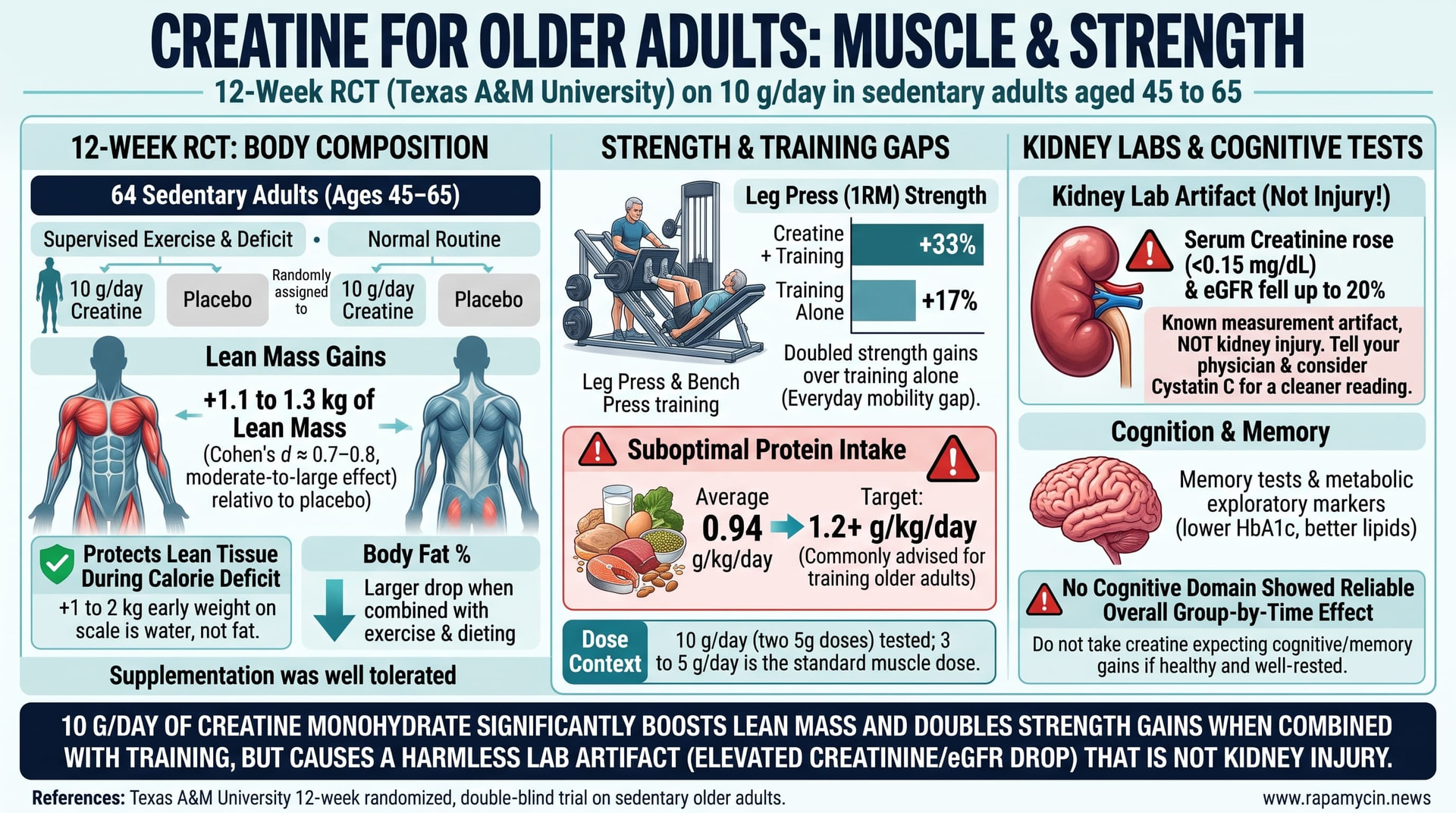
A 12-week randomized, double-blind trial from Texas A&M University tested 10 grams per day of creatine monohydrate in 64 sedentary adults aged 45 to 65. Participants first chose whether to join a supervised resistance and aerobic training program with a modest calorie deficit or to keep their normal routine, and were then randomly assigned to creatine or a maltodextrin placebo. Creatine increased DXA-measured lean mass by roughly 1.1 to 1.3 kg relative to placebo in both settings, improved leg and bench press strength, and produced a larger drop in body fat percentage when combined with exercise and dieting. The authors also report gains on some memory tests, lower HbA1c and better lipid profiles.
Most people who diet in middle age lose more than fat. A meaningful share of the weight that comes off is muscle, the tissue that keeps us strong, mobile and metabolically healthy as we age. A new trial from Richard Kreider’s Exercise and Sport Nutrition Lab at Texas A&M asks whether one of the cheapest and best-studied supplements available, creatine monohydrate, can shift that trade in our favor.
The team recruited 73 healthy but sedentary adults aged 45 to 65, most of them overweight. Each volunteer chose whether to join a supervised program of resistance and aerobic training three times a week, paired with a diet cut by 300 to 500 calories a day, or to carry on as usual. Within each group, participants were randomly assigned to 5 grams of creatine twice daily or an identical-looking carbohydrate powder for 12 weeks. Sixty-four finished.
The muscle results are the strongest part of the paper. In the exercise and diet group, creatine users ended with about 1.1 kg more lean mass than placebo users, whose lean mass barely moved. Creatine users who did no training gained a similar amount relative to their own placebo group. Leg press strength rose by roughly a third in the exercising creatine group, about double the gain from exercise alone, and bench press followed a similar pattern. Body fat percentage fell further when creatine was added.
There is an important asterisk. Creatine draws water into muscle cells, and DXA scanners count that water as lean tissue. Lean mass in the exercising creatine group peaked at six weeks and then slipped back, a pattern that fits early water loading at least as well as new muscle protein. The extra drop in body fat percentage partly reflects a larger denominator, since actual fat mass losses looked similar with or without creatine.
The brain findings warrant more caution. The researchers used a relatively high dose because only a small fraction of oral creatine reaches the brain, and they ran a large battery of memory, attention and reaction-time tests. Across eight cognitive tasks, none showed a significant overall difference between groups over time. The positive claims rest on individual comparisons, such as a temporary improvement in delayed word recall at six weeks, alongside results pointing the other way, including more attention errors and higher tension scores in some creatine groups. The authors themselves call these findings exploratory.
Blood work hinted that creatine without exercise lowered HbA1c, a marker of average blood sugar, by roughly a quarter of a percentage point versus placebo, with no change in fasting glucose. In people with normal glucose, that is a lead worth following, not a reason to treat creatine as a glucose-lowering therapy.
Context matters. The corresponding author chairs the scientific advisory board of AlzChem, which manufactured and donated the creatine, and he is also one of the journal’s editors-in-chief. That does not invalidate the data, but it raises the bar for independent replication.
The take-home is modest but useful: creatine appears to help middle-aged adults keep or build muscle and strength, including while dieting. Claims that it sharpens the healthy midlife brain remain unproven.
Actionable Insights
- Muscle: 10 g/day (two 5 g doses) added about 1.1 to 1.3 kg of lean mass over 12 weeks versus placebo. That is roughly 2% of a typical participant’s lean mass, and some of it is water stored in muscle. The effect size is moderate to large (estimated Cohen’s d about 0.7 to 0.8).
- Strength: Leg press 1RM rose about 33% with creatine plus training versus about 17% with training alone. A gap of that size is likely to matter for everyday function.
- Dieting: Creatine appears to protect lean tissue during a calorie deficit. Expect the scale to read 1 to 2 kg higher than it otherwise would early on. That is water, not fat.
- Memory: Do not take creatine expecting cognitive gains if you are healthy and well rested. No cognitive domain showed a reliable effect here.
- Kidney labs: Serum creatinine rose (under 0.15 mg/dL) and calculated eGFR fell by up to 20% in exercising creatine users. This is a known measurement artifact, not kidney injury, but tell your physician and consider cystatin C for a cleaner reading.
- Protein: Participants averaged only 0.94 g/kg/day, well below the 1.2 g/kg/day or more commonly advised for older adults who train.
- Dose: 3 to 5 g/day is the established muscle dose. This trial did not test whether 10 g outperforms it.
Context and Source
- Open Access Paper: Effects of creatine supplementation with and without exercise and diet intervention on body composition, cognitive function, and markers of health in middle-aged and older adults
- Institution: Exercise and Sport Nutrition Lab, Department of Kinesiology and Sports Management, Texas A&M University, College Station, Texas
- Country: United States
- Journal: Journal of the International Society of Sports Nutrition
- Impact evaluation: The impact score of this journal is 4.9, evaluated against a typical high-end range of 0-60+ for top general science, therefore this is a Medium impact journal.