Telmisartan Upregulating Klotho

That’s not an issue as it’s absolutely not usable for anything serious it seems from the study you linked.

That study has been 100% funded by Aktiia and done mostly by its employees.

The study was carried out with funding from Aktiia SA, the sponsor of the study.

Then they implemented none of the ISO standard’s method!

Then they cleaned the measurements

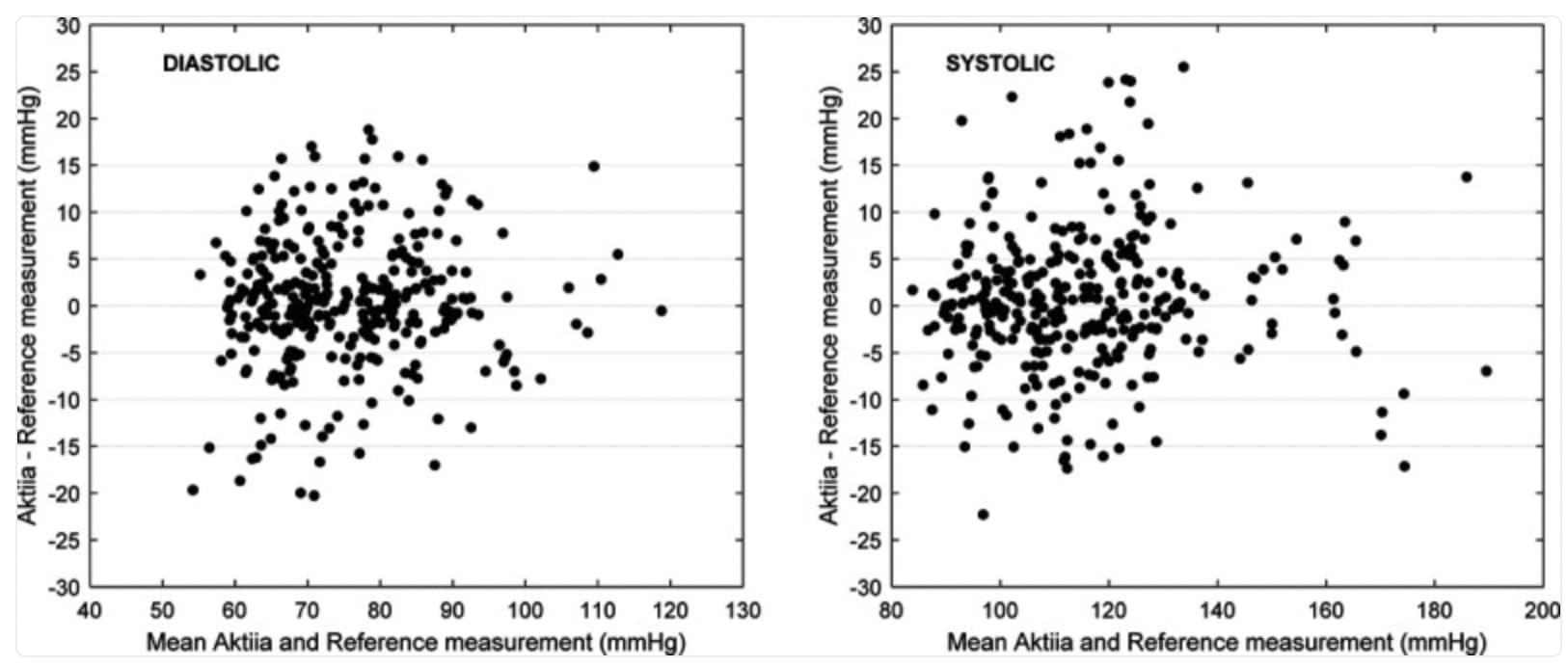
And after all that (and calibration!), they get rather bad measurements

4 Likes

I agree it’s weak support. However, it’s the only watch that I’ve heard of having any support. The cheap watches claiming to monitor BP are completely unsupported though. The overall answer is there is no reliably watch or ring such to measure BP. You can have the same wrist cuff or arm cuff we’ve all known to use, but that’s it.

AI-generated answer. Please verify critical facts.

The Omron HeartGuide is the only blood pressure watch currently approved as a medical device by the U.S. Food and Drug Administration (FDA). It uses an inflatable cuff integrated into the watch band to take oscillometric blood pressure readings, meeting clinical accuracy standards for a Class II medical device.

Other devices, such as the Hilo Band , have received FDA clearance as a medical device for over-the-counter use, with clinical validation and a planned consumer launch in 2026. The LiveMetric LiveOne device was also cleared by the FDA in 2022 as a smartwatch-like, cuffless blood pressure sensor, intended for use in clinical settings.

Review…

Ok I get it that smartwatches are not accurate, but I was wondering if any of you guys has a suggestion for a regular BP monitor since I’m considering buying one. I see so many versions on amazon with prices ranging from $30 to over $200 with reviews all over the place regardless of prices. In other words, I might buy an expensive one and still not be accurate so Is there one brand that is widely held as being accurate. Or maybe a better question would be do you mind sharing what brand are you using yourself? (assuming you monitor BP at home). Thank You,

Omron is generally well regarded. Personally I like and use Greater Good models, recommended by Wirecutter. I have their Bluetooth syncing battery sleeve and a plug in monitor. They’re consistent with each other and my prior models.

Here’s the AllInOne I got from GG, works a charm:

Wirecutter updated in February 2026, mirror’s my experience with models purchased about 3 years ago.

Their app sync’s easily with Apply Health.

1 Like

I do like the Conneqt Pulse. BTW I already posted a review here.

2 Likes

I like the Microlife brand. I have several spanning generations of their products. All are accurate and trouble free for a long time. I have one Microlife that is at least 20 years old. I do not know f any of their newer models integrate with smartphones but they have been in the business for decades. If they do not integrate with your smartphone health app, I would look for another brand that has been in the BP business for awhile.

1 Like

I actually may not care so much about integration. I’m perfectly fine with just looking at the screen couple times a day when i want to. I was even considering the manual ones thinking they might be more accurate but then read some reviews saying same as with the digital ones. For now I’m leaning towards Omron since it seems to be the one doctors recomend the most.

1 Like

I actually have 3 Omron models: new, old, and very old; two wrist and one armband models.
They are in agreement. When I go for my checkups, I take one of the wrist models with me and check it against the doctor’s electronic machine. They are always in close agreement. I feel much more comfortable with the accuracy of my BP measuring devices than my Contour Next blood glucose readings.

Next time you have a checkup, take your BP measuring device with you to check against the readings taken at your doctor’s office. No one has ever objected to this, and I don’t think that I am their first patient to do this.

The wrist models have good enough accuracy for tracking.

2 Likes

I prefer going back to the basics. I’m confident in the numbers every time I take my BP and I don’t have to wonder if the machine is working or not. This set up from Amazon is cheap, and it holds the diaphragm of the stethoscope in place so your arm can be relaxed while you pump with your free hand. Works really well.

3 Likes

yeah, I was considering these/manual ones also but surprisingly some reviews noted discrepancies with them also. I went with Omron simple one no Bluetooth as I don’t care for integration and it had good reviews 4.5 on 7000 isn’t too bad. Seems to be accurate though only have compared it to HIGI machines at Stop and Shop pharmacies, and not sure if those ones are accurate either. Hoever it does say they are calibrated to meet FDA standards. H

Higi machines are generally considered accurate, as they are calibrated to meet FDA standards and have undergone clinical validation"](are higi machines accurate - Search)

Amazon.com: OMRON Iron Blood Pressure Monitor for Home Use & Upper Arm Blood Pressure Cuff - #1 Doctor & Pharmacist Recommended Brand - Clinically Validated : Health & Household

Decent looking cuff. I had a hospital quality set around for a long time and used it a little. What I didn’t like was calling the nuance in the transition boundaries. I think the algorithm of modern digital cuffs has become so refined that it outperforms humans in terms of standardized readings. What it doesn’t do as well is listen for many anomalies, which can be useful. Every now and then I see an old mercury system for sale in an antique store. It would be fun to try one of those.

Yeah, but I concider it a pain in the a$$ compared to the Omron wrist versions.

Have any of you use Candesartan? I was thinking to switch, but given that I just switched and up-dosed the telmisartan, I will wait. The thing is Candesartan is an inverse-agonist and block mechanotransductive signalling of angiotensin II receptor subtype-1 (AT1R), something the other ARBs do not do. This signalling (can) persists even if the AT1R is blocked, and is involved in cardiac remodelling.

Have you guys ever heard of compound 21? It is an highly selective AT2R agonist that I would like to use. But it only has a 4 hour half life, some off target effects (low-affinity antagonist of the thromboxane TP receptor), and would need to be special-order synthesized. There are some short lived peptides as well, but they need to be refined, like semaglutide has been, to extend its short plasma half life.

Haven’t used candesartan or really researched it, but recently I’ve been intrigued by olmesartan which is highly potent against HBP (most among ARBs) with a good safety profile and some really good recent data on effectiveness in lowering dementia risk and ACM in hypertensives. Reasonable half life. Another option you may want to look into.

2 Likes

Note, that for people with both HT and T2DM, olmesartan looked very good compared to either candesartan or telmisartan, including renal impact. Older study and open label, but nice crossover design.

Difference in the effects of switching from Candesartan to Olmesartan or Telmisartan to Olmesartan in hypertensive patients with type 2 diabetes: the COTO study

“Data from all patients in the CO group (n=165) and the TO group (n=152) were analyzed. Clinic and morning home BP and urinary albumin levels showed a significant decrease from baseline at 16 weeks after switching to olmesartan in both the CO and the TO group (clinic BP, morning home diastolic BP, and urinary albumin, P <0.05; morning home systolic BP, P <0.01). In contrast, clinic BP, morning home BP, and urinary albumin were significantly increased again 16 weeks after switching back to candesartan or telmisartan (clinic BP, morning home diastolic BP, and urinary albumin, P <0.05; morning home systolic BP, P <0.01). No subjects experienced an adverse reaction that required withdrawal from the study. No adverse reactions attributable to the study drugs were observed.”

The more I study olmesartan, the more I like it!

But, then again an older study finds candesartan to be superior:

Effect of Switching from Telmisartan, Valsartan, Olmesartan, or Losartan to Candesartan on Morning Hypertension

But ultimately, olme noses ahead:

Comparative effect of candesartan and amlodipine, and effect of switching from valsartan, losartan, telmisartan and olmesartan to candesartan, on early morning hypertension and heart rate

1 Like

Hey Cronos, thanks a lot for this. I did my own lil research and it turns out that while candesartan is capable of stopping the mechanosensing stretch signal, which goes beyond just AT1R inhibition, it doesn’t bind AT1R in its ‘active’ form.

AT1R inverse agonism mechanism: ARBs stabilise AT1R in inactive conformation. Inverse agonists suppress not just Ang II-driven activation but also constitutive (ground-state) and mechanical stress-driven (stretch-induced) AT1R activation — critical distinction for aortic disease where haemodynamic wall stress is a constant stimulus independent of Ang II.

Active-state AT1R problem: When AT1R is already constitutively active, candesartan and telmisartan lose inverse agonist potency because their receptor contacts are altered in the active conformation. Olmesartan and eprosartan maintain full inverse agonism against constitutively active receptor.

This isn’t just about blood pressure anymore.

Now I have to try to explain to my GP why I want to switch again.

I wonder if a blend is a possibility?

A blend of what?

Drug t½ (hrs) BP ↓ (approx) Inverse agonism Blocks stretch (mechanotransduction) Active-state AT1R suppression Notes
Azilsartan ~11 −14 to −20 / −8 to −12 Very strong Yes (robust) High (likely preserved) Highest potency ARB clinically
Candesartan ~9 (active ~9–12) −10 to −15 / −6 to −9 Strong Yes (well proven) Moderate (reduced in active state) Gold standard inverse agonist
Eprosartan ~5–7 −8 to −12 / −5 to −8 Strong (unique binding) Yes (good evidence) High (preserved) Distinct non-biphenyl ARB
Irbesartan ~11–15 −10 to −14 / −6 to −9 Moderate Partial Moderate Balanced PK/PD
Losartan ~2 (metabolite 6–9) −8 to −10 / −4 to −6 Weak :x: Minimal :x: Poor Surmountable antagonist
Olmesartan ~13 −12 to −18 / −7 to −11 Very strong Yes (robust) Very high (preserved) Best evidence for active-state control
Telmisartan ~24 −12 to −16 / −7 to −10 Moderate–strong Partial Moderate–low Longest half-life, PPAR-γ
Valsartan ~6 −8 to −12 / −5 to −8 Moderate Partial Moderate Dose-dependent effects

I believe that the mechanotransduction signalling is an overlooked aspect of cardiac and aortic remodelling. It’s not just your blood pressure. I like the PPAR activity of telmisartan, but I will trade it for the mechanotransduction signalling.

1 Like