Thank you for your Taurine information above!! It’s surprising how helpful it is when looked into. I should not have been surprised by the Arthrofibrosis following my first knee replacement. I had experienced a number of fibrotic related type problems when I was younger: Endometriosis, frozen shoulder, and fibrocystic breast disease. An enterprising doctor here in town learned there was practically no iodine in the soil around the Great Lakes, so he conducted a study. When he provided me (and other subjects) with iodine (I think it was the atomic form, but I’m not sure) after about a year, my Endometriosis and my fibrocystic breast disease became much more normal. Unfortunately, he died of cancer, and his work was not promoted by other doctors. After that knee replacement experience, I have included iodine in my supplement list. That is helping with this revision, I think. Thank you again!!! I read all of that information very carefully.
From that paper.
Nevertheless, the study looked only at natural taurine levels in the body, and not at whether supplements have any benefits. “That’s something that has yet to be tested,” he says (Nir Barzilai).
Started taking Taurine a few months ago, and in spite of not being able to weight bear for a sustained period (knee revision surgery 3 months ago), my bone density test showed improvement, even though I have mostly forgotten my Residronate because it’s only once a week. Interesting test result!!
Molecular basis of human taurine transporter uptake and inhibition
Not very long, so I’m posting it in full.
GPT-4o mini. The prompt was: “please compare osmotic properties of taurine and creatine in the human body”
| Property | Taurine | Creatine |
|---|---|---|
| Osmotic Function | Acts as an osmolyte, helping to stabilize cell membranes and protect against osmotic stress. | Functions as an osmolyte, particularly in muscle cells, aiding in hydration and cellular function. |
| Concentration | Found in high concentrations in the heart, brain, and skeletal muscle. | Primarily concentrated in muscle tissue, with smaller amounts in the brain and other tissues. |
| Mechanism of Action | Stabilizes proteins and cellular structures, influencing ion transport and cell volume regulation. | Increases ATP availability, which can influence osmotic balance and hydration in muscle cells. |
| Physiological Role | Involved in bile salt formation, neurotransmission, and antioxidant defense. | Plays a crucial role in energy metabolism, particularly during high-intensity exercise. |
| Hydration Effects | Contributes to cellular hydration and may help prevent dehydration during stress. | Enhances water retention in muscle cells, promoting increased muscle volume and performance. |
| Impact on Osmotic Pressure | Helps maintain osmotic balance in cells, particularly under stress conditions. | Affects osmotic pressure by increasing intracellular water content, which can enhance muscle performance. |
Taurine and creatine both exhibit osmotic properties that are vital for cellular function, particularly in muscle and brain tissues.
Taurine
Taurine acts as an osmolyte, stabilizing cell membranes and protecting cells from osmotic stress. It is particularly concentrated in the heart and brain, where it plays roles in neurotransmission and antioxidant defense. Taurine helps maintain osmotic balance, especially during stress, contributing to cellular hydration.
Creatine
Creatine, on the other hand, is primarily known for its role in energy metabolism. It increases the availability of ATP, which is crucial during high-intensity exercise. Creatine also influences osmotic balance by promoting water retention in muscle cells, enhancing muscle volume and performance.
Both compounds are essential for maintaining osmotic balance and cellular function, but they serve different primary roles in the body.
lol, who said this

And I don’t get the ‘OmG iTs taKInG uP sPAcE!’ complaint. (Well, if you are on dial-up, maybe I do.) Apparently some people are severely put upon by scrolling.
Anyway, if the last hold-out is on board, sell everything.
Oh, yes, I was awaiting your attention when I posted this, I’m glad to see that I anticipated your very predictable MO and here you are right on schedule. And I apologize for having made you wait anxiously for so long before obliging, I know it’s been a long wait, but here you go. Alas, you didn’t notice my explanation about the reason for posting as it relates to readability vs walls of text. Posting anything that is short and to the point here is an equivalent of quoting - when we post a study for example, we post a short quotation (if very short, in full), not the entirety of the study, we put a convenient link for the latter. Now you’re welcome to wait until I post walls of text from AI - that way you can assure yourself a good date with “never” before saying “who said this”.
I do wonder though why you decided to post your highly anticipated faux “gotcha”, not in the dedicated thread that I created specifically to discuss this issue (note: discuss with community, not attempt to dictate, which for some reason you took umbrage with), and instead put in this completely OT noise in the taurine thread - however, I don’t want you to feel unnoticed, so here’s my acknowledgment right after your comment. Enjoy!
I had to search through your posts just to give it a heart because I agree wholeheartedly…
Stanfield still believes in Taurine as do I.
According to Stanfield, it seems to help metabolic health. I also believe it reduces senescent cells. Both effects are worth taking this cheap amino acid.
The paper that showed increased lifespan with taurine supplementation in mice used “normal”/wild-type C57BL/6J mice for their lifespan study. Normal in quotations because using genetically homogenous mice makes their results less robust—this could be strain rather than species-dependent results, although the lifespan increase in both males and females is evidence against that.
They also studied taurine transporter-deficient mice in this paper, so that’s probably what you’re referring to. The primates used in their study were also normal though.
The new study says taurine doesn’t decline with aging.
Tbh the paper suggesting taurine isn’t a reliable biomarker of aging is much ado about nothing and not worthy of a publication in Science. Changes in aging aren’t always damaging, some of them are adaptive and beneficial. Hypothetically speaking, taurine could skyrocket in aging and supplementing it might still improve outcomes, which is why it’s imperative to actually do the RCTs.
I agree that the outcome is what matters and I did allude to that earlier in the thread. I was just confused by the wording of this part of his tweet
“To find out whether changes in taurine levels affect health (or not) we accelerated taurine deficiency in animal models. Taurine deficient animals became unhealthy in many respects and lived for less time.”
That part led me to think they intentionally induced a taurine deficiency. The wording was confusing.
He lists a million potential side effects in his video on taurine, but only one was bothersome to me. It was that raising cysteine levels from taurine is associated with Parkinson’s (or CVD or AD). I imagine this is much ado about nothing, but I’m here to ask about it, and/or share…
I was advised to take 6g per day of taurine, so it’s a probably a good dose for me, and I feel great on it. Having said that, it seems many of you bigger people here don’t take that much. My thought has been, as vegan, I’m probably consuming less taurine than most people, so this might not be a large effective dose for me.
Here are the notable screen shots from his video:
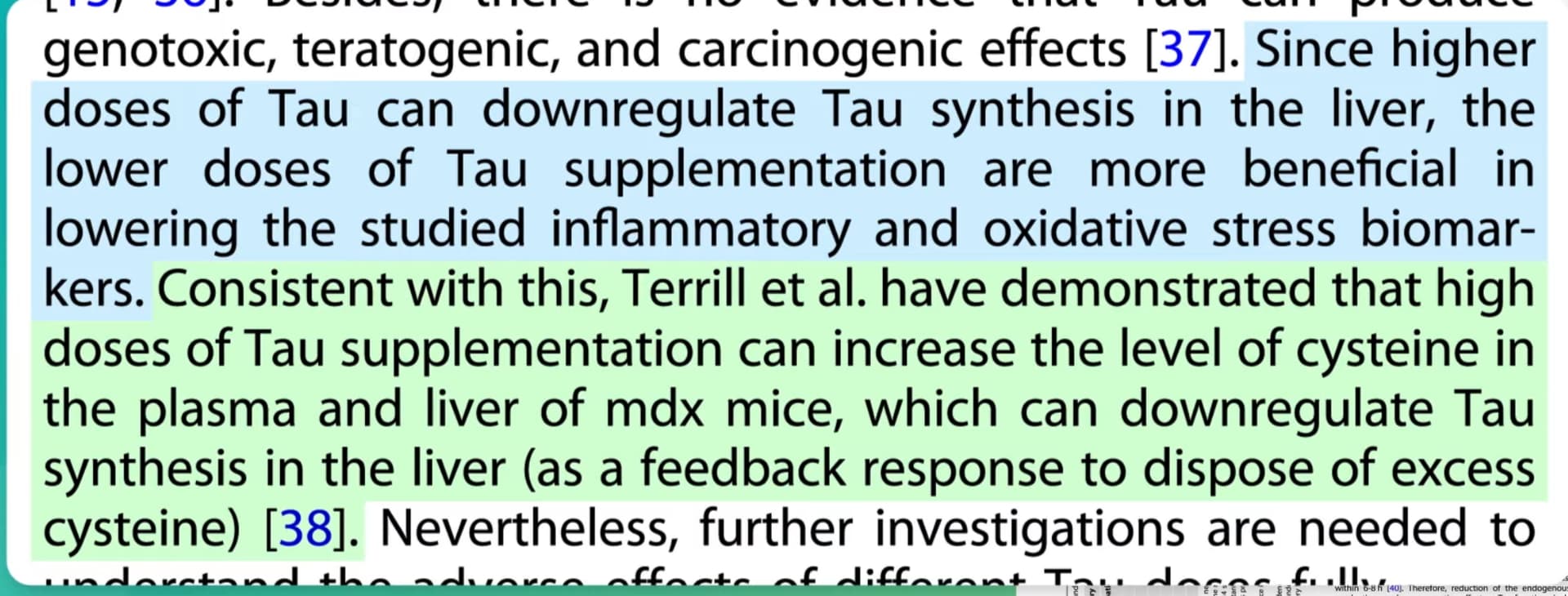

This part is a postive!

Dr. Greger has a pretty dour take on taurine, highlighting claims that excess taurine intake raises mortality up to 40% unless you’re plant based.
Like Beet Juice, Taurine Supplementation May Only Be Safe in the Context of a Plant-Based Diet (NutritionFacts.org - Dr. Greger)
Chinese paper, but better institution and journal.
SLC6A6 imports taurine into mitochondria to sustain mitochondrial translation and tumour growth
A very balanced approach:
I still take 4 gm/day in the morning. He says ITP is running it this year. The controversy is about what is happening to populations. Should we test tissue somehow and supplement accordingly?
A read of this thread reminds me that many gurus we read are overly eager to make pronouncements in advance of the facts. Whatever happened to the venerable, “I don’t know” when the only certainty is that our current understanding is significantly incomplete. As a population question, the best evidence suggests that taurine’s effects are likely to be age, fitness, diet, and gene dependent. As a person question, the high end challenge should be based on metrics whereas the low end question could be, “Do I feel or perform better?” I’m at the low end. I’m a tad faster and slightly less fatigued when hiking steep hills if I take taurine – so I take it and wait for better science.
“Here we show that SLC6A6, but not exogenous taurine, is essential for mitochondrial metabolism and cancer cell growth.” The implication here seems unclear.
Two years ago my osteopenia was able to be reversed to normal on my DEXA bone scan… only change that followed the bad report was Taurine in my coffee a teaspoon full… each morning for a year.
Tomorrow getting DEXA bone scan… if my score is pushed back more… I think we have a good N=1 for daily Taurine  .
.
That is very good news @Agetron! Be sure to let us know. I want to get a DEXA but mostly just to get a little better idea of how hard I can push certain routines at the gym.