I found this complete course on the Systems Biology of Aging and Longevity (https://youtube.com/playlist?list=PLLbr-B8cNbo45WZQT6TjTuSB5oSBzcIZh&si=rS0qBEkC0pHhRC2f).
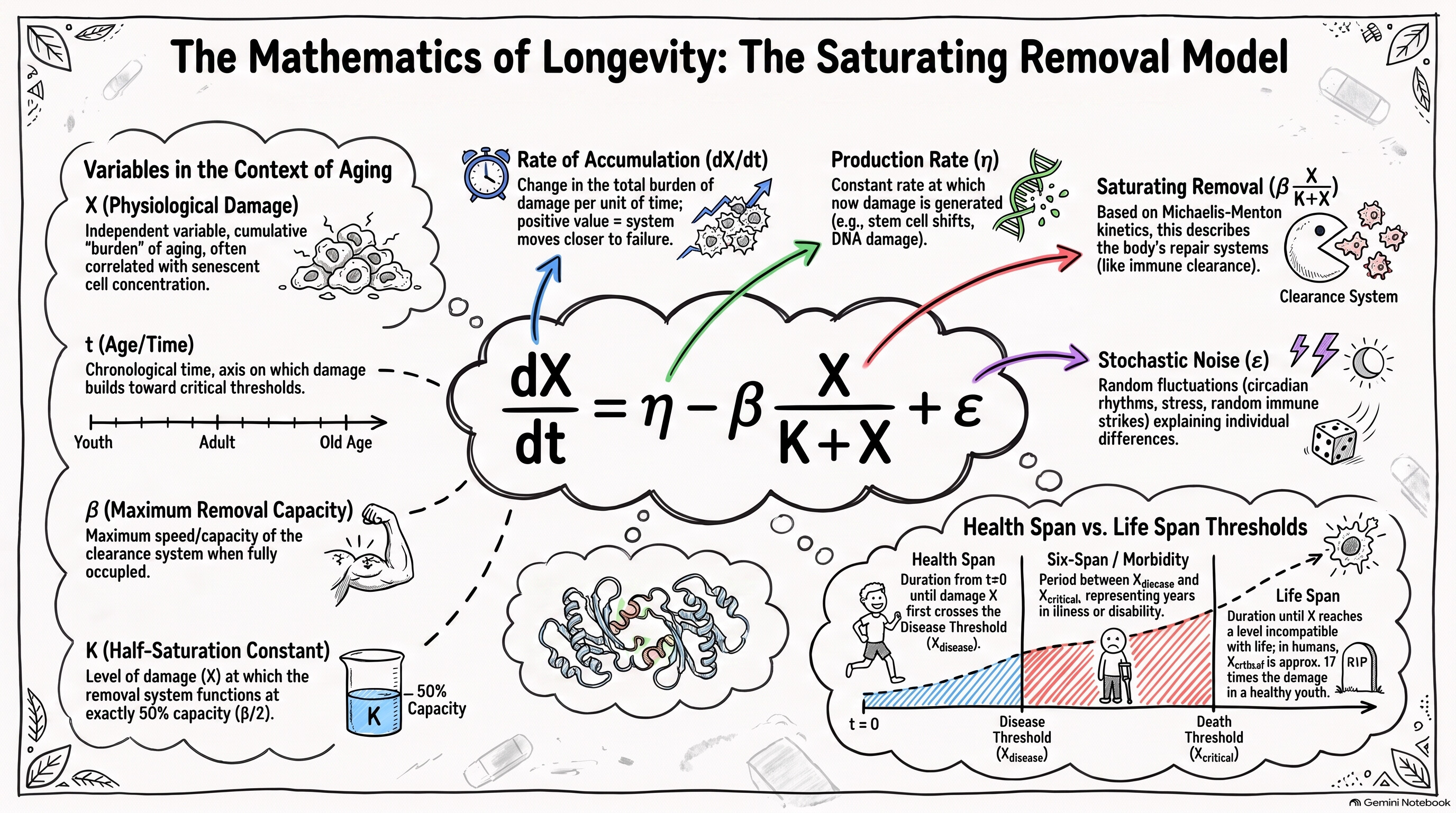
Uri Alon was trained as a physicist and shifted to biology, creating mathematical models of biological processes including aging. His Saturation Removal Model predicts aging, health span, and lifespan and the impact of different interventions on them. While it can be painful to see, with mathematical precision, just how ineffective most interventions are in addressing maximal lifespan, it’s also exciting that if we direct our efforts at the right components of model, we can achieve meaningful results on median lifespan and healthspan and with new therapeutics maximal lifespan/healthspan.
Here is Gemini’s infographic summary:
2 Likes
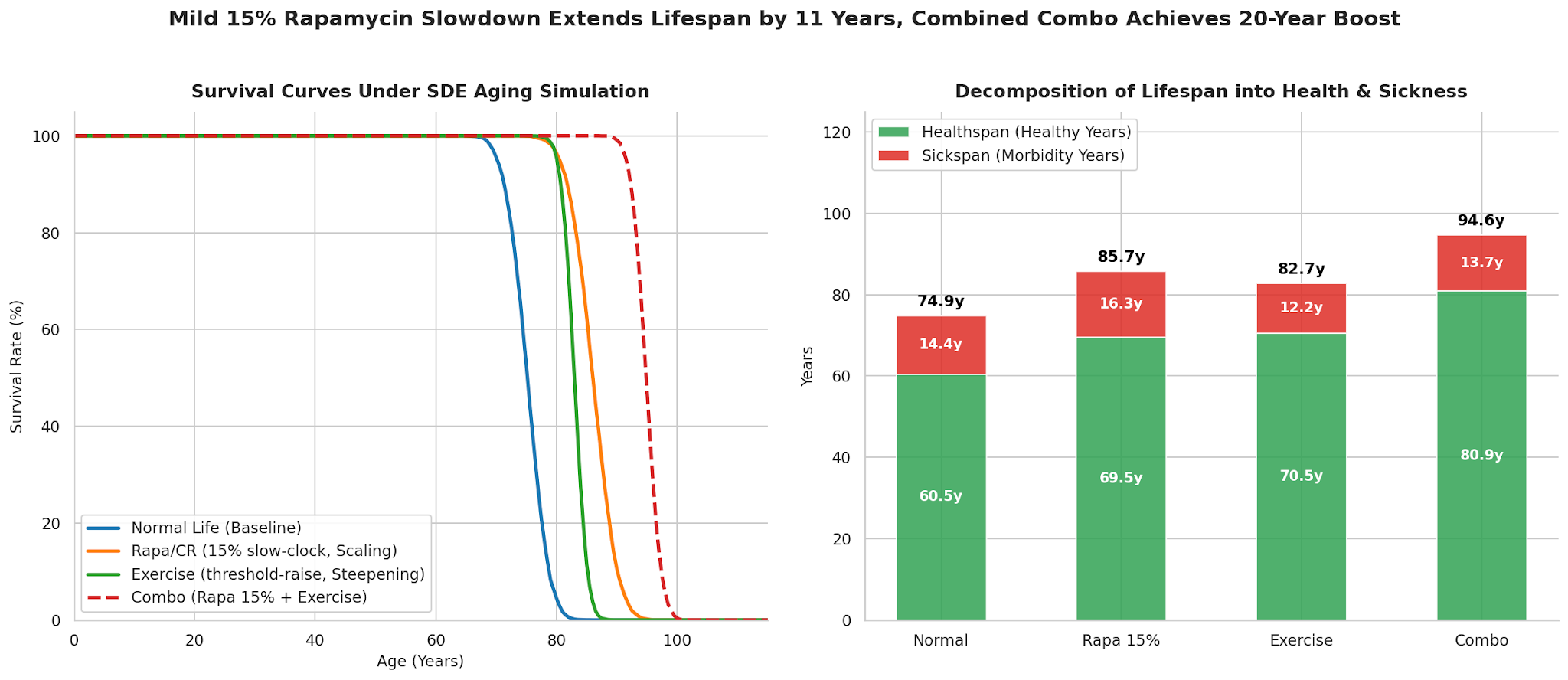
According to the SR model, rather than combining interventions that impact the same variable, if we address different variables we can have a greater impact. Here is Gemini’s calculation of the impact of rapamycin, exercise, and the two combined using the model. For the record, I don’t believe the exact numbers, especially for rapamycin, since we don’t have good human data for it, but I think it’s interesting as a conceptual exercise. Perhaps it could be applied to designing a personal intervention program or providing context for future research.
I think these approaches (and my degree is in Physics) are too abstract from the biological realities to be of much use.
When I dig into the hypothesized underlying biology, I see some research and personal applications. Here’s a summary that connects math to the biology:
Cellular garbage (X: senescent “zombie” cells secreting inflammatory SASP signals) accumulates as defective progeny produced by damage-factory houses (eta: stem cells accumulating histone alterations, R-loops, and double-stranded DNA breaks).
This damage is cleared by innate immune trucks (beta: Natural Killer cells and macrophages) whose maximum clearing capacity is physically constrained by microvascular capillary density (“roads”). Night-to-night circadian variations in immune clearing efficiency introduce stochastic noise (sigma), while systemic physiological reserve—measured by VO2 max, cardiac stroke volume, mitochondrial density, and lean muscle mass—defines the biological robustness thresholds for chronic disease (X_disease) and total organ failure (X_critical: death). Clinical disease onset and mortality occur as a first-passage time problem: the exact moment the fluctuating damage trajectory (X) crosses these structural boundary limits
Each element of the above is a testable hypothesis for researchers, and, although likely imperfect, seems better than randomly testing interventions.
In terms of immediate practical application to my longevity quest, selecting interventions with good coverage across the model seems to increase the probability that my basket of interventions has a more significant impact than saturating only one element.
I love the attempt to apply system-level mathematics to the problem of aging, which is likely a system-level process. But, admittedly, my math training ended with calculus and statistics, so maybe I’m missing something.
1 Like
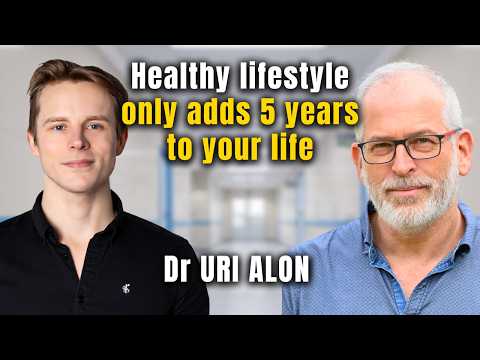
Here is a shorter introduction to Uri’s model, although it focuses on recalculating how much genetics impacts longevity (spoiler: more than we thought).
1 Like
A summary of that last video posted:
I. Executive Summary
This discussion between host Siim Land and systems biologist Prof. Uri Alon (Weizmann Institute of Science) centers on dismantling the long-held dogma that human lifespan heritability is capped at 10% to 25%. Historically, quantitative genetics derived low heritability estimates from Danish twin cohorts born between 1870 and 1900, as well as recent large genealogical pedigrees. Prof. Alon demonstrates that these legacy analyses are fundamentally confounded by high rates of extrinsic mortality—deaths from infectious diseases (such as tuberculosis and pneumonia), accidents, infant mortality, and undernutrition—which obscure underlying biological variation. By analyzing more recent cohorts of Swedish twins born between 1920 and 1935 (who lived under modern sanitation, antimicrobial therapies, and cardiovascular care) and applying mathematical corrections that isolate intrinsic aging from extrinsic hazards, Alon’s laboratory demonstrated that the heritability of intrinsic human lifespan rises to approximately 50% to 55%.
The primary thesis is that human longevity is governed by three distinct pillars: genetics (~50%), environmental/lifestyle factors, and irreducible stochastic biological noise. Stochastic noise explains why genetically identical model organisms raised in sterile, controlled environments still display wide variations in lifespan. Prof. Alon emphasizes a critical asymmetry in lifestyle interventions: adhering to optimal lifestyle factors (exercise, restorative sleep, metabolic health, abstinence from smoking, moderate/zero alcohol consumption, and strong social connectivity) yields an average extension of 5 years of life expectancy at age 40 and shifts an 80-year baseline to approximately 85. However, completely neglecting these factors penalizes life expectancy by up to 15 years.
Furthermore, lifestyle optimization compresses morbidity and allows an individual to realize their intrinsic genetic ceiling, but it cannot alter maximum human lifespan (the ~120-year barrier). Expanding maximum lifespan or altering intrinsic biological rates requires targeting the fundamental drivers of aging—such as senescent cell accumulation modeled via saturating removal kinetics. Prof. Alon also critiques current first- and second-generation epigenetic clocks, noting that while they detect cellular stress, infection, and acute trauma, they frequently fail to isolate proximal drivers of intrinsic biological aging.
II. Insight Bullets
- Historical estimates of human lifespan heritability (10% to 25%) are heavily biased by high historical background rates of extrinsic mortality.
- The original Danish twin registries evaluated cohorts born between 1870 and 1900, where infectious diseases like tuberculosis and pneumonia masked intrinsic biological aging.
- Analysis of modern Swedish twin registries (born 1920–1935) shows a baseline raw heritability of human lifespan approaching 44%.
- Correcting mathematically for extrinsic mortality across multiple independent cohorts reveals an intrinsic lifespan heritability greater than 50% (Shenhar et al., 2026).
- Human lifespan heritability aligns with the heritability of most other complex human physiological and cognitive traits once external noise is removed.
- Lifespan variance is partitioned across three core pillars: inherited genetics (~50%), environment/lifestyle, and intrinsic stochastic biological noise.
- Stochastic biological noise explains why isogenic C. elegans and inbred mice in identical laboratory environments exhibit non-identical lifespans.
- Optimizing the top modifiable lifestyle factors adds an estimated average of 5 years to life expectancy at age 40.
- The survival dividend of lifestyle interventions exhibits diminishing returns with age, reducing to approximately 1 additional year by age 90.
- Failing to practice foundational lifestyle health habits results in an asymmetric life expectancy penalty of roughly 15 years.
- Lifestyle interventions primarily serve as a prerequisite to reach one’s individual genetic potential rather than to reprogram species-specific maximum lifespan.
- Modifiable environmental and behavioral factors do not meaningfully extend maximum human lifespan beyond the ~120-year boundary.
- Modern medical interventions (such as pharmacotherapy for dyslipidemia and hypertension) can mathematically depress heritability estimates by rescuing individuals with high-risk genetic variants.
- Siblings of centenarians across non-Scandinavian populations demonstrate concordant elevated survival distributions, confirming the cross-cohort validity of high genetic heritability.
- Having two centenarian parents confers an estimated 24% survival advantage over the general population average.
- Having one centenarian parent confers an estimated 13% survival advantage, while a centenarian grandparent confers approximately 7%.
- Prof. Alon’s mathematical framework models cellular damage accumulation using stochastic ordinary differential equations based on a saturating-removal system.
- Senescent cells act as a rate-limiting metabolic burden where production increases with age while immune clearance capacity saturates.
- Interventions that uniformly stretch the survival curve scale both healthspan and sickspan proportionally rather than compressing morbidity.
- Specific interventions, including senolytic compounds, steepen survival curves in preclinical models and compress the relative duration of end-stage disability.
- Existing first- and second-generation epigenetic methylation clocks reflect transient systemic stressors (e.g., surgery, pregnancy, acute infection) rather than pure intrinsic biological decay.
- Next-generation biological clocks must focus on proximal drivers of damage accumulation to accurately inform human clinical longevity trials.
- Cross-species translation (e.g., yeast or rodent studies to humans) requires unified dynamical scaling models rather than direct linear dose extrapolation.
- Social connectivity represents physiological “health capital” with mortality effect sizes comparable to primary lifestyle risk factors.
- Educational material and computational modeling tools are hosted publicly on the Uri Alon Lab at the Weizmann Institute of Science.
III. Adversarial Claims & Evidence Table
| Claim from Video | Speaker’s Evidence | Scientific Reality (Current Data) | Evidence Grade (A-E) | Verdict |
|---|---|---|---|---|
| Intrinsic human lifespan heritability is >50% | Mathematical modeling of Swedish/Danish twin cohorts removing extrinsic mortality (Shenhar et al., 2026). | Cohort studies and twin models adjusting for non-aging deaths demonstrate heritability of intrinsic mortality between 50% and 55% (Shenhar et al., 2026; Herskind et al., 1996). | Level C | Strong Support |
| Prior twin studies claiming 10–25% heritability were confounded | Legacy Danish cohorts (1870–1900) and pedigree studies confounded by early infectious and extrinsic deaths. | Validated biostatistically. High background extrinsic mortality dilutes genetic signal; modern epidemiological data confirm intrinsic vs. extrinsic divergence (Ruby et al., 2018). | Level C | Strong Support |
| Optimizing top lifestyle factors adds ~5 years of life at age 40 | Mathematical estimation from multi-variable demographic and epidemiological data sets. | Large prospective cohort analyses (e.g., Nurses’ Health Study / HPFS) demonstrate that adopting 4–5 low-risk lifestyle factors extends life expectancy at age 50 by 12–14 years over adopting zero factors, matching a net gain of 5–6 years over average adherence (Li et al., 2018). | Level C | Strong Support |
| Zero lifestyle factors causes an asymmetric loss of ~15 years | Population-level epidemiological survival curves comparing zero vs. median adherence. | Consistent with meta-analytic prospective cohort data showing severe multi-morbidity, smoking, sedentariness, and metabolic syndrome reduce life expectancy by 10 to 14+ years (Nyberg et al., 2020). | Level A | Strong Support |
| Epigenetic clocks measure transient stress, not just biological aging | Dynamic shifts observed in DNA methylation markers during acute surgery, pregnancy, and critical illness. | Confirmed in human clinical studies. DNAm clocks (e.g., Horvath, GrimAge, PC-clocks) spike during severe physiological stress (major surgery, COVID-19, pregnancy) and reverse post-recovery (Poganik et al., 2023). | Level B | Strong Support |
| Saturating removal of senescent cells drives the Gompertz mortality law | In-house mathematical modeling of damage production and immune clearance saturation in rodents. | Preclinical validation shows senescent cell accumulation accelerates due to decreased clearance, but direct translation of the exact ODE parameters to human clinical mortality remains theoretical (Karin et al., 2019). | Level D (Translational Gap) | Plausible |
| Senolytics steepen the survival curve and compress the sickspan | Mathematical extrapolation and survival curves in aged rodent models receiving senolytic regimens. | Preclinical rodent studies demonstrate morbidity compression with Dasatinib + Quercetin or Navitoclax (Xu et al., 2018), but human Phase II trials have not demonstrated lifespan extension or definitive sickspan compression. | Level D (Translational Gap) | Speculative |
IV. Actionable Protocol (Prioritized)
High Confidence Tier (Level A/B Evidence)
- Atherosclerotic & Metabolic Risk Suppression: Pharmacological and lifestyle optimization targeting ApoB (or LDL-C) and glycemic stability. Medical management of dyslipidemia, hypertension, and insulin resistance directly alters intrinsic mortality trajectories, compensating for polygenic risk (Ference et al., 2017).
- Cardiorespiratory Fitness & Resistance Training: Minimum 150–300 minutes of moderate-to-vigorous physical activity (MVPA) weekly combined with twice-weekly progressive resistance training. Cardiorespiratory fitness displays a dose-dependent inverse relationship with all-cause mortality without an observed upper threshold (Mandsager et al., 2018).
- Complete Avoidance of Inhaled Toxins: Complete cessation of tobacco smoking. Smoking accelerates biological age indices and induces irreversible somatic DNA alterations, driving intrinsic and extrinsic cardiovascular/oncologic mortality (Pirie et al., 2013).
- Sleep Architecture Preservation: Objective maintenance of 7 to 9 hours of uninterrupted sleep per night. Habitual short (<6 hours) or fragmented sleep correlates with systemic low-grade inflammation, impaired glymphatic clearance, and metabolic derangements (Itani et al., 2017).
Experimental Tier (Level C/D Evidence, High Safety Margins)
- Social Health Capital Optimization: Quantifiable engagement in strong reciprocal social, marital, and community relationships. Epidemiological meta-analyses show strong social integration conveys a 50% increased likelihood of survival relative to social isolation, a protective effect size matching smoking cessation (Holt-Lunstad et al., 2010).
- Epigenetic Age Testing as Dynamic Stress Biomarkers: Tracking second- or third-generation biological clocks (e.g., DunedinPACE, GrimAge) to observe physiological trend lines, while treating acute fluctuations as systemic stress indicators rather than fixed biological aging checkpoints.