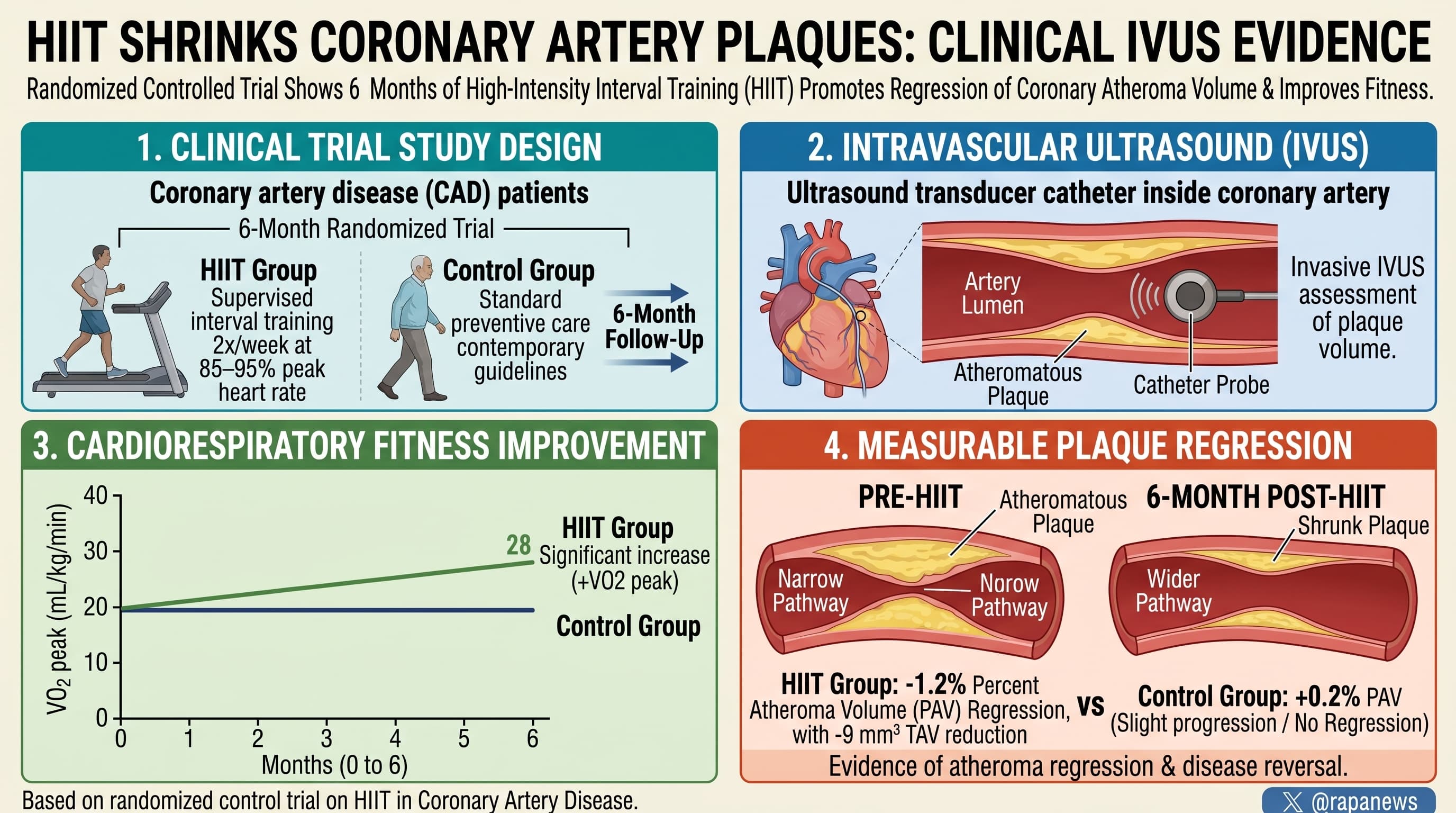
A randomized controlled trial provided intravascular ultrasound evidence that high-intensity interval training can shrink atheromatous plaques in patients with coronary artery disease. Compared to standard preventive guidelines, six months of high-intensity training improved cardiovascular fitness and induced measurable regression of coronary atheroma volume.
For decades, doctors have advised heart attack survivors to get moving. Physical exercise is an undisputed cornerstone of cardiac rehabilitation, known to slash the risk of future cardiovascular events and improve overall mortality rates. Yet, the exact structural mechanics of how exercise protects the heart have remained poorly documented. Most imaging modalities, such as standard angiography, only show a two-dimensional silhouette of the blood vessel lumen. They cannot reveal the composition or the physical volume of the plaque hiding inside the arterial wall. Because of this limitation, it has remained unknown whether physical activity merely slows the progression of heart disease, or if it can actively reverse the physical blockages choking off the coronary arteries.
A recent randomized controlled trial published in the European Journal of Preventive Cardiology offers a definitive answer. Researchers tracked 60 patients with stable coronary artery disease who had recently undergone percutaneous coronary intervention, commonly known as stent placement. Using highly sensitive intravascular ultrasound, which involves threading a tiny ultrasound probe directly into the coronary arteries, the team mapped the exact geometry of the patients’ coronary plaques before and after a six-month intervention.
The results are striking. Patients assigned to two weekly sessions of supervised high-intensity interval training experienced a measurable shrinkage in their coronary plaques. Specifically, their total atheroma volume, representing the physical bulk of the atherosclerotic plaque, decreased significantly by 9.0 cubic millimeters. In stark contrast, patients following standard contemporary preventive guidelines saw no such regression. Their plaque volume marginally increased by 3.0 cubic millimeters despite receiving standard medical care.
This trial represents a major leap in cardiovascular science. It is the first study to use intravascular ultrasound to definitively show that vigorous exercise induces positive remodeling of coronary anatomy. While statin drugs and advanced lipid-lowering therapies have previously demonstrated plaque regression, this study proves that behavioral interventions can exert similar mechanical benefits on the arterial wall.
The underlying mechanism likely extends beyond simple fat burning. The researchers noted that cholesterol profiles, including LDL levels and Apolipoprotein B, remained completely unchanged in the exercise group. Instead, the intense bursts of cardiac output during interval training likely alter the local hemodynamic forces inside the blood vessels. The repeated surges in coronary blood flow increase endothelial shear stress, a physical frictional force that signals the arterial wall to remodel, stabilize, and shed diseased tissue.
For patients and clinicians, the message is unequivocal. Pushing the cardiovascular system to its upper limits triggers structural healing. High-intensity interval training counteracts atherosclerotic progression, proving that aggressive lifestyle interventions can reshape coronary anatomy and reverse physical disease.
Actionable Insights
This study confirms that engaging in high-intensity interval training can actively reverse coronary artery disease. For individuals looking to maximize longevity and cardiovascular health, targeted high-intensity sessions provide structural benefits.
The protocol used was highly specific and manageable. Participants performed a 10-minute warm-up, followed by four sets of 4-minute intervals at 85 to 95 percent of their peak heart rate, separated by 3 minutes of active recovery. Just two sessions of this protocol per week over six months yielded substantial clinical results.
The magnitude of the benefit is highly practically significant. The high-intensity group experienced a 1.2 percent absolute reduction in Percent Atheroma Volume, while the control group saw a 0.2 percent increase. The total plaque volume decreased by an average of 9.0 cubic millimeters in the exercising group compared to a 3.0 cubic millimeter increase in the control group. This effect size equates to a moderate Cohen’s d of approximately 0.53 for plaque regression, a physiological effect nearly identical to the plaque reduction achieved by intensive daily statin therapy. Incorporating high-intensity bursts into your weekly routine is a proven strategy for physical plaque reversal.
Context/Source
- Paywalled Paper: High-intensity interval training induces beneficial effects on coronary atheromatous plaques: a randomized trial, March, 2023.
- Institution: St. Olavs University Hospital and Norwegian University of Science and Technology.
- Country: Norway.
- Journal: European Journal of Preventive Cardiology.
- Impact Evaluation: The impact score of this journal is 8.4, evaluated against a typical high-end range of 0 to 60+ for top general science, therefore this is a High impact journal.